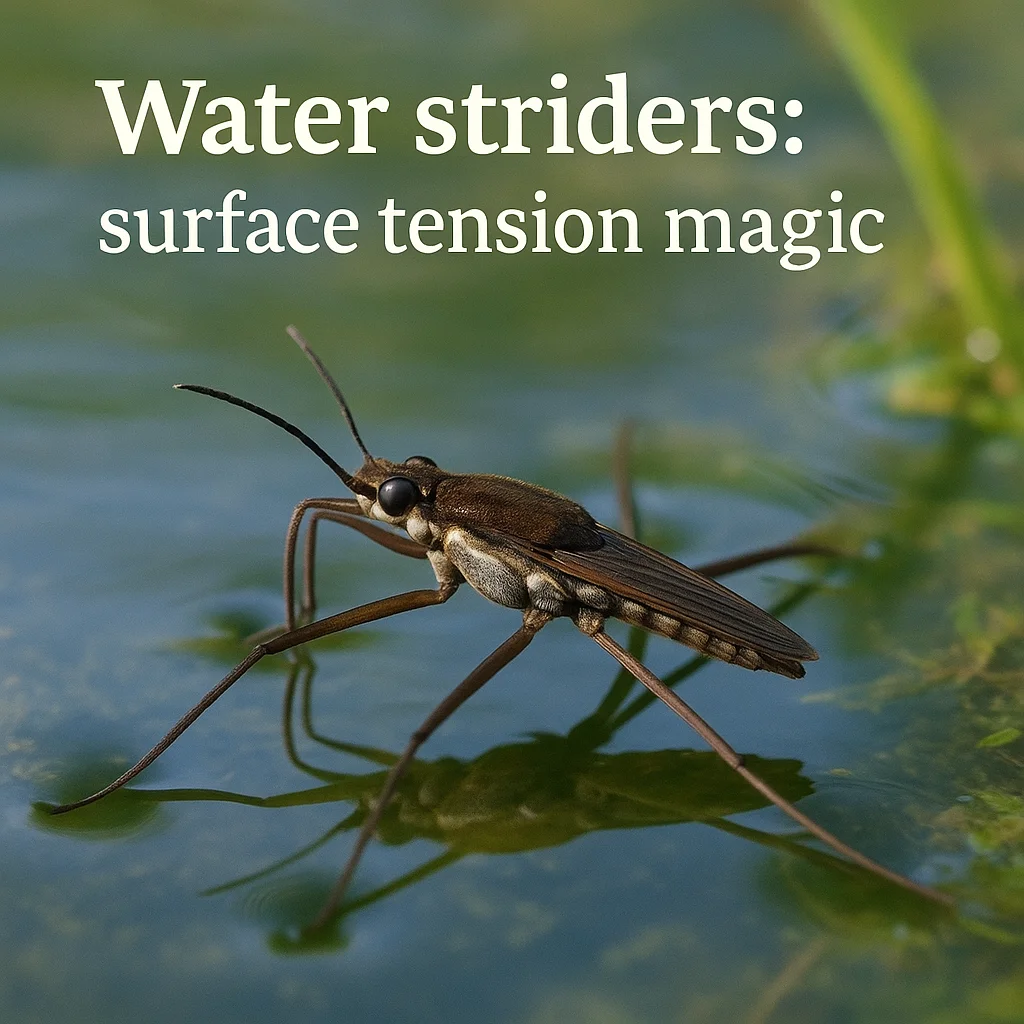
🕷️ Water striders: surface tension magic
🧾 Quick Facts
Water striders, often fascinating for their ability to walk on water, belong to a group of insects that intrigue both scientists and nature enthusiasts. Here are some essential facts about them:
- Common names: Water strider, pond skater, water skater
- Scientific name: Varies across genera, most commonly Gerris
- Insect or not: Yes, they are true insects and belong to the invertebrate group
- Order / family: Hemiptera / Gerridae
- Typical size range: 0.5 to 1.5 cm in length
- Key colors/patterns: Usually dark, ranging from brown to black
- Activity: Typically diurnal
- Typical habitats: Freshwater bodies like ponds, lakes, and streams
- Where in the world it occurs: Found globally, predominantly in temperate and tropical regions
- Seasonality: Most visible during warmer months, spring to early fall
🔍 Identification
Identifying water striders involves observing their unique characteristics and behaviors. Here's how to spot them:
Water striders have a streamlined, elongated body that allows them to skim across water surfaces efficiently. Their antennae are short and robust, aiding in their navigation across the water. They possess membranous wings that are typically underdeveloped and rarely used for flying.
Their most distinctive feature is their legs—specifically the long, middle and hind legs, which they use to evenly distribute their weight across the water's surface tension. They move with a gliding motion, utilizing rapid leg movements to propel themselves.
Look-alikes include various other aquatic insects, but none mimic their effortless skimming on water as clearly as the water strider.
- Top ID Tips:
- Long, slender body at rest above the water
- Prominent long middle and hind legs spread out, resting on the water surface
- Dark coloration, usually black or brown
- Short wings, rarely used in flight
- Gliding movement on water surfaces
- Often found in groups or clusters
- Visible during daylight on calm water
🧠 Basic Body Structure
Understanding the body structure of insects like water striders helps in appreciating their unique adaptation to their aquatic habitat.
Water striders have three main body segments: the head, containing sensory organs like the eyes and short antennae; the thorax, where the wings and six legs are attached; and the abdomen, housing vital organs.
As insects, they possess a robust exoskeleton providing structural support and protection. Molting occurs as they grow, shedding their exoskeleton to emerge larger each time. Water striders are invertebrate, meaning they lack a backbone, which is common to all insects.
🌍 Habitat & Distribution
Water striders thrive in a wide range of freshwater environments. They prefer calm waters such as ponds, marshes, and slow-moving streams where surface tension is most stable.
Typical microhabitats include water surfaces near the edges of ponds or lakes. They are globally distributed, seen in temperate to tropical climates. However, habitat changes, such as pollution or habitat destruction, can decrease their sightings.
📅 Seasonal Appearance & Activity
Depending on region and climate, water striders are most active and observable during certain times:
During the spring and summer months, these insects are diurnal, most visible during daylight hours when weather conditions are mild. They bask in temperatures that support the delicate tension of water, avoiding heavy rains or strong winds.
- Best Time to Spot It:
- Spring to early fall in most regions
- Mid-morning to late afternoon
- During calm and mild weather
- On still, undisturbed water surfaces
🥚 Reproduction & Egg-Laying
Mating behaviors of water striders can often be observed on the water's surface. Males possess specialized structures to hold onto females, engaging in a sometimes vigorous courtship process.
Females lay their eggs on submerged plant stems or debris within the water, providing protection. Egg counts can vary based on environmental conditions, usually ranging from tens to hundreds per female.
🌀 Metamorphosis & Life Cycle
Water striders undergo incomplete metamorphosis, consisting of three stages: egg, nymph, and adult.
The egg stage lasts for about a week to ten days, after which nymphs emerge. These nymphs resemble smaller adults and go through several molts, gaining size and strength, a process that spans several weeks. During nymph stages, they feed on small aquatic insects and detritus present on the water surface.
Adults can live for several months, contributing to the next generation during their lifetime.
🍽️ Diet & Feeding Behavior
Water striders are primarily predators, feeding on small insects and larvae that fall onto the water's surface. They detect prey through vibrations and use piercing-sucking mouthparts to capture and consume.
By maintaining control over insect populations, they play a pivotal role in their aquatic ecosystem.
🦉 Predators & Defense
Water striders face various natural predators, including birds, amphibians, and larger aquatic insects.
When threatened, they rely on their agility and speed to escape. Some species can produce defensive chemicals to deter predators, while others utilize camouflage with their dark coloration.
- Defense Highlights:
- Quick, agile movements over water
- Camouflage with water surface and shadows
- Group presence for safety in numbers
- Chemical deterrents (species-specific)
👥 Social Behavior & Swarms
Water striders are typically solitary but can often be seen in loose aggregations, or small groups, which are less about social interaction than about optimized hunting grounds.
Occasionally, environmental factors like food abundance can trigger temporary swarming behaviors, though these are typically short-lived.
🧭 Senses & Communication
Water striders rely heavily on their sensory abilities to interact with their environment. Vibration detection is particularly critical for locating prey or detecting motion on the water surface.
Smell and touch are essential, aiding in communication and detection of chemical cues. These adaptations ensure their survival and efficiency as predators.
🌱 Role in the Ecosystem
Water striders are essential components of their ecosystems, functioning as both predators and prey. By controlling the populations of various aquatic insects, they help maintain ecological balance.
They also serve as a food source for various birds and amphibians, contributing to the food web dynamics of aquatic environments.
Though not directly impactful on agriculture, their presence is an indicator of ecosystem health and water quality.
📉 Population & Conservation Notes
Generally, water striders are common in suitable habitats, though local populations can vary significantly. Their dependence on clean, calm water means they are susceptible to pollution and habitat degradation.
- How to Help (Low-Impact):
- Preserve local water bodies and maintain cleanliness
- Support wetland conservation efforts
- Avoid pesticide use near aquatic habitats
- Plant native vegetation around water edges to provide habitat
⚠️ Human Interaction & Safety
Water striders pose no threat to humans as they do not bite or sting. Observation from a distance is recommended to avoid disrupting their natural behavior.
If bitten by insects in their habitat, washing the area with water and seeking professional guidance in case of severe reactions is essential. Observational enjoyment should prioritize the well-being of these insects without collection or harm.
📌 Summary
- Water striders are notable for their ability to walk on water.
- They thrive in calm freshwater habitats globally.
- Most visible in warmer months during daylight.
- Reproduces by laying eggs on submerged surfaces.
- Undergoes incomplete metamorphosis.
- Predatory diet, consuming other insects on the water’s surface.
- Quick, agile defense mechanisms against predators.
- Not harmful to humans; valuable ecosystem role in pest control.