🕷️ Giant water bugs: underwater hunters
🧾 Quick Facts
Giant water bugs, belonging to the family Belostomatidae, are fascinating aquatic insects known for their predatory behavior. They can be found in various regions across the globe, with habitats ranging from ponds to marshes, where they play a vital ecological role.
- Common names: Giant water bugs, toe-biters, electric-light bugs
- Scientific name: Varies by species within the Belostomatidae family
- Insect or not: Insect (has six legs and an exoskeleton)
- Order / family: Hemiptera / Belostomatidae
- Typical size range (adult): 2 to 10 cm (0.8 to 4 inches)
- Key colors/patterns: Brown or dark gray, flat and oval-shaped bodies
- Activity: Primarily nocturnal
- Typical habitats: Freshwater bodies like ponds, lakes, and marshes
- Where in the world it occurs: North and South America, Asia, Australia
- Seasonality: Most visible in warmer months
🔍 Identification
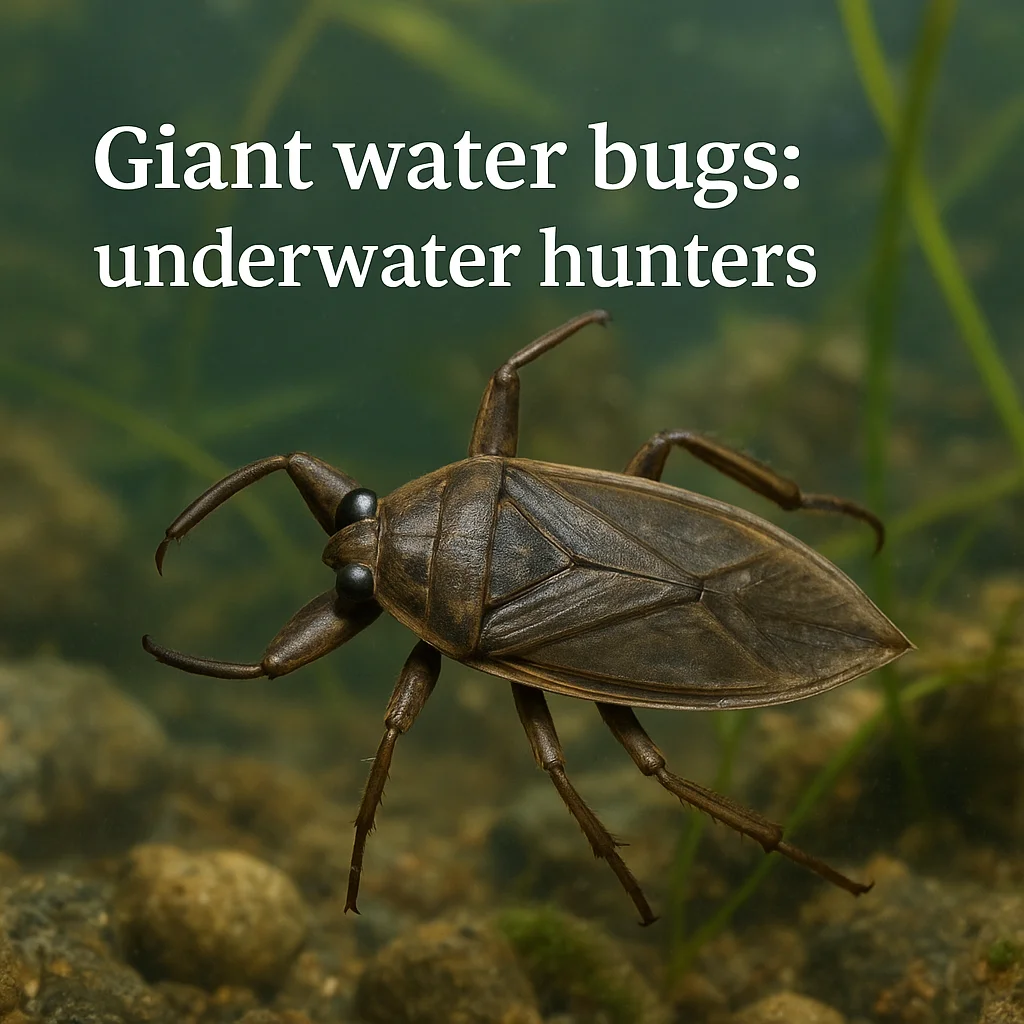
Giant water bugs are noticeable for their robust, oval-shaped bodies and flattened appearance, allowing them to glide through water efficiently. They have short, retractable antennae and a flattened head that integrates seamlessly with the body. Their forelegs are modified for grasping prey, resembling claws, while the other legs are paddle-shaped, aiding in swimming. Their wings lie flat against their backs.
- Oval, flat body designed for stealthy swimming
- Short, retractable antennae barely visible
- Claw-like forelegs for catching prey
- Hind legs adapted for swimming
- Dark brown or gray coloring for camouflage
- Active primarily at night
- Found in still or slow-moving freshwaters
- Frequently mistaken for other aquatic insects
- Whole specimen visible in images
🧠 Basic Body Structure
The giant water bug, like all insects, has three main body sections: the head, thorax, and abdomen. It possesses six legs, typical of insects, and an exoskeleton that provides protection and support. Giant water bugs undergo molting to grow, shedding their exoskeleton when outgrown. They have wings that allow occasional flights but are mainly adapted for aquatic life. As an invertebrate, it lacks a spinal column, typical to all insects.
🌍 Habitat & Distribution
Giant water bugs are typically found in freshwater environments such as ponds, lakes, slow-moving streams, and marshes. They require clean, oxygenated water abundant in prey like small fish and insects. These bugs are widespread, inhabiting parts of North and South America, Asia, and Australia. Seasonal changes and human activity like urban development can affect their habitats, influencing sightings.
📅 Seasonal Appearance & Activity
These bugs are most active during warmer months when water temperatures rise, enhancing their hunting activities. Although they primarily hunt at night (nocturnal), they can occasionally be seen during the day. Favorable weather conditions, such as moderate rainfall and temperatures, also contribute to their increased presence.
- Spring and summer in temperate regions
- Year-round in tropical climates
- Most active during warm, humid nights
- During or following rainfall
- Optimal during dusk and dawn
🥚 Reproduction & Egg-Laying
Mating behaviors in giant water bugs vary by species but often involve intricate courtships where males grasp females to encourage copulation. Females lay eggs on vegetation or surfaces near the water, sometimes even on the backs of males in certain species, who then guard them until hatching. Egg counts vary, but a single female can produce several hundred eggs in favorable conditions.
🌀 Metamorphosis & Life Cycle
Giant water bugs undergo incomplete metamorphosis, progressing through egg, nymph, and adult stages. Nymphs resemble smaller adults and undergo several molts, growing slightly larger each time. These juvenile bugs primarily feed on aquatic invertebrates or small twigs. As they mature, they expand their diet to larger prey. The duration of each stage varies, often depending on environmental factors such as temperature and food availability.
🍽️ Diet & Feeding Behavior
Giant water bugs are opportunistic predators. Nymphs start feeding on tiny aquatic organisms, while adults hunt larger prey, including small fish, amphibians, and insects. They utilize piercing-sucking mouthparts, injecting digestive enzymes to liquefy and ingest their prey internally. Their role as predators makes them vital in controlling aquatic ecosystems.
🦉 Predators & Defense
Giant water bugs face predation from birds, larger fish, reptiles, and amphibians. Their primary defense includes camouflage provided by their coloring, allowing them to blend into the waterbed or among vegetation. They may also play dead when threatened, a behavior known as thanatosis. Despite their fearsome appearance, their bites are non-lethal to humans, though they should be handled with caution.
- Camouflage with murky water tones
- Thanatosis to avoid attention
- Defensive bite in self-defense
- Swimming speed to escape threats
👥 Social Behavior & Swarms
Giant water bugs are generally solitary, focusing on individual hunting and territorial behaviors. During mating seasons, they may come into proximity for reproduction, but typically avoid forming swarms or social structures. Their interactions with others of their kind are limited to mating or occasional competition for food.
🧭 Senses & Communication
These bugs rely on keen senses to navigate and hunt effectively. They use sensitive compound eyes to detect movement and changes in light, while their antennae help with tactile and chemical sensing underwater. Communication is primarily non-verbal, involving vibrations in the water to signal presence or conflict to other bugs.
🌱 Role in the Ecosystem
Giant water bugs are essential predators in aquatic ecosystems, helping balance populations of smaller aquatic creatures, thus preventing overpopulation and maintaining ecological stability. Their predation on pests and health of aquatic systems indirectly benefits humans, though they don't directly impact agriculture or crops.
📉 Population & Conservation Notes
Generally considered locally common in suitable habitats, giant water bug populations can be affected by pollution, habitat destruction, and water quality degradation. Conservation focuses on maintaining healthy freshwater ecosystems. Data on their population status is limited, but they often thrive in well-preserved environments with abundant prey.
- Promote clean and natural water habitats
- Encourage native aquatic vegetation growth
- Avoid pesticide runoff into water bodies
- Support wetlands conservation initiatives
⚠️ Human Interaction & Safety
While giant water bugs can deliver a painful bite if provoked, they pose no serious danger to humans. To avoid potential discomfort, observe these creatures respectfully and do not attempt to handle them. If bitten, clean the area with soap and water, and seek professional advice if a severe reaction occurs.
📌 Summary
- Identifiable by their oval, flat bodies and claw-like forelegs
- Frequent freshwater environments, preferring clean, oxygenated water
- Most active in warm months, particularly at night
- Undergoes incomplete metamorphosis from egg to adult
- Primarily predators with piercing-sucking mouthparts
- Natural predators include birds and fish; defend with camouflage
- Solitary with limited social interaction
- Key ecosystem role in controlling aquatic pest populations
- Locally common, but dependent on healthy habitats
- Harmless to humans; caution advised due to defensive bites