🕷️ Common water bug misconceptions
🧾 Quick Facts
Water bugs, often mistaken for other aquatic insects, are fascinating creatures belonging to various species and families. Here are some key points to note about these common water bugs:
- Common names: Water bugs, toe-biters, electric light bugs
- Scientific name: Varies by species
- Insect or not: Yes, they are true insects
- Order / family: Varies, often Belostomatidae
- Typical size range: 2 to 4 inches (5 to 10 cm)
- Key colors/patterns: Brown, tan, or gray; sometimes mottled or striped
- Activity: Mostly nocturnal
- Typical habitats: Ponds, streams, marshes, and other freshwater bodies
- Where in the world it occurs: Found worldwide, particularly in warmer regions
- Seasonality: More active during warmer months
🔍 Identification
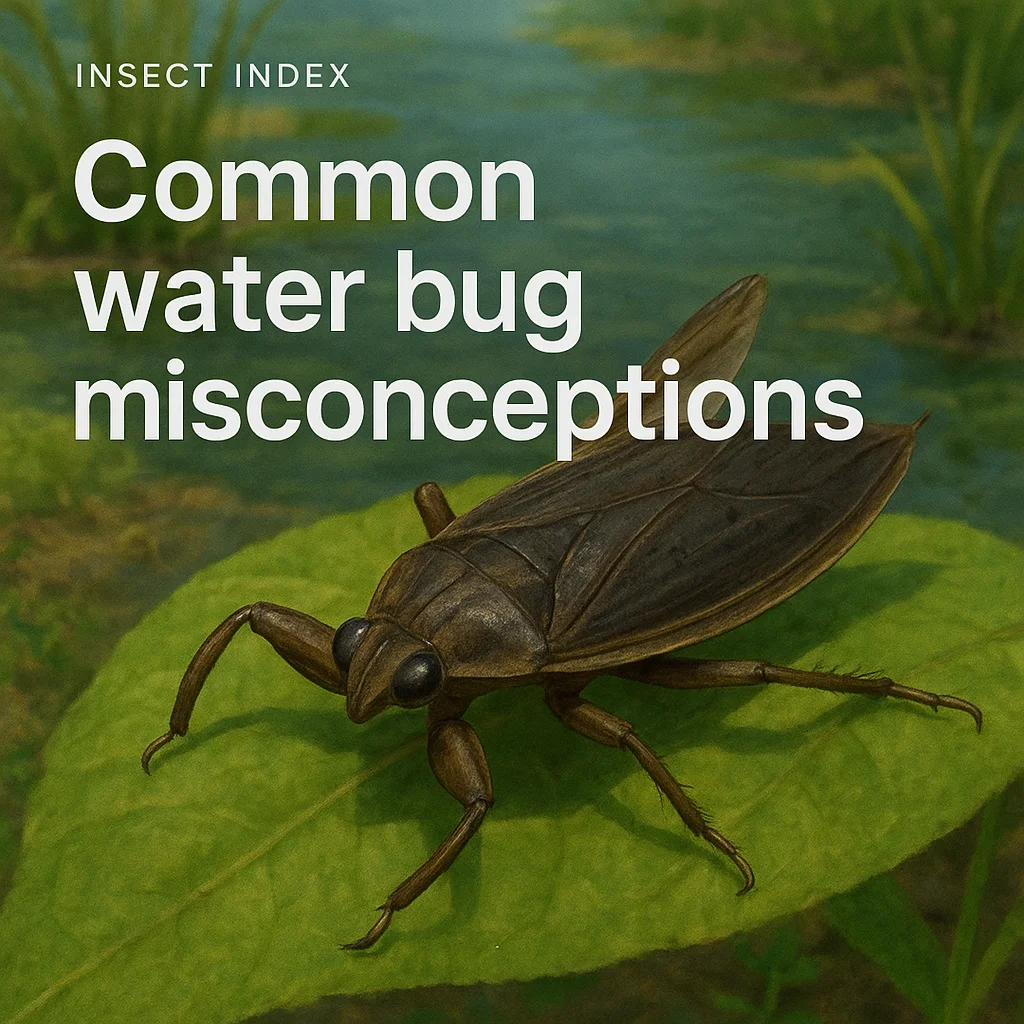
Water bugs can be identified by several distinct features. Their robust, elongated bodies make them stand out amongst other freshwater insects. Most species have flat bodies and raptorial front legs adapted for grasping prey. They also have a distinctive X-shaped pattern on their backs formed by overlapping wings.
- Body shape and silhouette: Flat or slightly convex with an elongated oval shape
- Antennae type: Short and often hidden beneath the head
- Wing features: Hardened forewings with membranous tips
- Leg traits and movement style: Raptorial front legs for seizing prey; hind legs adapted for swimming
- Distinguishing look-alikes and common confusion: Often confused with cockroaches or beetles
- Top ID Tips:
- Flat, elongate body with a broad head
- Raptorial forelegs for grasping prey
- Hardened forewings forming an X pattern
- Short antennae hidden under the head
- Strong swimmers, especially in calm waters
- Nocturnal; attracted to lights
- Elongate, pointed breathing tubes at the abdomen tip in some species
🧠 Basic Body Structure
As true insects, water bugs have three main body parts: the head, thorax, and abdomen. They possess six legs, with variations in adaptability such as grasping forelegs and swimming hind legs. Their bodies are protected with an exoskeleton that is periodically shed in a molting process to allow growth. Most species have wings that are partially hardened and partially membranous, aiding in both flying and swimming.
Water bugs are invertebrates, meaning they lack a backbone. Instead, their hard outer shell serves as a structural support.
🌍 Habitat & Distribution
Water bugs are found in a variety of freshwater environments worldwide, including ponds, streams, marshes, and lakes. They often dwell in the vegetative boundaries of these water bodies, hiding among plants, rocks, and debris. They thrive in temperate to tropical climates but are less common in very cold or arid regions.
Changes in climate, pollution, and habitat destruction can significantly influence their distribution, often pushing them to seek out new suitable habitats.
📅 Seasonal Appearance & Activity
Water bugs are predominantly active during warmer months when water temperatures are suitable for breeding and foraging. Typically nocturnal, they are most noticeable on warm nights, particularly in the vicinity of artificial lighting sources that attract they prey.
- Best Time to Spot It:
- Warm, summer nights
- During nighttime foraging times
- When water temperatures rise
- Nearby lights and illuminated areas
🥚 Reproduction & Egg-Laying
Mating behaviors of water bugs can include complex courtship displays, which vary significantly by species. Some species are known for males carrying eggs on their backs post-mating until hatching occurs, a strategy that provides protection and better oxygenation for the eggs.
Females typically lay eggs on various substrates like plant stems, stones, or even directly on the male's back, depending on the species. The number of eggs can vary from a few dozen to several hundred, depending on environmental conditions and the species involved.
🌀 Metamorphosis & Life Cycle
Water bugs undergo incomplete metamorphosis, developing through three stages: egg, nymph, and adult. During the nymph stage, they closely resemble adults but lack fully developed wings and reproductive organs. This stage can last several weeks to months, depending on the species and environmental conditions.
Nymphs are aquatic and hunt similar prey to adults, including small invertebrates and occasionally fish. Upon reaching maturity, they develop wings and reproductive structures for reproduction.
🍽️ Diet & Feeding Behavior
Water bugs are predominantly carnivorous, wielding piercing-sucking mouthparts to inject venomous saliva that paralyzes prey and begins digestion. They feed on a range of aquatic organisms, including insects, small fish, and amphibians.
These insects play a role as predators within their ecosystem, helping to maintain aquatic population balances by controlling the numbers of various prey species.
🦉 Predators & Defense
Water bugs face predation from various animals such as birds, fish, and mammals. They have evolved several defense mechanisms, including their ability to bite when handled and releasing a pungent odor to dissuade predators. Their coloration provides camouflage against sediment and aquatic vegetation.
- Defense Highlights:
- Camouflage in their aquatic environment
- Strong bite as deterrence against handling
- Odor release to repel threats
- Swift swimming to evade capture
👥 Social Behavior & Swarms
Water bugs are generally solitary creatures, coming into contact with one another primarily for mating purposes. Although they do not form swarms, favorable environmental conditions may lead to localized population increases.
Mating usually involves territorial displays and signaling, ensuring successful encounters while minimizing aggressive interactions.
🧭 Senses & Communication
Water bugs rely on several senses to navigate and interact within their environment. Vision is crucial under low-light conditions, while chemical cues play a vital role in finding mates and prey. Vibrations transmitted through water surface act as a signal during mating and foraging.
These insects communicate mainly through tactile and chemical signals, although some use stridulation or sound generation by rubbing body parts to produce mating calls or territorial sounds.
🌱 Role in the Ecosystem
As predators, water bugs contribute significantly to controlling populations of smaller aquatic organisms, thus influencing aquatic community dynamics. They serve as prey for larger species, forming an integral part of the food web.
While beneficial in maintaining ecological balance, their presence in artificial ponds may decrease the populations of fish fry, potentially impacting ornamental or commercial setups.
📉 Population & Conservation Notes
Generally, water bugs are common in suitable habitats, although some populations face threats from habitat degradation, pollution, and climate change. Information on specific populations is limited, and local abundance can vary significantly.
- How to Help (Low-Impact):
- Promote the conservation of natural wetlands
- Avoid using harmful pesticides near water bodies
- Plant native vegetation around ponds and streams
- Encourage the preservation of natural water quality
⚠️ Human Interaction & Safety
Water bugs can bite if handled, resulting in a painful experience similar to a bee sting. To minimize any adverse impact, it is advisable to wash the area with soap and water and avoid scratching. Seek professional advice if a severe reaction occurs.
Respectful observation from a distance is recommended, avoiding any collection or handling to lessen stress on these valuable creatures.
📌 Summary
- Water bugs are true insects with a global presence primarily in warmer regions.
- They inhabit various bodies of freshwater, where they act as predators.
- Peak activity coincides with warmer temperatures and nighttime conditions.
- They possess unique raptorial forelegs and swimming adaptations.
- Water bugs undergo incomplete metamorphosis: egg, nymph, and adult stages.
- They feed on small aquatic organisms, playing a role in ecosystem balance.
- Natural enemies include birds, fish, and mammals.
- Preserving natural habitats and avoiding pesticides benefit their populations.
- Interaction through observation is encouraged, reducing stress and impacts.