🕷️ Wheel Bug Assassin Bug The Spiky Predator Explained
🧾 Quick Facts
The Wheel Bug Assassin Bug, a fascinating member of the insect world, is notable for its distinctive appearance and predatory habits. This species is a member of the family Reduviidae and can be observed in a variety of habitats, showcasing its adaptability.
- Common Names: Wheel Bug, Assassin Bug
- Scientific Name: Arilus cristatus
- Insect: Yes, it is an invertebrate
- Order / Family: Hemiptera / Reduviidae
- Typical Size Range: 1 to 1.5 inches (2.5 to 3.8 cm)
- Key Colors/Patterns: Gray to brown with a spiky, cog-like disc on the thorax
- Activity: Primarily diurnal
- Typical Habitats: Forests, gardens, meadows
- Where in the World: North America
- Seasonality: Most visible in late spring through early fall
🔍 Identification
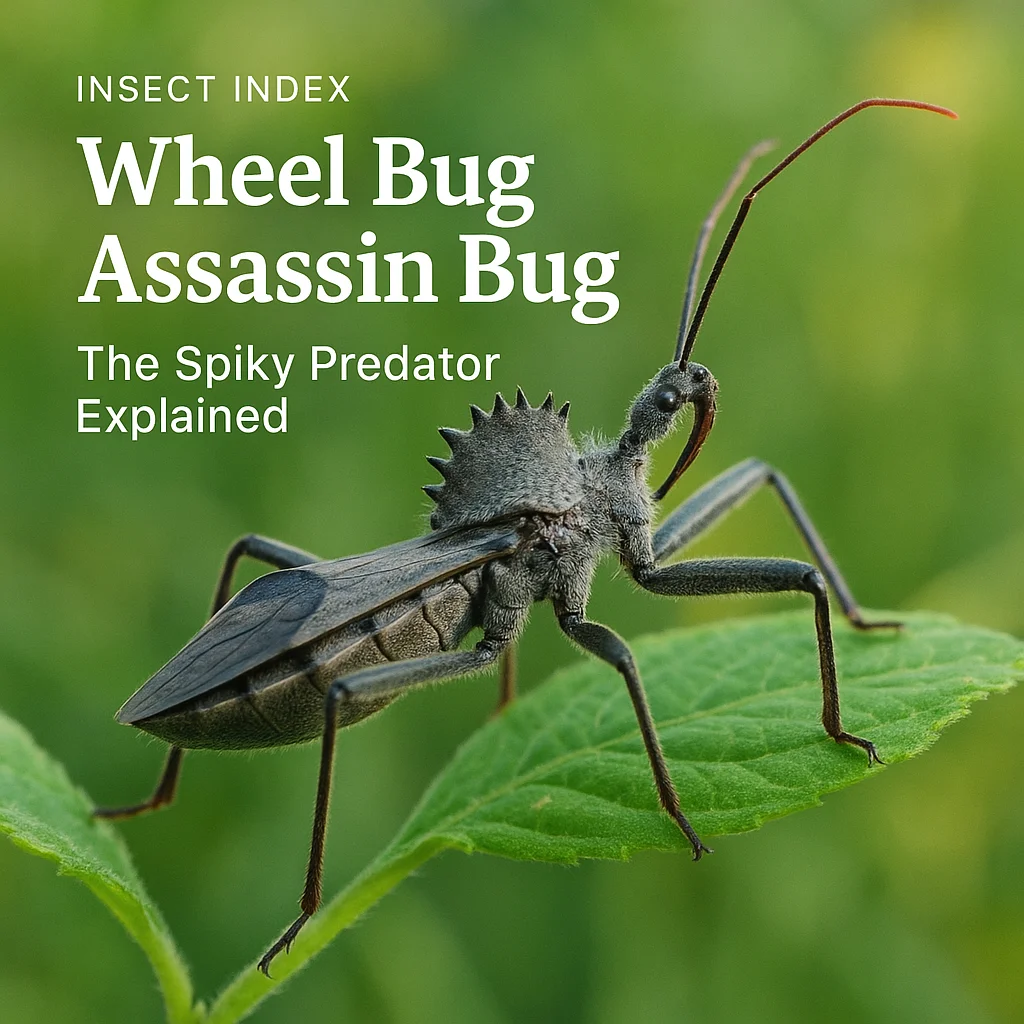
The Wheel Bug is renowned for its distinct body shape and menacing silhouette. Its thorax features a prominent, wheel-like structure with spiky projections that give the species its common name. This predatory insect has long, slender legs that facilitate its stealthy movements, and its antennae are long and segmented, aiding in navigation and sensory perception.
Winged adults are equipped with membranous wings that cover their abdomen. In terms of coloration, it typically sports a gray to brown hue. Distinguishing it from similar species is facilitated by its unique ‘wheel’ or cog-like feature on its back.
- Top ID Tips:
- Look for the spiky, wheel-like structure on the thorax
- Gray to brown coloration
- Long, slender legs for stealthy movement
- Long, segmented antennae
- Membranous wings covering the abdomen
- 1 to 1.5 inches in length
- Primarily found in North America
- Piercing-sucking mouthparts visible on close inspection
🧠 Basic Body Structure
The Wheel Bug, like all insects, is characterized by its segmented body comprising the head, thorax, and abdomen. It possesses six legs, enabling agile movement across varied terrains. The insect's exoskeleton provides structural support and protection, and it undergoes molting as it grows. Notably, it features a membranous wing set at maturity, permitting flight over short distances. Being an invertebrate, it lacks a spinal column, relying on its external shell for defense.
🌍 Habitat & Distribution
The Wheel Bug is versatile in its habitat preferences, typically dwelling in forests, gardens, and meadows. It favors areas with abundant foliage and prey availability. Within these environments, they can often be found lurking under leaves, on tree bark, or amidst the vegetation. Geographically, this bug is predominantly found across North America, thriving in temperate climates. Habitat changes, such as urbanization and pesticide use, may influence local abundance and visibility.
📅 Seasonal Appearance & Activity
This insect is most active and visible from late spring to early fall, with peak activity during the warmer months. Being primarily diurnal, they are often spotted basking in sunlight during the day, retreating to sheltered spots as temperatures drop. Weather conditions such as rain and high humidity are less favorable for sightings, as these conditions typically limit their activity.
- Best Time to Spot It:
- Late spring to early fall
- During warm and sunny weather
- Mid-morning to late afternoon
- In dense vegetation rich environments
🥚 Reproduction & Egg-Laying
Wheel Bugs exhibit intriguing mating behaviors, often involving long courtship rituals. After mating, females lay eggs in clusters on leaves or plant stems, ensuring the offspring are positioned in a habitat abundant with food resources. The number of eggs can vary widely, with a single female capable of laying several dozen eggs in one reproductive cycle.
🌀 Metamorphosis & Life Cycle
The Wheel Bug undergoes incomplete metamorphosis, with life stages including egg, nymph, and adult. Eggs hatch into nymphs resembling miniature adults but lacking wings. The nymphs transition through several molts, growing larger with each stage and eventually developing wings as they reach adulthood.
Nymphs and adults share a similar diet, preying on other insects. This insect’s life cycle from egg to adult can take several months, with environmental conditions such as temperature impacting development duration.
🍽️ Diet & Feeding Behavior
As a formidable predator, the Wheel Bug primarily feeds on other insects, making use of its piercing-sucking mouthparts to extract fluids from its prey. This dietary preference positions the Wheel Bug as a vital component of pest control, as it regulates the populations of several garden pests.
🦉 Predators & Defense
Natural predators of the Wheel Bug include birds, rodents, and larger insects. In defense, the Wheel Bug employs a variety of tactics, including camouflage, a quick bite with its piercing mouthparts, and the emission of a pungent odor when threatened. Its spiky thoracic structure further deters potential predators by enhancing its intimidating appearance.
- Defense Highlights:
- Camouflage amongst foliage
- Pungent odor emission when threatened
- Threatening spiky appearance
- Quick defensive bite
- Fast escape when necessary
👥 Social Behavior & Swarms
The Wheel Bug is a solitary creature, typically encountering others of its kind only during the mating season. It does not form swarms or colonies, and territories are not aggressively defended. Interactions between individuals are primarily limited to mating encounters.
🧭 Senses & Communication
Wheel Bugs rely heavily on their keen sense of smell and sight for locating prey and navigating their environment. They use their antennae to detect chemical signals in the air, assisting in finding mates and identifying food sources. Although largely silent, they do communicate through subtle vibratory signals during mating.
🌱 Role in the Ecosystem
The Wheel Bug plays a crucial role in controlling pest populations, feeding on a variety of insect species that are harmful to plants and crops. While beneficial for pest management, their presence in large numbers can indicate an imbalance in the ecosystem. They maintain a predator-prey relationship with many garden pests, helping to naturally regulate their populations.
📉 Population & Conservation Notes
Although widely common in suitable habitats, the Wheel Bug's population can be impacted by habitat destruction, pesticide use, and climate change. Promoting environments that support their ecological needs can aid in maintaining their population stability.
- How to Help (Low-Impact):
- Encourage native plant growth to support insect biodiversity
- Limit pesticide use in gardens
- Preserve natural habitats where possible
- Leave leaf litter to provide shelter for insects
⚠️ Human Interaction & Safety
The Wheel Bug is not aggressive towards humans but may bite if mishandled, causing mild discomfort. It is important to observe these insects respectfully and without interference, washing the area thoroughly if bitten, and seeking professional advice if a severe reaction occurs. Encouraging natural observation rather than collecting ensures these bugs continue to thrive in their natural habitats.
📌 Summary
- Identifiable by its unique spiky, wheel-like thorax
- Common in diverse habitats across North America
- Most visible from late spring to early fall
- Undergoes incomplete metamorphosis
- Predominantly insectivorous, aiding in pest control
- Predators include birds, rodents, and larger insects
- Silent, with chemical and vibratory communication
- Crucial ecological role in pest regulation
- Populations affected by pollution and habitat destruction
- Minimal threat to humans; observe respectfully