🕷️ True bug myths and facts
🧾 Quick Facts
True bugs belong to the order Hemiptera and are often misunderstood in terms of their biology, ecology, and behavior. While they are mostly harmless to humans, their distinct characteristics and ecological roles make them fascinating subjects of study.
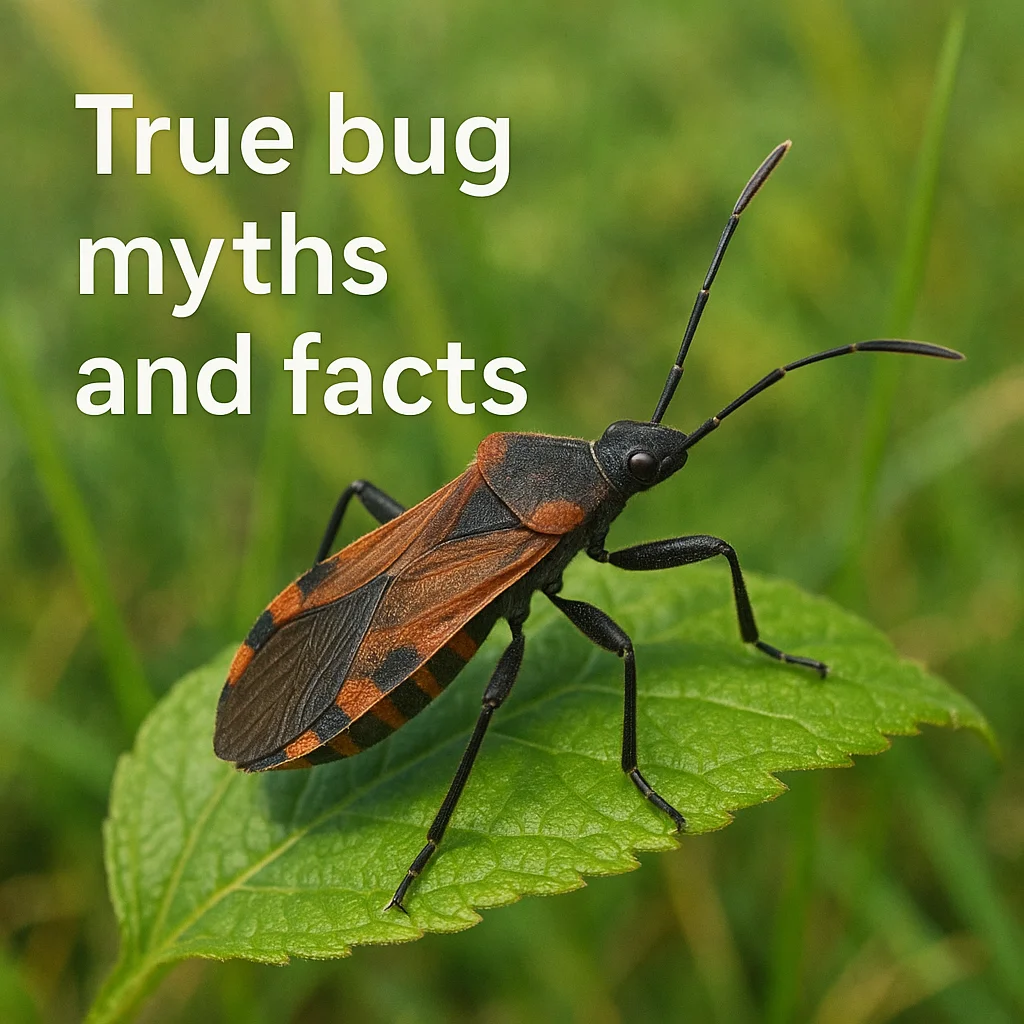
- Common Names: True bugs, Hemipterans
- Scientific Name: Varies across species
- Insect or Not: Insect; they are invertebrates
- Order / Family: Hemiptera; family varies by species
- Typical Size Range (Adult): 3 mm to over 100 mm
- Key Colors/Patterns: Varied; often brown, green, or brightly colored with patterned wings
- Activity: Day and night activity varies by species
- Typical Habitats: Forests, grasslands, wetlands, and gardens
- Where in the World: Found worldwide, except extreme cold regions
- Seasonality: Most visible during warm months
🔍 Identification
Recognizing true bugs in the field involves noting their distinctive body shape and features. True bugs have a flattened, oval body with a clear distinction between the head, thorax, and abdomen. They typically possess antennae that are long and thread-like. The wings, when present, are often held flat over the body with partially hardened forewings.
Leg morphology can vary, but many true bugs have legs suitable for walking or swimming. Some true bugs are often mistaken for beetles or other invertebrates, but they can be differentiated by their piercing-sucking mouthparts.
- Oval or shield-shaped body
- Distinctively long antennae
- Wings held flat over the body, with partially hardened forewings
- Piercing-sucking mouthparts, distinct from chewing types
- Variety of leg forms depending on habitat (swimming, walking)
- Don't confuse with beetles: beetles have hardened forewings entirely
🧠 Basic Body Structure
True bugs, like all insects, have three main body segments: the head, thorax, and abdomen. They possess six legs and are characterized by their exoskeleton, which they periodically shed through molting as they grow. Most species have two pairs of wings, with the forewings often partially hardened at the base and membranous at the tips. True bugs are invertebrates, meaning they lack a backbone.
🌍 Habitat & Distribution
True bugs inhabit a range of environments, from dense forests to open grasslands, and even urban gardens. They are adaptable, living on plants, under bark, within leaf litter, or along water edges. Their geographic distribution is near-global, with species occurring in diverse climates from tropical rainforests to temperate zones. Changes in habitat due to urbanization or climate shifts can influence their presence and visibility in certain areas.
📅 Seasonal Appearance & Activity
True bugs are typically most active during the warmer months. Many species are diurnal, so they are most easily observed during the day, especially in areas with plenty of foliage or flowers. Weather conditions such as warm temperatures and moderate humidity enhance their activity levels.
- Most visible in spring and summer
- Diurnal in many species, increasing daytime visibility
- Warm temperatures enhance activity
- Rain and high humidity may reduce activity as bugs seek shelter
🥚 Reproduction & Egg-Laying
Courtship and mating behavior in true bugs can vary, with some using sound or chemical signals to attract mates. Eggs are typically laid in or on plants, soil, or water, depending on the species. The clutch size can vary significantly, with some laying a few large eggs, while others lay numerous small ones.
🌀 Metamorphosis & Life Cycle
True bugs undergo incomplete metamorphosis, consisting of three stages: egg, nymph, and adult. Nymphs resemble smaller, wingless adults and undergo several molts before reaching maturity. At each stage, they may occupy different niches; nymphs might live under leaf litter or within plant tissues, whereas adults might be more active on the plant surface or in open areas.
The diet can shift as true bugs mature, with nymphs and adults potentially preferring different resources. The complete development cycle duration is variable, heavily influenced by environmental conditions.
🍽️ Diet & Feeding Behavior
True bugs utilize piercing-sucking mouthparts to feed. They typically consume plant sap as herbivores, but some are predators, targeting other insects. Others may scavenge or play roles in pollination. As nymphs and adults, their diet profoundly impacts plant and pest dynamics in their environments.
🦉 Predators & Defense
Birds, reptiles, amphibians, spiders, and predatory insects are natural enemies to true bugs. Defense strategies are diverse; many adopt camouflage to blend with surroundings, while others employ mimicry—resembling unpalatable species. Some bugs can release chemicals, utilizing foul smells or mild toxins to deter predators.
- Use camouflage to hide within foliage
- Mimicry to appear like unpalatable species
- Chemical defenses for predator deterrence
- Quick movements to escape threats
👥 Social Behavior & Swarms
True bugs generally exhibit solitary behavior, although aggregations can occur, especially when resources are abundant. Few species display any form of cooperative behavior, and they rarely form swarms. However, seasonal movements or migrations might be observed as individuals respond to environmental changes.
🧭 Senses & Communication
True bugs rely on a combination of senses for communication and navigation. Vision is important for locating food and mates, while chemical signals like pheromones facilitate mating and territory marking. Some species use sound to communicate or ward off predators, through vibrations or stridulation.
🌱 Role in the Ecosystem
True bugs play various ecological roles, from pollinators to herbivores impacting plant health. As predators, they can control pest populations, contributing to natural balance. Their role in decomposition funnels nutrients back into the ecosystem. They also serve as food for higher trophic levels, supporting biodiversity.
📉 Population & Conservation Notes
True bug populations are typically stable in regions with enduring natural environments. However, localized declines can occur due to habitat destruction, pesticides, and climate change. Population data is often limited, with local abundance varying widely.
- Encourage native plants to support local bug species
- Avoid unnecessary pesticide use
- Preserve natural habitats by reducing land development
- Leave leaf litter undisturbed for microhabitats
⚠️ Human Interaction & Safety
True bugs are typically harmless to humans and do not actively seek human interaction. Some species might bite if handled, usually resulting in mild irritation. If bitten, clean the area with water and avoid scratching. Seek professional advice if any severe reaction occurs.
Encourage respectful observation practices to appreciate their presence without collecting or harming these insects.
📌 Summary
- True bugs belong to the order Hemiptera, distinct for their body shape and piercing-sucking mouthparts.
- They are adaptable, inhabiting diverse environments and showing variation in appearance and behavior.
- Seasonality and environmental conditions heavily influence their visibility and activity.
- True bugs undergo incomplete metamorphosis, with lifecycles linked to ecological roles as herbivores or predators.
- They contribute to ecosystem dynamics through roles in pollination, pest control, and as prey species.
- Population health often relies on stable habitats, with declines linked to human disturbances.
- Interactions with humans are generally benign, but respectful observation promotes coexistence.