🕷️ Leaf-footed Bugs Leaf-like Legs And Garden Impacts
🧾 Quick Facts
Leaf-footed bugs are intriguing insects in the family Coreidae, known for their distinctive leaf-like expansions on their hind legs. While often noticed in gardens, their impact can vary.
- Common names: Leaf-footed bug, Squash bug
- Scientific name: Varies
- Insect or not: Yes, an insect (invertebrate)
- Order / family: Hemiptera / Coreidae
- Typical size range: 10–30 mm
- Key colors/patterns: Brown, gray, black with distinct leg enlargements
- Activity: Generally diurnal
- Typical habitats: Gardens, forests, agricultural areas
- Where in the world it occurs: Worldwide, particularly in temperate regions
- Seasonality: Spring to fall in temperate regions
🔍 Identification
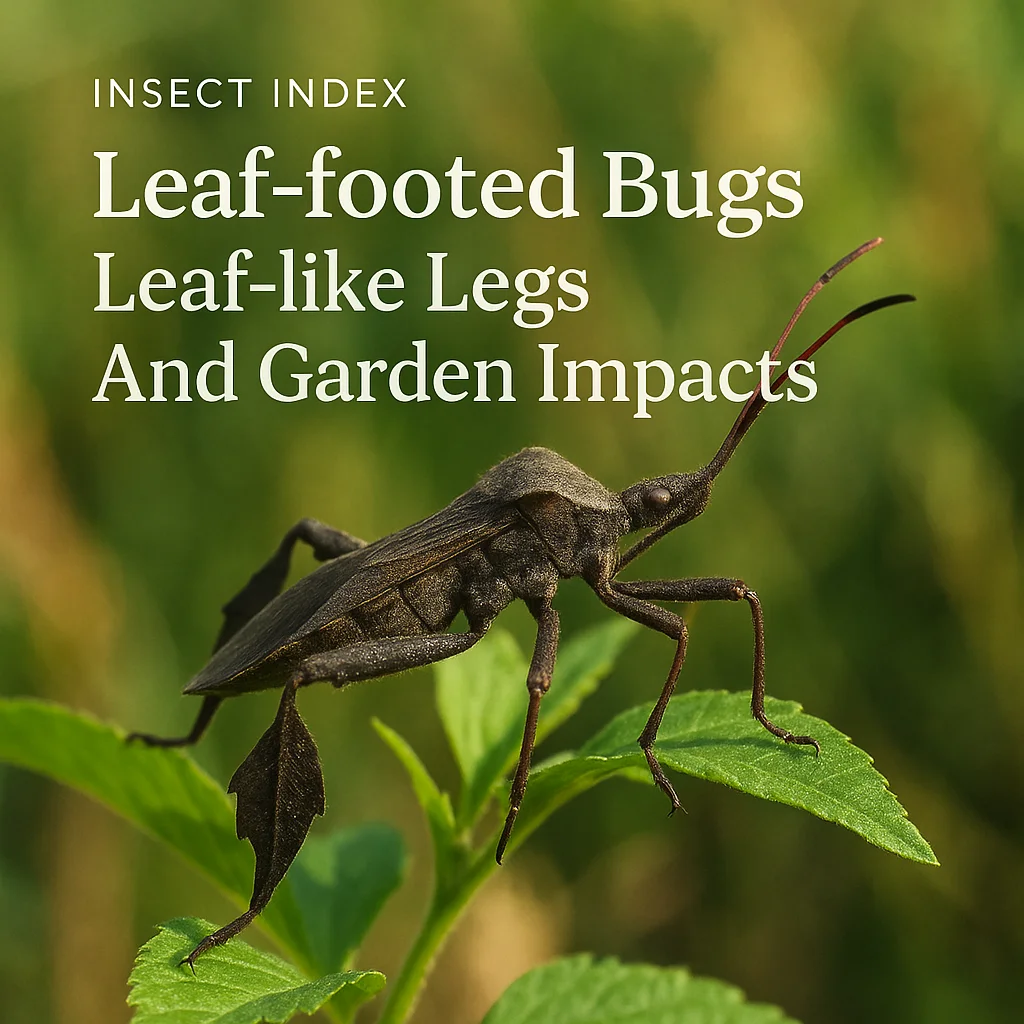
Leaf-footed bugs can be recognized by their elongated and somewhat flattened bodies, with conspicuously thickened hind legs that resemble leaves. These bugs have long, segmented antennae and pronounced, veined wings when at rest.
The similarity to other Hemiptera family members can lead to confusion, but their unique leg morphology helps distinguish them.
- Body shape: Elongated and flat
- Antennae: Long and segmented
- Wings: Tough, veined, and rest flat
- Legs: Hind legs with leaf-like expansions
- Common confusion: Similar to stink bugs, but differentiated by leg shape
- Color: Mostly dull earth tones
🧠 Basic Body Structure
The leaf-footed bug, like all insects, has a tripartite body — head, thorax, and abdomen. The head houses sensory organs with two compound eyes and long antennae. The thorax supports three pairs of legs and two pairs of wings. The abdomen contains digestive and reproductive organs.
These bugs possess a sturdy exoskeleton and are invertebrate, meaning they lack a spinal column. The exoskeleton provides protection and must be molted as the insect grows.
🌍 Habitat & Distribution
Leaf-footed bugs typically inhabit gardens, agricultural fields, and forests where they have access to a variety of plants. They can often be found on shrubs and creeping vegetation.
Geographically, these bugs are found in temperate and tropical regions across the globe. Their presence can fluctuate with environmental changes such as deforestation or urban development, influencing their local abundance.
📅 Seasonal Appearance & Activity
Leaf-footed bugs are most active from spring to autumn when temperatures are favorable. They are mainly diurnal creatures, actively foraging during daylight hours.
- Best seen from: Late spring to early autumn
- Active during daylight hours
- Prefer warm, calm weather
- Absent during harsh cold seasons
🥚 Reproduction & Egg-Laying
In leaf-footed bugs, reproduction involves courtship behaviors where males may compete for female attention. Mating success often relies on male displays of vigor and suitability.
Eggs are usually laid on the underside of leaves or on dry surfaces within their habitat. The number of eggs varies, with females laying clusters. The humidity and temperature can influence hatching success.
🌀 Metamorphosis & Life Cycle
Leaf-footed bugs undergo incomplete metamorphosis, progressing through egg, nymph, and adult stages. After hatching, nymphs resemble smaller adults but lack wings. They molt several times as they mature.
Throughout the nymphal stages, they feed primarily on plant sap and develop over several weeks, with variations based on climate and food availability.
🍽️ Diet & Feeding Behavior
Leaf-footed bugs primarily feed on plant sap, which they extract using piercing-sucking mouthparts. Adults and nymphs are known to prefer fruits, stems, and leaves, impacting various plant species, especially in agricultural settings.
As herbivores, they play a role in controlling plant overgrowth but can also be seen as pests due to their potential to damage crops.
🦉 Predators & Defense
Leaf-footed bugs face threats from birds, lizards, frogs, and spider predators. To protect themselves, they employ camouflage that allows them to blend with foliage and bark. Their leaf-like leg structures aid in this visual mimicry.
Some species also emit a foul odor when threatened, deterring predators.
- Camouflage: Helps blend with environment
- Mimicry: Leg shapes confuse predators
- Odor release: Chemical defense
- Quick movements: Escape from threats
👥 Social Behavior & Swarms
Leaf-footed bugs are generally solitary and territorial, though they may congregate in areas where resources are abundant. They do not form colonies but may aggregate in favorable microclimates or feeding sites.
Swarms are uncommon, but population bursts might occur in optimal conditions.
🧭 Senses & Communication
Leaf-footed bugs rely on keen visual and olfactory senses, using their eyes and antennae to navigate and communicate. They utilize pheromones for mating signals and territory demarcation.
Noises are not typically used for communication; instead, they depend on chemical cues to locate sources or partners.
🌱 Role in the Ecosystem
Leaf-footed bugs act as both herbivores and prey within their ecosystems, impacting plant communities and providing food for higher trophic levels. They play a dual role—sometimes beneficial through pollination, and detrimental when in large numbers causing crop harm.
Interactions with plants can range from mutualistic, when aiding pollination, to parasitic as they damage host plants for nutrients.
📉 Population & Conservation Notes
While local populations of leaf-footed bugs can be abundant, global data on specific population trends is limited. Habitat modification through agriculture alters their numbers, sometimes leading to localized increases.
- Encourage native plant growth
- Avoid broad-spectrum pesticides
- Maintain diverse garden ecosystems
- Provide natural habitats: logs, stones
⚠️ Human Interaction & Safety
While leaf-footed bugs may bite if handled aggressively, their bites are not dangerous. Standard first aid includes washing the area and avoiding scratching. As with any insect, professional medical advice is advised if a severe reaction occurs.
Observing these bugs should be done with respect for their role in nature, and non-intrusive methods are recommended to avoid unnecessary harm to populations.
📌 Summary
- Identification: Recognized by leaf-like legs
- Habitat: Gardens, forests, agricultural areas
- Seasonality: Active from spring to fall
- Life Cycle: Incomplete metamorphosis (nymph-adult)
- Diet: Herbivorous, feeds on plant sap
- Natural Enemies: Birds, reptiles, amphibians
- Ecological Role: Herbivore in plant-predator dynamics
- Human Interaction: Minimal threat, respect natural behavior