🕷️ Brown Marmorated Stink Bug: Invasive Overview
🧾 Quick Facts
The Brown marmorated stink bug is a well-known agricultural pest due to its destructive feeding habits and adaptive behaviors. It is an insect native to East Asia that has become invasive in many other parts of the world.
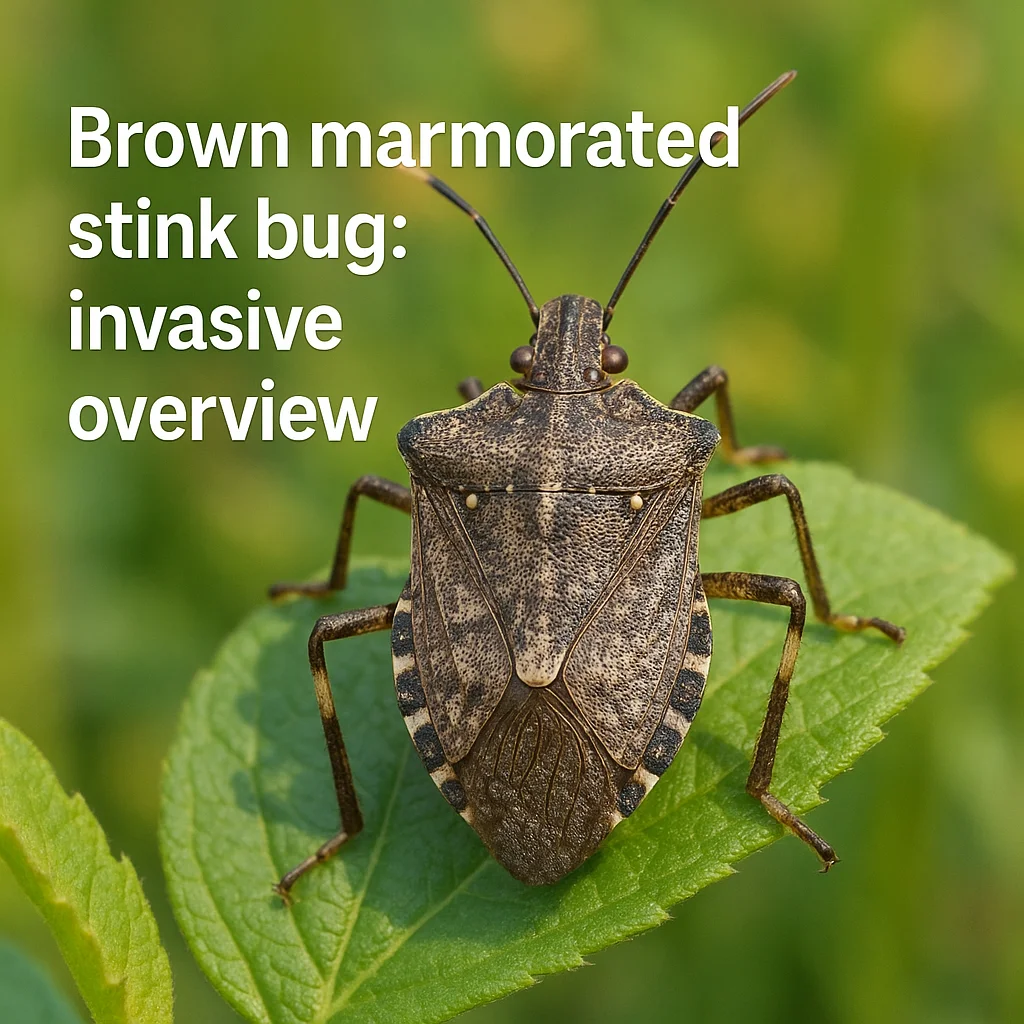
- Common names: Brown marmorated stink bug, BMSB
- Scientific name: Halyomorpha halys
- Insect: Yes, it is an invertebrate
- Order / Family: Hemiptera / Pentatomidae
- Typical size range (adult): 12–17 mm in length
- Key colors/patterns: Mottled brown appearance with white banding on the antennae
- Activity: Primarily diurnal
- Typical habitats: Agricultural fields, gardens, urban areas
- Where in the world it occurs: Originally native to East Asia; invasive in North America, Europe, and South America
- Seasonality: Most visible from spring through autumn
🔍 Identification
To recognize the Brown marmorated stink bug in the field, look for its characteristic shield-shaped body and brown mottled coloration that provides camouflage against bark and foliage. The stink bug's antennae are notably ringed with alternating bands of white.
- The body has a broad triangular shape typical of stink bugs.
- Antennae are long, straight, with distinct white bands.
- The wings are folded over the body, forming an "X" pattern on the back.
- Legs are pointed and adapted for walking, lacking specialized adaptations for jumping or swimming.
- Often confused with other native North American stink bugs that have a similar shape but differ in patterns and coloration.
- Top ID Tips
- Look for the shield shape
- White antennae bands are distinctive
- Brown, marbled coloration with subtle patterning
- Mistaken for other stink bugs, check “X” shape on wings
- Smells when disturbed
- Check underside for darker markings
🧠 Basic Body Structure
The Brown marmorated stink bug, like all insects, consists of three primary body parts: the head, thorax, and abdomen. The head bears sensory appendages, the thorax anchors six legs and wings, and the abdomen houses internal organs. They possess an exoskeleton, a hard outer structure that provides protection and must be periodically shed during molting. As an invertebrate, it lacks a backbone.
🌍 Habitat & Distribution
The Brown marmorated stink bug thrives in diverse environments, from rural agricultural lands to urban settings. It adapts well to temperate climates, commonly inhabiting orchards, gardens, and even human homes. In its invasive range, it establishes itself in continents like North America and Europe and adjusts its habitats in response to food availability and human structures.
Microhabitats include under loose bark, within leaf litter, and around agricultural crops. Changes in habitat such as deforestation or urbanization tend to increase human encounters and sightings.
📅 Seasonal Appearance & Activity
The Brown marmorated stink bug is primarily visible from spring through autumn, with peak activity during warm weather when crops and plants are abundant. As a diurnal insect, it is active throughout the day, seeking shelter during cooler temperatures at night. Activity decreases during rain but increases in mild climatic conditions.
- Best Time to Spot It
- Spring, post-winter; warming temperatures bring them out
- Throughout summer during crop growth periods
- Warm, dry days are ideal for activity
- Early autumn when seeking shelter for diapause
🥚 Reproduction & Egg-Laying
Brown marmorated stink bugs engage in courtship that involves the release of specific pheromones to attract mates. Females lay eggs on the undersides of leaves in clusters, with each cluster containing around 20–30 eggs, although this number can vary regionally. These eggs are typically pale green in color. Females choose host plants with ideal conditions where nymphs will have ready access to food upon hatching.
🌀 Metamorphosis & Life Cycle
The Brown marmorated stink bug undergoes incomplete metamorphosis with three distinct stages: egg, nymph, and adult. Eggs hatch into nymphs that resemble miniature adults but lack wings. Nymphs feed and molt through several stages, called instars, typically five, over about four to six weeks. The adult stage is reached in late spring and can last several months, depending on local climate and environmental conditions.
🍽️ Diet & Feeding Behavior
As herbivores, Brown marmorated stink bugs use their piercing-sucking mouthparts to feed on the juices of plants. They are particularly fond of fruits, vegetables, and ornamental plants, which includes a wide array of agricultural crops. They have a substantial impact on agriculture due to their feeding habits, contributing to significant crop losses.
🦉 Predators & Defense
The stink bug's natural predators include birds, spiders, and small mammals. It also faces predation from parasitoid wasps that target its eggs. To defend against these threats, the stink bug utilizes chemical defenses, releasing an unpleasant odor from scent glands when disturbed. Additionally, its mottled coloration provides camouflage among foliage.
- Defense Highlights
- Chemical odor to deter predators
- Camouflage with natural surroundings
- Mimics appearance of less palatable species
- Quick flight as a means of escape
👥 Social Behavior & Swarms
The Brown marmorated stink bug is primarily solitary outside of mating activities. However, it exhibits aggregating behavior in response to environmental conditions, such as during overwintering. They may form large groups or swarms when locating sites to overwinter, often inside structures, driven by instinct to respond to pheromones and temperature changes.
🧭 Senses & Communication
The stink bug relies heavily on olfactory senses for communication, using pheromones for mate attraction and aggregation purposes. Its compound eyes provide a broad field of vision for detecting movement, whereas antennae are integral for tactile sensation and chemical detection within its environment.
🌱 Role in the Ecosystem
Ecologically, the Brown marmorated stink bug fulfills the role of a pest due to its feeding habits on various crops, impacting agricultural productivity. It is part of a complex food web, serving as prey for various predators and playing a minor role in plant population control by way of feeding on plant sap. Its presence can affect native species’ populations and contribute to shifting ecological balances.
📉 Population & Conservation Notes
The Brown marmorated stink bug is commonly reported in many invasive regions, showing resilience in adapting to new environments. Increases in agricultural acreage and urban gardens have facilitated its spread. Conservation measures focus on managing its impact on agriculture due to its status as an invasive species. Efforts are underway globally to mitigate its population using natural predators and integrated pest management.
- How to Help (Low-Impact)
- Planting native species to support local ecosystems
- Encouraging predator species like birds
- Avoiding broad-spectrum pesticides that harm beneficial insects
- Leaving some natural foliage for wildlife habitat
⚠️ Human Interaction & Safety
The Brown marmorated stink bug does not bite or sting humans, making it largely harmless in direct encounters. However, handling it for extended periods can cause skin irritation due to its defensive chemicals. As a common pest, it is best observed respectfully in its environment. Indoor invasions during colder months should be managed with care, focusing on exclusion and preventive measures.
For any skin irritation, wash the affected area with soap and water, avoid scratching, and consult a professional if the irritation persists.
📌 Summary
- ID: Mottled brown with white banded antennae
- Habitat: Agriculture, urban areas, and natural environments
- Seasonality: Spring to autumn, most active in warm weather
- Life Cycle: Incomplete metamorphosis; egg, nymph, adult
- Diet: Herbivorous, feeds on a wide array of plants
- Predators: Birds, spiders, parasitoid wasps
- Ecology: Invasive agricultural pest, impacts native species
- Human Notes: Non-threatening, observe respectfully