🕷️ How cicada nymphs live underground
🧾 Quick Facts
Cicada nymphs are fascinating invertebrates that spend the majority of their lives beneath the soil. Their unique life cycle and intriguing behaviors make them a subject of interest for entomologists and nature enthusiasts alike.
- Common names: Nymph, Cicada, Periodical Cicada
- Scientific name: Varies (e.g., Magicicada spp. in North America)
- Insect or not: Yes, they are insects
- Order / family: Hemiptera / Cicadidae
- Typical size range (adult): 2.5 to 5 cm
- Key colors/patterns: Brown (nymphs); Black, green, red (adults)
- Activity: Primarily nocturnal when emerging
- Typical habitats: Deciduous forests, woodlands, grasslands
- Where in the world it occurs: Found on every continent except Antarctica
- Seasonality: Adult cicadas are most visible in late spring to summer
🔍 Identification
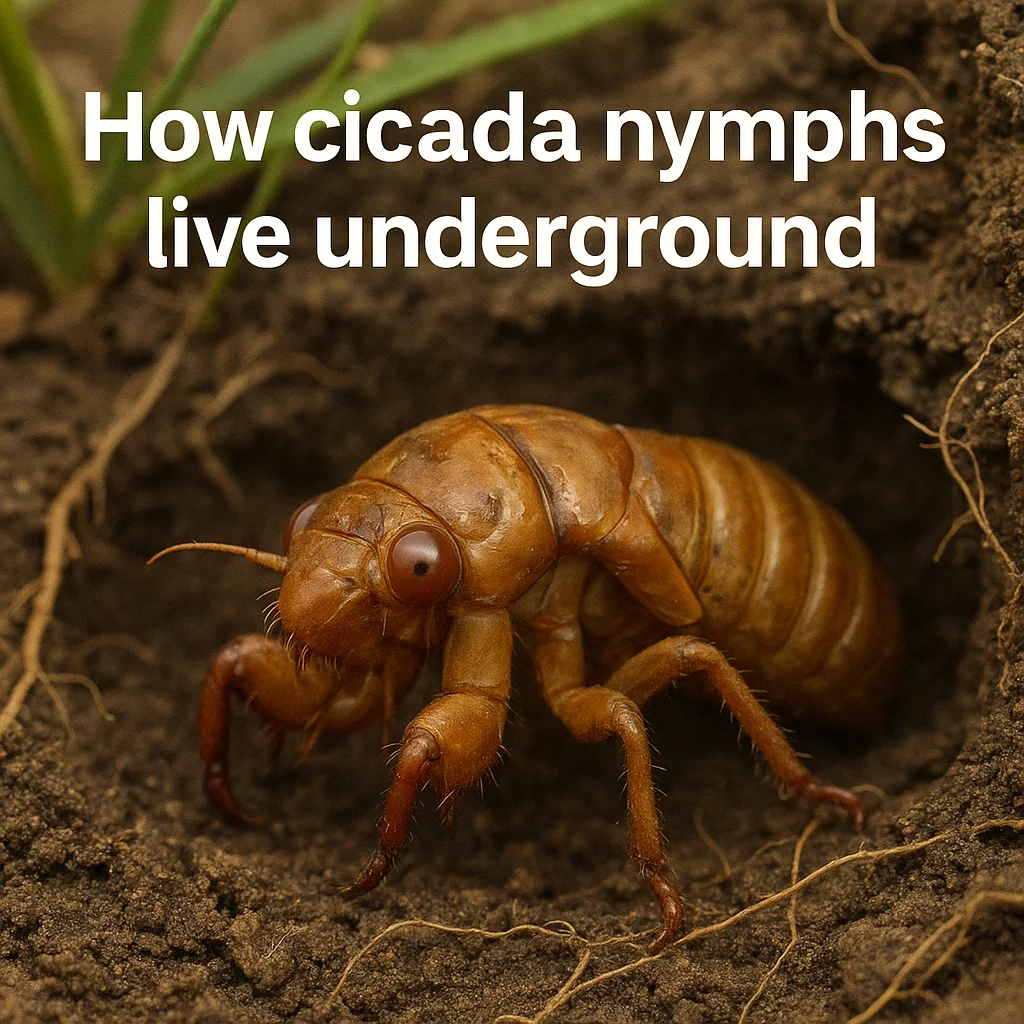
Cicada nymphs can be recognized by their stout, robust bodies designed for an underground lifestyle. Their bodies have a streamlined silhouette with strong front legs adapted for digging. As nymphs, they lack wings, unlike their adult counterparts.
- Body shape and silhouette: Bulky with a rounded profile
- Antennae type: Short antennae for sensing underground
- Wing features: Wings absent in nymphs; adults have two pairs of membranous wings
- Leg traits and movement style: Strong front legs for excavation
- Distinguishing look-alikes: May be confused with beetle larvae, but cicada nymphs are larger with different leg structures
🧠 Basic Body Structure
Like other insects, cicada nymphs have a segmented body divided into a head, thorax, and abdomen. They possess six legs, characteristic of all insects, with an exoskeleton that provides protection and structural support. As invertebrates, cicada nymphs rely on their exoskeleton rather than a backbone. Unlike nymphs, adult cicadas develop wings after molting.
🌍 Habitat & Distribution
Cicada nymphs thrive in diverse environments, favoring deciduous forests and woodland areas. They dwell underground, taking advantage of soil suitable for sustaining their multi-year developmental period. Cicadas are cosmopolitan insects found on every continent except Antarctica, adaptable to climates ranging from temperate to tropical, though regional differences exist. Changes in habitat due to urbanization or deforestation can impact local populations and sightings.
📅 Seasonal Appearance & Activity
Cicada nymphs are primarily active underground until they emerge as adults. Most adults are observed in late spring through summer. Emergence is tied to temperature and soil conditions, with warmer climates triggering earlier activities. During emergence, nymphs crawl upwards during the night to limit exposure to predators.
- Best Time to Spot It
- Late spring or early summer
- Warm nights after rainfall
- In regions with periodic emergences: every 13 or 17 years
🥚 Reproduction & Egg-Laying
Cicada mating involves elaborate acoustic signals, with males producing distinct songs to attract females. After mating, females lay eggs in slits they create in tree branches. The number of eggs and egg-laying behaviors can vary between species, with some depositing hundreds of eggs over multiple sites.
🌀 Metamorphosis & Life Cycle
Cicadas undergo incomplete metamorphosis, progressing from egg to nymph before becoming adults. Nymphs hatch and burrow underground, where they may spend several years feeding on tree root juices. After the developmental period ends, nymphs emerge en masse, molt, and transform into winged adults. This life stage, though brief, is critical for reproduction.
🍽️ Diet & Feeding Behavior
As nymphs, cicadas nourish themselves through piercing-sucking mouthparts to extract sap from tree roots. This feeding behavior supports their extended subterranean existence. Upon reaching adulthood, they shift their diet to plant juices, a strategy that supports their energetic needs during the brief adult phase.
🦉 Predators & Defense
Cicadas face various predators, including birds, reptiles, and small mammals. Their primary defense as nymphs is concealment underground. As adults, they employ camouflage and escape flight. Their periodic emergence, particularly for species with synchronized lifecycles, saturates the environment with numbers that overwhelm predators.
- Defense Highlights
- Concealment: Underground life limits exposure to predators
- Camouflage: Drab coloration blends with environment
- Mass emergence: Safety in numbers dilutes predation
- Quick flight: Adults escape through rapid take-off
👥 Social Behavior & Swarms
Cicadas generally lead solitary lives underground. However, synchronized emergence due to periodic life cycles results in spectacular mass swarms. These emergences are typically triggered by soil temperature thresholds and are essential for mating success, as the sheer number of adults facilitates finding partners.
🧭 Senses & Communication
Cicadas rely on well-developed sensory organs to navigate their environment. Vision is particularly important for adults. They communicate via sound, with males producing distinct calls that play a crucial role in mating. This sound production is achieved through specialized structures known as tymbals.
🌱 Role in the Ecosystem
Cicadas play a vital role in ecosystems, acting as both prey and predator. They contribute to nutrient cycling when dead cicadas decompose and enrich the soil. Their feeding can help thin tree canopies, allowing light to reach understory plants. While their activities might be seen as detrimental in large numbers, they are important for balanced ecosystems.
📉 Population & Conservation Notes
Many cicada species are common in suitable habitats, but localized threats such as habitat destruction, pollution, and pesticides can affect populations. While data on their global numbers is limited, changes in land use can alter their range and abundance.
- How to Help (Low-Impact)
- Plant native trees to provide habitat
- Minimize pesticide use to safeguard populations
- Preserve leaf litter as microhabitat
- Support conservation efforts for native woodlands
⚠️ Human Interaction & Safety
Cicadas are harmless to humans and do not bite or sting. They pose no significant threat to pets or crops, though large emergences may cause minor disturbances. Observation should be respectful, without collecting or harming these beneficial insects.
📌 Summary
- Cicada nymphs are robust, soil-dwelling insects
- They are widespread, except in polar regions
- Active mainly in late spring to summer
- Exhibit incomplete metamorphosis, transitioning from nymphs to adults
- Feed on plant juices throughout their life cycle
- Predators include birds, reptiles, and mammals
- Fulfill ecological roles as nutrient cyclers and prey
- Efforts should focus on preserving habitats and observing responsibly