🕷️ Scale insects: close relatives overview
🧾 Quick Facts
Scale insects are a fascinating and diverse group of tiny, sap-sucking creatures that are closely related to aphids and mealybugs. Despite their small size, they can have significant impacts on plants and ecosystems. Here's a quick rundown of some important facts about scale insects.
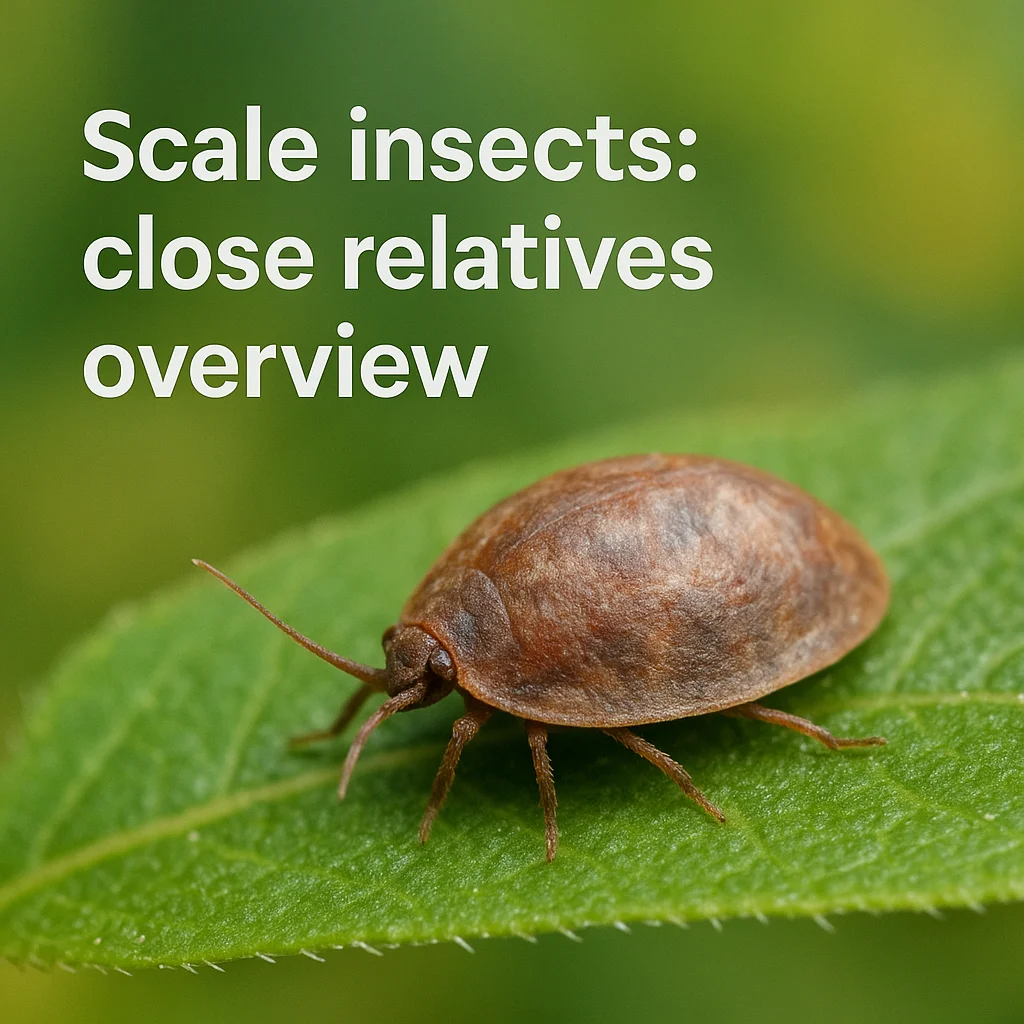
- Common names: Scale insects
- Scientific name: Varies by species
- Insect or not: Yes, they are invertebrates
- Order / family: Hemiptera / varies by species
- Typical size range: 1–6 mm in length
- Key colors/patterns: Varies; often brown, black, or yellowish
- Activity: Mostly active day and night
- Typical habitats: Orchards, gardens, forests
- Where in the world it occurs: Worldwide, especially in temperate and tropical regions
- Seasonality: Most active during warm months
🔍 Identification
Identifying scale insects in the field can be challenging due to their small size and ability to blend with plant surfaces. However, there are distinctive features that can aid recognition:
- Body shape and silhouette resemble tiny, flattened discs or rounded bumps.
- Antennae are typically reduced or absent in adults, aiding distinction from other insects.
- Wing features are generally absent in females, while males may have one pair of wings.
- Legs are not prominent, as most adult females are immobile and attached to host plants.
- Often confused with aphids or mealybugs, but scale insects lack the leg and antennae visibility of these groups.
- Top ID Tips:
- Look for circular or elongated bumps on plant stems or leaves.
- Check for a waxy covering or scale over the insect.
- Consider plant health; yellowing or wilting may suggest infestation.
- Use a magnifying glass for better identification.
- Check surrounding plants for similar infestations.
- Observe any sticky residue (honeydew) on plant surfaces.
🧠 Basic Body Structure
Scale insects, like all other insects, have a head, thorax, and abdomen, but these are not always distinctly separate due to their flattened shape. They have a tough exoskeleton that provides protection. The adult female scale insects often have an oblong shell-like covering and lack visible legs or wings, making them appear stationary. Scale insects are invertebrates, meaning they have no internal skeleton but rely on their tough outer covering for structural support.
🌍 Habitat & Distribution
Scale insects are adaptable and can be found in a variety of environments, ranging from forests and grasslands to urban gardens and orchards. They are particularly prevalent in areas with abundant host plants, such as citrus orchards and ornamental gardens. In terms of microhabitats, these insects often reside on branches, leaves, or stems, sometimes hiding under bark or nestled in crevices. They are globally distributed, with a strong presence in temperate and tropical regions where suitable climates and host plants are abundant.
📅 Seasonal Appearance & Activity
Scale insects are most visible during the warm months when plants are actively growing. During these times, they can frequently be found attached to host plants. Being predominantly nocturnal and diurnal, these insects can be observed both day and night. Their activity and visibility are influenced by warm temperatures, so sightings may decrease during colder months.
- Best Time to Spot It:
- Spring through late summer for most visibility.
- Warm and humid conditions favor activity.
- Day and night, especially on warm, dry days.
- During plant health checks in gardens or orchards.
🥚 Reproduction & Egg-Laying
Scale insects typically exhibit fascinating reproductive strategies. Some species can reproduce parthenogenetically, meaning females can produce offspring without mating. When sexual reproduction occurs, males engage in brief mating sequences. Female-scale insects lay eggs directly onto the host plant, often concealed under their protective scale covering. The number of eggs can vary widely, depending on species and environmental conditions.
🌀 Metamorphosis & Life Cycle
Scale insects undergo incomplete metamorphosis, transitioning from egg to nymph to adult. The stages include:
Egg: Eggs are typically laid under the female's scale and hatch into nymphs.
Nymph: Also known as "crawlers," these are the most mobile stage, moving to find a suitable feeding spot on the plant where they will develop into adults.
Adult: Females become stationary and develop a hard protective scale. Males may develop wings and actively search for females, though they quickly die post-mating.
🍽️ Diet & Feeding Behavior
Scale insects are sap-suckers, feeding on plant juices obtained from leaves, stems, or branches using their specialized piercing-sucking mouthparts. This feeding method allows them to extract nutrients from the phloem of plants. Their feeding can weaken plants and make them susceptible to disease or damage.
🦉 Predators & Defense
Natural predators of scale insects include birds, small mammals, and various insect species such as lacewings, ladybugs, and parasitic wasps. They employ several defense strategies, including:
- Dense, waxy or shell-like covering that provides protection from predators.
- Secretion of sticky honeydew deterring some predators.
- Blending with plant structures to avoid detection.
- Some species have symbiotic relationships with ants, which protect them in exchange for honeydew.
👥 Social Behavior & Swarms
Scale insects are primarily solitary, but due to their reproductive efficiency and crowding on host plants, they can appear to form groups or clusters. They do not form swarms or organized colonies, but the high density of individuals may result in significant plant infestations.
🧭 Senses & Communication
Scale insects possess limited senses, primarily relying on chemoreception to detect host plants and pheromones for mating purposes. They use chemical cues to communicate, and females may release pheromones to attract males. Their vision is underdeveloped, relying more heavily on their sense of touch and chemical responses.
🌱 Role in the Ecosystem
Scale insects play important roles in ecosystems by participating in the food web as both prey and consumers. They contribute to nutrient cycling by decomposing plant matter and serving as food for various predators. However, heavy infestations can cause economic implications in agriculture and horticulture by damaging crops and ornamental plants.
📉 Population & Conservation Notes
Scale insects are often reported as common in suitable habitats, though populations can vary widely due to natural enemies and environmental conditions. While not typically endangered, certain species may face challenges in areas with intense agricultural pesticide use and habitat removal. Conservational efforts can help promote balance:
- How to Help (Low-Impact):
- Plant native species which provide habitat balance.
- Encourage natural predators by providing diverse ecosystems.
- Avoid or limit pesticide use where possible.
- Leave areas of leaf litter and fallen branches.
⚠️ Human Interaction & Safety
Scale insects do not bite or sting humans. However, their presence can lead to plant health problems, causing significant agricultural damage. Gardeners and farmers should monitor plant health and take appropriate non-destructive measures to maintain balanced ecosystems. Respectful observation is crucial, and collecting wild specimens is discouraged.
📌 Summary
- Scale insects are small, sap-sucking invertebrates with protective coverings.
- They inhabit various environments, from forests to urban gardens.
- Visible primarily during warm months, both day and night.
- They undergo incomplete metamorphosis with direct development into adults.
- Feeding primarily on plant sap via piercing-sucking mouthparts.
- Preyed upon by birds, insects, and other larger animals.
- Contribute to the ecosystem as prey, but can harm plants.
- Human safety interactions are low, no danger to people.