🕷️ Planthoppers Waxy Tails And Incredible Jumps
🧾 Quick Facts
Planthoppers are a fascinating group of insects known for their remarkable jumping abilities and distinctive waxy tails. These creatures belong to a diverse array of species with variations in size, color, and habitat preferences.
- Common Names: Planthoppers
- Scientific Name: Varies by species
- Insect or Not: Invertebrate, insect
- Order / Family: Hemiptera / Fulgoridae (among others)
- Typical Size Range: 5–20 mm long (adult)
- Key Colors/Patterns: Green, brown, patterned wings, waxy tail filaments
- Activity: Primarily diurnal
- Typical Habitats: Grasslands, forests, gardens
- Where in the World: Widespread across temperate and tropical regions
- Seasonality: Most visible during spring and summer
🔍 Identification
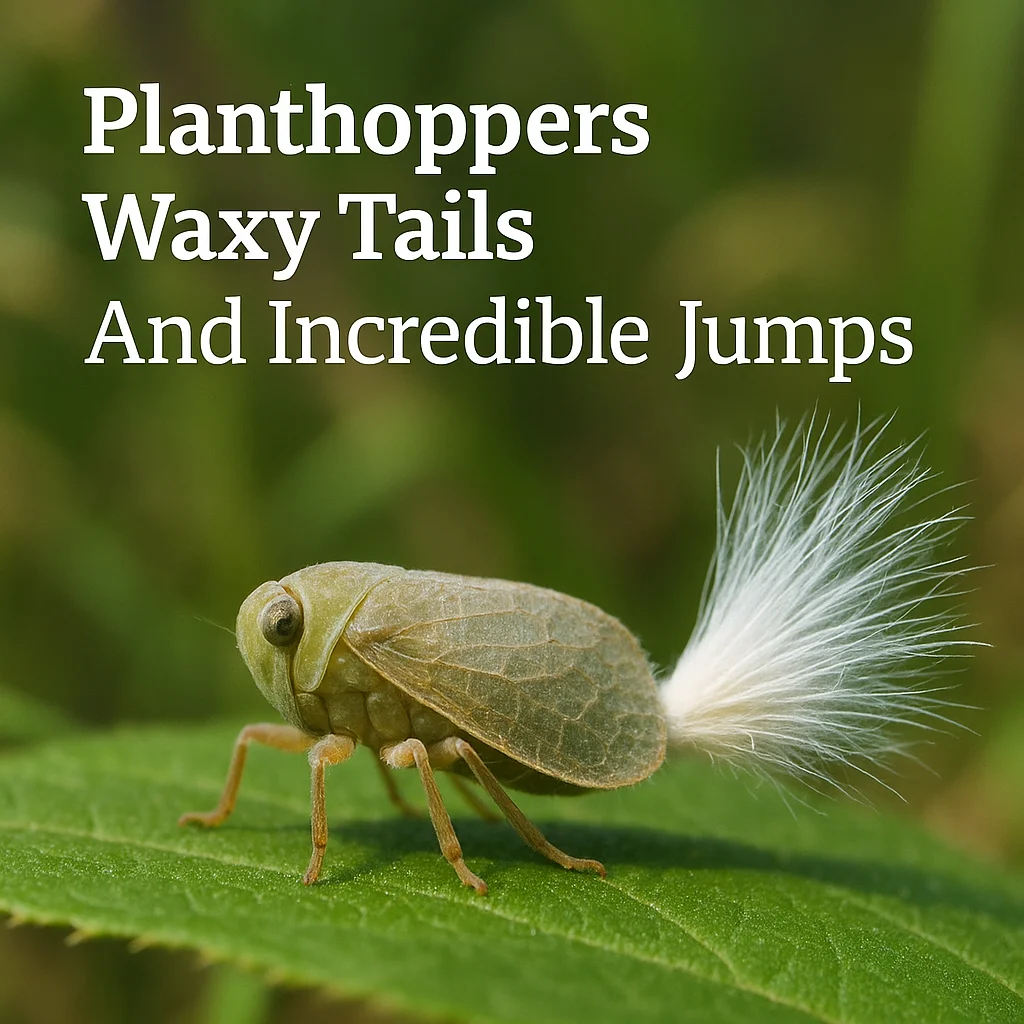
Recognizing planthoppers in the field can be rewarding due to their unique appearance and behaviors. They possess a distinct body structure, often with a broad head and a tapered, slender abdomen. Their wings are typically transparent or patterned, contributing to their camouflaging abilities. Planthoppers are noted for their waxy tails, which are composed of fine, filamentous structures that may appear fluffy or tufted. These tails can be quite striking, especially when the insect is at rest.
- Wedge-shaped silhouette with elongated bodies
- Short antennae, usually not prominent
- Transparent or patterned wings that rest tent-like over the back
- Strong, spring-loaded hind legs for jumping
- Waxy tail filaments resembling fine hairs or fluff
- Often confused with leafhoppers or cicadas but differentiated by tail structures and jumping ability
🧠 Basic Body Structure
Planthoppers, like other insects, have a three-part body structure consisting of the head, thorax, and abdomen. They have six legs, which are a defining feature of insects. Their exoskeleton provides protection and needs to molt as they grow. Wings are usually present, adding to their distinctive appearance. As an invertebrate, they lack a backbone, which is characteristic of insects and differentiates them from vertebrate animals.
🌍 Habitat & Distribution
Planthoppers thrive in lush environments where they can access ample vegetation. They are commonly found in forests, grasslands, and gardens, taking advantage of the dense plant life for feeding, mating, and camouflage. Within these areas, they often reside in microhabitats such as under leaves, among grasses, or within flowering plants. Planthoppers are globally distributed, especially in temperate and tropical regions, where climatic conditions support their lifestyle. Habitat alterations can affect their local abundance, making them less visible in areas with significant vegetation loss.
📅 Seasonal Appearance & Activity
These insects are most active during warm weather, primarily showing visibility in spring and summer. Being diurnal, they go about their activities during daylight hours, when their food sources, predominantly plant sap, are more available. Climate plays a significant role in their activity, with warmer temperatures favoring increased movement and visibility.
- Most active during warm months
- Visible on sunny days
- Rare sightings during cold or rainy weather
- Increased visibility in early morning and late afternoon
🥚 Reproduction & Egg-Laying
Mating behavior among planthoppers is intriguing, with some species exhibiting courtship displays to attract partners. Once mating occurs, females typically lay their eggs on plants, selecting locations that provide maximum access to food once the nymphs hatch. The number of eggs can vary considerably by species and environmental conditions, ensuring the survival of at least a portion of the offspring in varying circumstances.
🌀 Metamorphosis & Life Cycle
Planthoppers undergo incomplete metamorphosis, progressing from egg to nymph, and finally to adult. The nymph stages are characterized by multiple molts, allowing them to grow and eventually develop wings. Nymphs are generally plant-feeding and live in similar habitats as adults. Each stage varies in duration depending on environmental conditions, particularly temperature and humidity.
🍽️ Diet & Feeding Behavior
The diet of planthoppers primarily consists of plant sap, which they access using their specialized piercing-sucking mouthparts. Both nymphs and adults utilize this feeding method, positioning themselves strategically on host plants to extract nutrients. As herbivores, they play a role in the ecological food web, often influencing plant health and contributing to plant community dynamics.
🦉 Predators & Defense
Planthoppers face predation from a variety of natural enemies, including birds, spiders, and some predatory insects. To defend themselves, they rely on speed and their exceptional jumping abilities, which allow them to escape quickly when threatened. Their waxy tails also serve as a form of camouflage and may confuse predators.
- Camouflage through cryptic coloration and waxy tails
- Rapid, powerful jumps to escape predators
- Blend into plant environments
- Occasional mimicry of other insects
👥 Social Behavior & Swarms
Planthoppers are generally solitary insects, although they may be seen in groups when suitable food sources draw multiple individuals. Large congregations can sometimes give the illusion of swarming, especially when conditions such as humidity and temperature create ideal feeding conditions. These gatherings are typically not coordinated or permanent.
🧭 Senses & Communication
Planthoppers possess keen senses that facilitate their survival and reproduction. Their vision is adapted to detect movement and changes within their surroundings, crucial for avoiding predators. They also rely on vibration and sound to communicate and respond to environmental stimuli. Sound production, often as substrate vibrations, plays a role in mate attraction and recognition.
🌱 Role in the Ecosystem
Planthoppers contribute to their ecosystems as herbivores, affecting plant health and community structures. While their feeding can sometimes lead to economic impacts on agriculture, they also serve as prey for various wildlife, integrating into the broader ecological food web. They can indirectly aid in plant pollination, though their role is more significant in nutrient cycling through their contribution to plant interactions.
📉 Population & Conservation Notes
Planthoppers are generally common in suitable habitats, although their local abundance can fluctuate with changes in environmental conditions such as habitat loss or climate shifts. Their populations can be threatened by pesticide use and habitat destruction. Conservation efforts can aid in maintaining biodiversity and ecosystem balance by promoting habitat preservation.
- Maintain native plant habitats
- Limit pesticide application
- Encourage natural predators
- Preserve diverse plant communities
⚠️ Human Interaction & Safety
Planthoppers are harmless to humans and do not bite or sting. When observing them, it is best to appreciate their natural behaviors without disturbing them or their habitats. Encouraging natural habitats can support their populations and contribute to biodiversity.
📌 Summary
- Planthoppers are recognized by their waxy tails and strong jumping abilities.
- Preferring lush plant habitats, they are globally distributed in temperate and tropical zones.
- Most active in warm months and during daylight.
- They undergo incomplete metamorphosis from egg to adult.
- Feeding mainly on plant sap, they play a role in plant-insect dynamics.
- Natural predators include birds and spiders; defense includes camouflage and jumping.
- Though generally solitary, they are seen together around rich food sources.
- They aid in nutrient cycling and serve as prey within ecosystems.
- Local abundance varies; conservation efforts focus on habitat maintenance.
- Safe around humans; respectful observation is encouraged.