🕷️ Mealybugs Vs Scale Insects Quick ID For Houseplants
🧾 Quick Facts
Mealybugs and scale insects are common pests that often annoy houseplant enthusiasts. Though they are quite different in appearance and biology, they share a common reputation for damaging plants. Here’s a quick look at these invertebrates:
- Common names: Mealybugs, Scales
- Scientific name: Varies (multiple families and genera)
- Insect or not: Both are insects
- Order / family: Hemiptera; Pseudococcidae (mealybugs), Coccidae and Diaspididae (scales)
- Typical size range: 1–5 mm (adult)
- Key colors/patterns: White, grayish, brown, or black
- Activity: Generally diurnal but can be found at any time
- Typical habitats: Indoor plants, gardens, greenhouses
- Where in the world it occurs: Global, particularly in temperate and tropical regions
- Seasonality: Year-round in suitable indoor conditions
🔍 Identification
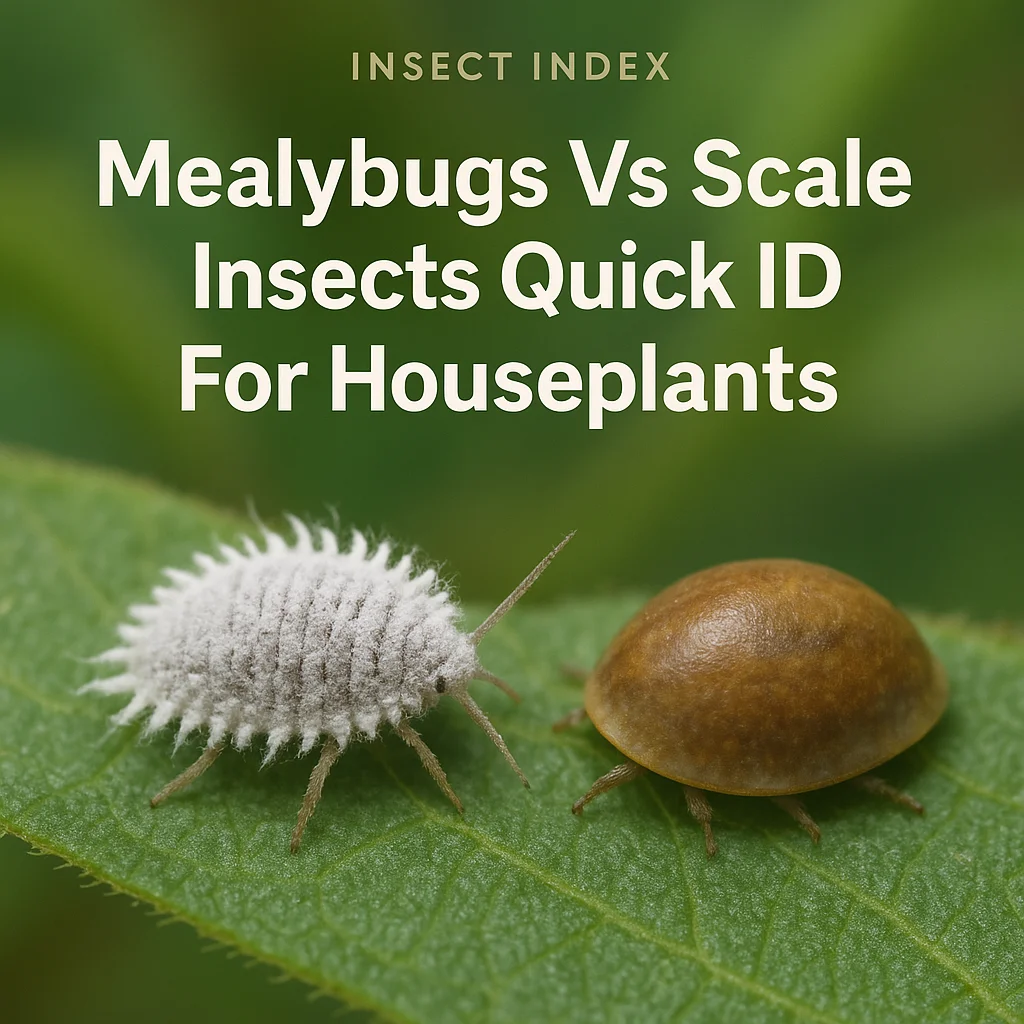
Identifying mealybugs and scale insects involves understanding their unique features. Mealybugs are distinct for their soft, white, and waxy appearance, while scale insects have hard shells and come in various colors.
- Body shape and silhouette: Mealybugs are oval and soft-bodied, often covered in a white powdery wax. Scale insects are more dome-shaped or flat, with a shell covering.
- Antennae type: Mealybugs have short, straight antennae. Scale insects' antennae are not visible when mature.
- Wing features: Neither has wings as adults.
- Leg traits and movement style: Mealybugs have visible legs and can crawl slowly. Adult scale insects are immobile.
- Distinguishing look-alikes and common confusion: Mealybugs are often mistaken for mold due to their white wax. Scales can be mistaken for plant growths.
- Check for powdery wax for mealybugs, and hard shells for scales.
- Mealybugs will move if disturbed; scales will not.
- Examine infestation sites: mealybugs prefer joints and soft plant tissues; scales attach firmly to stems.
- Inspect under magnification to observe body structure.
- Check for honeydew or sooty mold on leaves.
- Search for egg sacs nearby for clues.
🧠 Basic Body Structure
Both mealybugs and scale insects share the fundamental insect body structure, which includes a head, thorax, and abdomen. They have six legs and an exoskeleton that provides support and protection. Mealybugs, as juvenile instars, molt multiple times, whereas scale insects’ protective covers remain after molting. Adult scales lose their legs and become sedentary, relying on their protective armor.
These are invertebrates, meaning they lack a backbone and rely on their exoskeleton for structural support.
🌍 Habitat & Distribution
Mealybugs and scale insects favor environments where they can feed on plant sap. They are often found in gardens, greenhouses, and on houseplants, particularly in warmer climates.
Microhabitats include the undersides of leaves, leaf joints, and along stems where they can access plant juices. Their geographic range is broad, being common in nearly all continents, especially in temperate and tropical areas.
Changes in habitat, such as increased indoor humidity or the introduction of new plant species, can affect their prevalence on houseplants.
📅 Seasonal Appearance & Activity
These insects can be found on houseplants throughout the year, especially in controlled indoor environments. Outdoors, their visibility might be seasonally restricted to warmer months.
- Best observed in warmer, humid environments.
- Active throughout the day, peaking during daytime.
- More visible during warmer and rainy seasons outdoors.
- Indoor plants can harbor them year-round.
- Often brought indoors with new plant introductions.
- Consider monitoring plants after weather changes.
🥚 Reproduction & Egg-Laying
Mealybugs and scale insects have fascinating reproductive habits. Mealybug females produce fluffy egg sacs attached to plants. Eggs are laid on plant surfaces and yield offspring that look like tiny adults. Scale insects also lay eggs under their protective shell, securing them from predators.
The number of eggs produced can vary widely depending on species and environmental conditions, often in the hundreds, ensuring a high survival rate.
🌀 Metamorphosis & Life Cycle
Both insect groups undergo incomplete metamorphosis, transitioning from egg to nymphs and then to adults through several molting stages.
Nymphs, known as "crawlers," disperse to find feeding spots after hatching. They go through several nymphal stages before maturing. During these stages, they continue to consume plant sap, which provides essential nutrients for growth.
The life cycle of mealybugs and scale insects varies, depending on temperature and food availability, but they generally can complete several generations per year.
🍽️ Diet & Feeding Behavior
Both mealybugs and scale insects are sap-feeders, using their piercing-sucking mouthparts to draw plant sap, which can weaken plants and create openings for disease. They prefer feeding on soft plant tissue, often targeting young, tender areas.
Their feeding activity can result in the secretion of honeydew, a sugary substance that attracts sooty mold fungi and can further stress plants.
🦉 Predators & Defense
The natural predators of mealybugs and scale insects include birds, parasitic wasps, ladybugs, and predatory beetles, which help control their populations in natural ecosystems.
The primary defense of these insects includes tough exoskeletons or waxy coverings, which shield them from predators and environmental stress. They can also hide under leaves or crevices.
- Wax and armor provide protective barriers.
- Camouflage with plant surfaces prevents detection.
- Clusters can create mechanical protection.
- For scale insects, immobility can mimic plant parts.
👥 Social Behavior & Swarms
Mealybugs and scale insects are not social in the way ants or bees are, but they often occur in clusters due to their reproductive habits and the tendency to remain in one area for feeding.
Swarms do not occur, but local infestations can happen when conditions are favorable, leading to rapid population growth and spread on host plants.
🧭 Senses & Communication
These insects rely heavily on chemical communication, using pheromones to attract mates and establish colonies. Their sense of smell is crucial for locating hosts and mating partners.
Mealybugs release pheromones to attract potential mates and signal the presence of a suitable host plant.
🌱 Role in the Ecosystem
In their natural habitats, mealybugs and scale insects play varied ecological roles. They participate in the balance of ecosystems by acting as prey for larger animals and contributing to plant control.
Their relationship with honeydew can sometimes benefit other arthropods or even affect plant-pollinator dynamics. However, as pests, they can impact agricultural systems and plant health negatively when populations are uncontrolled.
📉 Population & Conservation Notes
These pests are often reported as common in suitable environments like gardens and houseplants. While they are not threatened, their presence is indicative of environmental conditions conducive to their life cycle.
- Encourage natural predators by planting diverse species.
- Avoid excessive pesticide use, which can harm beneficial insects.
- Regularly inspect and clean plants to prevent infestation.
- Leave leaf litter or organic matter to support a balanced micro-ecosystem.
⚠️ Human Interaction & Safety
Mealybugs and scale insects do not pose direct threats to humans as they do not bite or sting. Their impact is limited to plant damage. Handling these insects should be followed by hand washing to remove any plant sap or residues.
For controlling infestations, avoid collecting wild specimens. Instead, practice natural management techniques like introducing beneficial insects or applying mild soap solutions.
📌 Summary
- Mealybugs are soft-bodied and waxy; scales are hard-shelled.
- Found globally, particularly indoors or in mild climates.
- Present year-round but most active in warm, humid environments.
- Incomplete metamorphosis with nymph stages called "crawlers."
- Feed on plant sap using piercing-sucking mouthparts.
- Predators include birds, wasps, and ladybugs.
- Not social; infestations may look like clustering.
- Contribute to plant ecosystems, impacting both positively and negatively.
- Common in suitable habitats; diverse planting helps manage populations.
- Safely controlled with eco-friendly practices rather than harsh chemicals.