🕷️ Ants and aphids: honeydew “farming”
🧾 Quick Facts
The relationship between ants and aphids is a fascinating example of mutual symbiosis in the insect world. This relationship involves ants "farming" aphids for their sweet secretions known as honeydew.
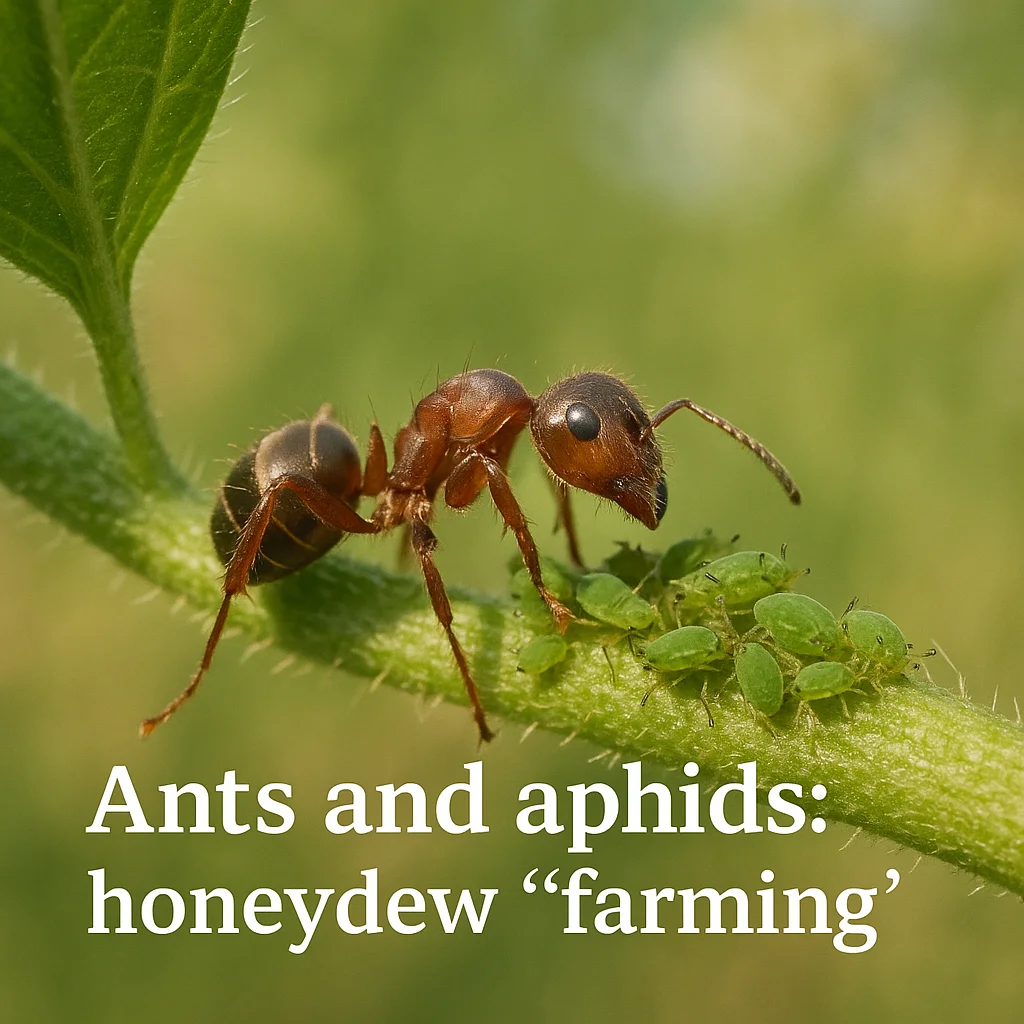
- Common names: Ant-aphid symbiosis, honeydew farming
- Scientific name: Varies
- Insect or not: Yes, ants and aphids are both insects
- Order / family: Formicidae (ants), Aphididae (aphids)
- Typical size range (adult): Ants: 1–13 mm, Aphids: 1–10 mm
- Key colors/patterns: Ants: black, red, brown; Aphids: green, black, brown
- Activity: Occasionally both diurnal and nocturnal
- Typical habitats: Gardens, forests, grasslands, crops
- Where in the world: Worldwide, except Antarctica
- Seasonality: Most active in spring and summer
🔍 Identification
Ants and aphids can be easily identified by their distinct appearances and behaviors. Ants have a segmented body with three distinct parts: the head, thorax, and abdomen. Aphids are small, soft-bodied insects often found clustered on plant stems.
- Top ID Tips
- Look for ants tending to clusters of aphids on plant stems.
- Ants are typically more mobile and can be seen running along branches.
- Aphids are stationary and feed by piercing plant tissues.
- Ants have elbowed antennae, while aphids have long antennae.
- Winged forms of aphids may appear during colony expansion.
- Ants come in various sizes and colors depending on the species.
- Aphids often appear green but can vary in color.
🧠 Basic Body Structure
Both ants and aphids are invertebrates, meaning they lack a backbone. As insects, they share common body structures: a head, thorax, and abdomen. Each has six legs. They possess an exoskeleton, which they periodically molt as they grow. Some species of aphids can develop wings at certain life stages, while the majority of ants remain wingless throughout their lives except for the reproductive members.
🌍 Habitat & Distribution
Ants and aphids are highly adaptable insects found in a wide range of environments from dense forests to urban gardens. Aphids thrive on plants where they can extract sap, while ants are versatile foragers and nest builders, commonly seen protecting aphid colonies.
They are present on every continent except Antarctica, favoring temperate and tropical climates. Changes in habitat due to urbanization, agriculture, and climate can affect their distribution and abundance.
📅 Seasonal Appearance & Activity
Ants and aphids are most commonly observed during the warmer months of the year. Their activity peaks in spring and summer when plants are lush, providing aphids with plenty of feeding sites and ants with ample honeydew resources.
- Best Time to Spot It
- Late spring to early summer
- Daytime, particularly during warm, sunny days
- Following periods of rain which stimulate plant growth
- In regions with mild winters, some activity may persist year-round
🥚 Reproduction & Egg-Laying
The reproductive behaviors of ants and aphids differ significantly. Ants mate during specific nuptial flights, where winged males and females swarm to mate. Aphid reproduction involves both sexual and asexual reproduction, with females often producing live young without mating in a process known as parthenogenesis.
Aphid eggs are typically laid on host plants in the fall, going through overwintering before hatching in the spring. Egg count and reproductive strategies are variable among species and environmental conditions.
🌀 Metamorphosis & Life Cycle
Aphids undergo an incomplete metamorphosis consisting of egg, nymph, and adult stages. Nymphs resemble adults but are smaller and not fully developed. Aphids feed on plant sap throughout all stages, living on the same plants where they were hatched. The life cycle is rapid, with multiple generations occurring within a season.
Ants have a complete metamorphosis cycle, including egg, larva, pupa, and adult stages. Larvae are nurtured in the nest, where worker ants feed and groom them. Upon reaching maturity, ants assume roles within the colony suited to their caste—worker, queen, or male.
🍽️ Diet & Feeding Behavior
Aphids are herbivores, using their piercing-sucking mouthparts to consume plant sap. This diet is rich in sugars, resulting in the excretion of honeydew, a sugary liquid that attracts ants.
Ants have a diverse diet that includes honeydew, other insects, nectar, and decaying organic material. In their interaction, ants 'milk' aphids for honeydew by gently stroking them, a behavior that benefits both parties.
🦉 Predators & Defense
Predators of ants and aphids include birds, spiders, parasitoid wasps, and beetles. Aphids rely on their numbers and rapid reproduction for survival, while some develop wings to disperse and colonize new plants.
Ants offer a degree of protection to aphids, deterring predators through aggressive behavior. Ants themselves use chemical defenses and their powerful mandibles as defense mechanisms.
- Defense Highlights
- Ants protect aphid colonies from predators.
- Aphids can develop wings for dispersal and protection.
- Ants use chemical communication to mobilize defense.
- Ants' biting and stinging provide direct protection.
👥 Social Behavior & Swarms
Ants are highly social insects living in complex colonies with defined roles: workers, queens, and drones. They cooperate in foraging, nesting, and defense, communicating predominantly through pheromones.
Aphids are not social but appear congregated due to their reproductive strategy and attraction to suitable feeding sites. Ants' tending behavior might create an apparent swarm to aid in protection and resource utilization.
🧭 Senses & Communication
Ants have a keen sense of smell used for navigation and colony communication through pheromones. They also perceive the world through vibrations and tactile feedback. Aphids rely more on chemical cues to find host plants and avoid predators.
Communication between ants and aphids is driven by the aphids' production of honeydew, encouraging ants to tend to and protect the aphid colonies.
🌱 Role in the Ecosystem
Ants and aphids play integral roles in ecosystems. Ants are involved in soil aeration, seed dispersal, and biological pest control. Aphids contribute to plant community dynamics by influencing plant growth and serving as food for predators.
Their mutualistic relationship contributes to both pest control and plant damage dynamics. While ants defend aphids from natural enemies, aphid feeding can sometimes damage crops, illustrating the complex and nuanced interactions within ecosystems.
📉 Population & Conservation Notes
The population dynamics of ants and aphids are generally stable in natural habitats but can fluctuate due to environmental changes and agricultural practices. Habitat loss, pesticide use, and climate change impact their populations.
- How to Help (Low-Impact)
- Plant native vegetation to support local insect populations.
- Reduce pesticide use to protect beneficial insects.
- Encourage natural predators by maintaining habitat complexity.
- Provide gardening spaces that mimic natural environments.
⚠️ Human Interaction & Safety
Ants can bite or sting when disturbed, but most common ant species are harmless to humans. It's essential to observe them respectfully from a distance and avoid disturbing their colonies. Aphids do not pose a direct threat to humans, but they can affect plant health.
If an ant bite causes discomfort, wash the area with soap and water, avoid scratching, and seek professional advice if a severe reaction occurs.
📌 Summary
- Recognizable by ants tending to aphids on plants.
- Common in gardens, forests, and agricultural areas.
- Most active and visible during the spring and summer.
- Aphids reproduce rapidly, often leading to large colonies.
- Ants protect aphid colonies in exchange for honeydew.
- They both serve important roles in ecosystem dynamics.
- Avoid excessive pesticide use to protect ant and aphid populations.
- Observe from a respectful distance to avoid disturbing natural behaviors.