🕷️ Stick insect habitats and diets
🧾 Quick Facts
Stick insects, also known as walking sticks, belong to a fascinating group of insects specialized for life in their environments. Here's a quick overview of these remarkable insects:
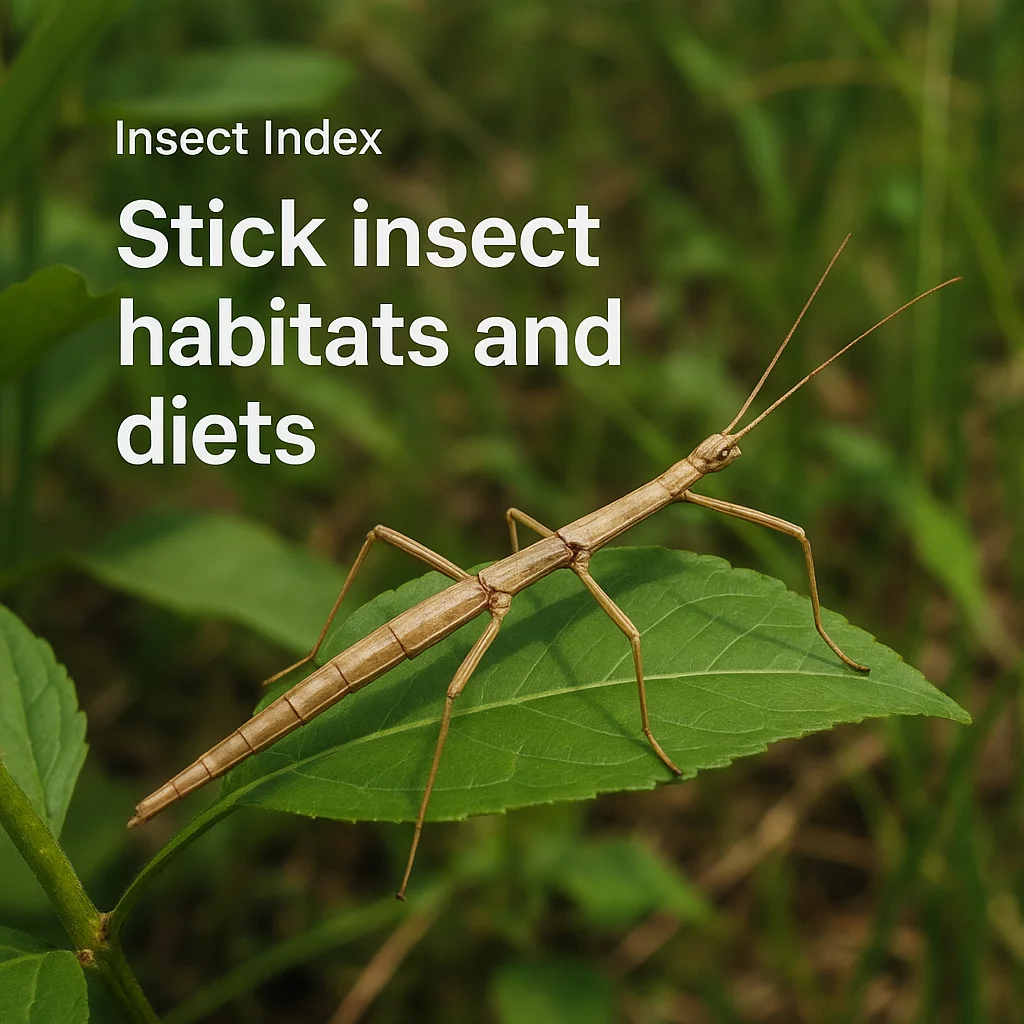
- Common names: Stick insect, walking stick
- Scientific name: Varies (e.g., Phasmatodea order)
- Insect or not: Invertebrate; they are true insects.
- Order / family: Order Phasmatodea, families often vary
- Typical size range: 1 cm to over 30 cm depending on species
- Key colors/patterns: Green, brown, and sometimes mottled
- Activity: Primarily nocturnal
- Typical habitats: Forests, gardens, grasslands
- Where in the world it occurs: Worldwide, mostly in tropical and subtropical areas
- Seasonality: More common in warm months but varies globally
🔍 Identification
Stick insects are masters of camouflage, often resembling twigs or branches, which can make them incredibly hard to spot. Here's how to recognize them:
- Long, cylindrical body shape that mimics the silhouette of a stick
- Typically very slim with elongated legs that resemble thin twigs
- Often wingless, but some species have short, vestigial wings
- Long antennae, sometimes indistinguishable among the twig-like body
- Walks with a slow, deliberate rocking motion, imitating the swaying of branches
- Top ID Tips:
- Look for thin, twig-like bodies sitting motionlessly on branches
- Note any slow, swaying movements
- Check for color matching to surroundings
- Look closely in leaf-litter or on shrubs
- Inspect the underside of leaves; they might be hiding in plain sight
- Be mindful of their nocturnal activity; night time searches may be more fruitful
🧠 Basic Body Structure
Stick insects are typical insects with a segmented body divided into three main parts: the head, thorax, and abdomen. With their elongated bodies, they're easily mistaken for natural debris.
They possess six legs, typical of insects, and most lack substantial wings but can have small, non-functional wing structures in some species. As invertebrates, stick insects have an exoskeleton, which they periodically shed through molting to grow.
🌍 Habitat & Distribution
Stick insects thrive in a variety of environments, mainly favoring forests, woodlands, gardens, and grasslands. They are most diverse in tropical regions, where lush vegetation offers abundant camouflage and food sources. Regions such as Southeast Asia, Australia, and South America house numerous unique species.
In these habitats, stick insects utilize microhabitats like leaf litter, under bark, and within dense foliage where they remain hidden from predators. As habitats change due to urbanization or climate, sightings can fluctuate, making habitat preservation crucial for their survival.
📅 Seasonal Appearance & Activity
These insects are predominantly nocturnal, making them more active after dusk. They are mostly observed during warmer months in temperate regions when plant growth is plentiful.
Rainy or humid conditions might increase their activity, as moisture supports their preferred environments.
- Best Time to Spot It:
- Nighttime in gardens or forests
- During warm, humid evenings
- In spring and summer months
- While gently sifting through leaf litter
🥚 Reproduction & Egg-Laying
Mating behaviors of stick insects can be protracted affairs, with pairs often engaging in extended copulation periods. Females typically lay eggs on the ground, which resemble seeds, adding to their concealment.
The number of eggs laid can vary significantly. Some species can reproduce parthenogenetically, meaning females produce offspring without males.
🌀 Metamorphosis & Life Cycle
Stick insects undergo incomplete metamorphosis, progressing through egg, nymph, and adult stages. Their life cycle stages are as follows:
The egg stage lasts several months, with eggs hidden among leaf litter or soil. Once hatched, the nymph resembles a smaller version of the adult, looking like miniature sticks, eating leaves from the start.
Nymphs undergo multiple molts before reaching adulthood, with cycles lasting several months to years. Adult stick insects take on larger, robust stick-like forms and continue to feed on leaves.
🍽️ Diet & Feeding Behavior
As herbivores, stick insects feed primarily on the leaves of trees and shrubs. During all life stages, they use chewing mouthparts to consume their leafy diets. They play a vital role in maintaining the balance of plant populations in their ecosystems by limiting leaf overgrowth.
🦉 Predators & Defense
Common predators of stick insects include birds, reptiles, amphibians, spiders, and various types of mammals. However, they have evolved sophisticated defense mechanisms to counteract these threats:
- Defense Highlights:
- Expert camouflage to resemble twigs
- Mimicry and remaining still to avoid detection
- Some can emit defensive secretions if disturbed
- Detachable limbs that can regenerate over time
👥 Social Behavior & Swarms
Stick insects are largely solitary creatures, spending most of their lives alone except during mating. They do not form swarms or colonies, and interactions are typically limited to brief encounters around reproductive activities.
🧭 Senses & Communication
Stick insects rely heavily on their well-developed sense of smell and vibration detection to navigate their surroundings and detect predators. Visual acuity is less crucial due to their camouflaging behavior, but feelers on their antennae help them touch and sense the environment.
Communication is generally limited but can involve vibrations transmitted through substrates to signal danger or courtship.
🌱 Role in the Ecosystem
Stick insects contribute significantly to their ecosystems as primary consumers. By feeding on leaves, they help control vegetation density, benefiting plant diversity. Their presence supports the food chains, serving as prey for numerous predators.
📉 Population & Conservation Notes
Although data on specific populations is limited, stick insects are reported as common in suitable habitats. Factors like habitat destruction, pesticide use, and climate changes pose threats that could affect their populations. To aid in their conservation, people can contribute by fostering native plant growth and reducing pesticide application.
- How to Help (Low-Impact):
- Plant native vegetation
- Avoid using pesticides
- Preserve leaf litter and natural debris
- Encourage habitat conservation efforts
⚠️ Human Interaction & Safety
Stick insects are harmless to humans and do not bite or sting. Observing them respectfully, from a distance, ensures their continued safety and enjoyment in nature without the impact of collection or harm.
📌 Summary
- Stick insects closely resemble twigs, aiding in their remarkable camouflage.
- Primarily found in forests and gardens of tropical and subtropical regions.
- They are nocturnal and most visible in warmer months.
- Undergo incomplete metamorphosis, from egg to nymph to adult.
- Herbivorous, feeding on leaves with chewing mouthparts.
- Vulnerable to birds and predators, defended by camouflage.
- Important ecological roles include plant population management and as prey.
- Conservation efforts can be supported by preserving habitats and reducing pesticides.
- Enjoy their beauty respectfully, promoting their preservation in the wild.