🕷️ Praying mantis: ambush hunter behavior
🧾 Quick Facts
The praying mantis is a remarkable insect known for its predatory prowess and unique appearance. As an ambush hunter, it uses its exceptional camouflage and rapid strikes to capture prey. Here are some quick facts about this fascinating insect:
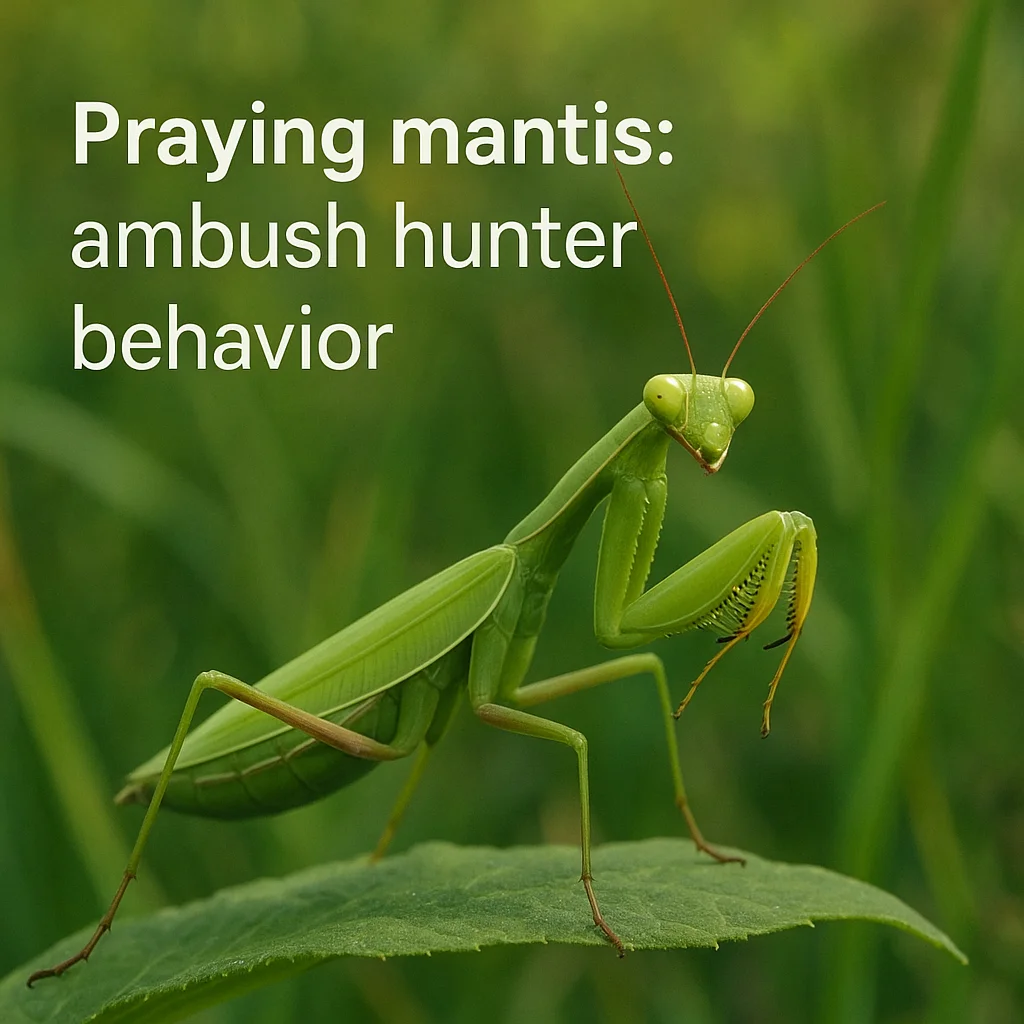
- Common names: Praying mantis, Mantid
- Scientific name: Varies (Over 2,400 species within the order Mantodea)
- Insect or not: Insect (member of invertebrates)
- Order / family: Mantodea / varies across numerous families such as Mantidae
- Typical size range: 1–6 inches (2.5–15 cm), depending on species
- Key colors/patterns: Often green or brown; excellent camouflagers
- Activity: Primarily diurnal, but some instances of nocturnal activity
- Typical habitats: Forests, grasslands, gardens, and fields
- Where in the world it occurs: Found on all continents except Antarctica
- Seasonality: Most visible during late summer and fall in temperate regions
🔍 Identification
Recognizing a praying mantis in the field involves noticing its distinct body shape and posture.
- The body is elongated with a flexible neck, allowing the head to turn almost 180 degrees.
- Antennae are typically long and slender, aiding in detecting pheromones and other chemical cues.
- The wings, when present, can be folded neatly along the back and may display intricate patterns.
- The front legs are adapted for grasping, known as raptorial legs, which they hold in a "praying" position.
- Common look-alikes include stick insects, but mantises have a more triangular head and grasping legs.
- Top ID Tips:
- Elongated body with a triangular head
- Long, slender antennae
- Raptorial forelegs with spines for capturing prey
- Green, brown, or other camouflage colors
- Smooth motion and head rotation up to 180 degrees
- Natural positioning near plants or organic material
🧠 Basic Body Structure
Understanding the basic body structure of the praying mantis helps in appreciating its adaptability.
- Head: Equipped with compound eyes, it provides a wide field of vision.
- Thorax: Connects the head to the abdomen and houses the legs, providing maneuverability.
- Abdomen: Houses organs and can swell in gravid females.
- Six legs: Standard insect leg count with front legs adapted for predation.
- Exoskeleton offers protection from physical injuries and dehydration.
- Undergoes molting to grow, shedding its outer layer multiple times before adulthood.
The praying mantis is an invertebrate, meaning it lacks a spinal column, relying on its exoskeleton for structure and support.
🌍 Habitat & Distribution
Praying mantises inhabit a variety of environments that provide ample concealment from both prey and predators.
- Preferred environments include forests, grasslands, gardens, meadows, and agricultural fields.
- Microhabitats involve hiding under leaves, inside flower clusters, or camouflaging against bark.
- They are geographically widespread, found on all continents excluding Antarctica, adapting to climates ranging from tropical to temperate.
- Habitat alteration through urban development may reduce encounters in natural settings but sometimes increases presence in gardens and parks.
📅 Seasonal Appearance & Activity
Praying mantises are most active and visible at certain times, which aligns with their life cycle and environmental conditions.
- Mature adults are often seen during summer and fall, especially in temperate climates.
- Primarily diurnal, but activity may also occur at dusk or during humid nights.
- Weather influences include temperature and precipitation, with warmer, drier climates enhancing visibility.
- Best Time to Spot It:
- Late summer and early fall
- Warm, dry afternoons in sunny areas
- During times of low vegetation disturbance
- Sunny, clear days following rain
🥚 Reproduction & Egg-Laying
Praying mantis reproduction involves complex behaviors, occasionally including sexual cannibalism.
- Males approach females with caution and risk, relying on specific courtship displays to prevent attack.
- Eggs are laid in a protective frothy case called an ootheca, often attached to plants or under bark.
- Typical egg counts vary from dozens to a few hundred, securing high survival rates through numbers.
🌀 Metamorphosis & Life Cycle
The life cycle of a praying mantis involves incomplete metamorphosis, progressing through egg, nymph, and adult stages.
- Egg stage: Eggs are secured in oothecas during fall, hatching synchronously in spring.
- Nymph stage: Initially wingless and resembling miniature adults, they grow through multiple molts.
- Adult stage: Final molt develops wings, extending life for a few months, focused on reproduction.
🍽️ Diet & Feeding Behavior
The praying mantis is an obligate carnivore, adeptly capturing a variety of prey.
- Utilizes rapid raptorial forelegs to catch insects, spiders, small vertebrates, and occasionally hummingbirds.
- Mouthparts are chewing type, adapted for gripping and consuming live prey.
- Primarily act as predators within their ecosystems, impacting local insect populations and serving as pest control.
🦉 Predators & Defense
Despite being skilled hunters, praying mantises have several natural enemies including birds, bats, and larger insects.
- Depend on camouflage and positioning within foliage to avoid detection.
- When threatened, they employ displays like spreading wings and raising forelegs to intimidate.
- Swiftness combined with sudden strikes helps deter or escape pursuers.
- Defense Highlights:
- Exceptional camouflage abilities
- Threat displays with extended wings
- Quick, agile maneuvers
- Strategic positioning within foliage
👥 Social Behavior & Swarms
Praying mantises are largely solitary creatures with no social structures or swarm behaviors.
- Encounters are mainly during mating, which demands meticulous and cautious approach from males.
🧭 Senses & Communication
Praying mantises have well-developed sensory structures enabling efficient hunting and mating.
- Vision: Highly acute through compound eyes, detecting movement and gauging distance.
- Smell: Chemoreceptors on antennae help in pheromone detection for locating mates.
- Sound and vibration: Hearing organs located on the thorax allow for detection of bat echolocation.
- Communication through body language and chemical signaling rather than vocal or auditory means.
🌱 Role in the Ecosystem
Praying mantises have significant ecological roles as both predator and prey.
- Contribute to pest control by preying upon a diverse array of insects.
- Serve as food for birds and other higher trophic level organisms, integrated into food webs.
- Interactions with plant environments often involve no detriment to vegetation.
📉 Population & Conservation Notes
While many species of praying mantises are common, some face challenges due to environmental pressures.
- Generally abundant in favorable habitats, but habitat loss and pesticide use can pose risks.
- Light pollution and changing climates may affect their nocturnal activities.
- How to Help (Low-Impact):
- Encourage native plant growth for habitat continuity
- Avoid pesticide use in gardens
- Preserve leaf litter and vegetation fringes
- Reduce light pollution during peak activity times
⚠️ Human Interaction & Safety
The praying mantis is harmless to humans and poses no risk of bites or stings. Observing these insects in their natural habitats is both safe and fascinating.
- Defer to gentle observation practices, avoiding physical disturbance or collection of wild specimens.
📌 Summary
- Easily identified by elongated bodies and raptorial front legs
- Preferred habitats include gardens and wooded areas
- Most active during warm, late summer days
- Undergoes incomplete metamorphosis through distinct life stages
- Diet consists chiefly of other insects, playing a crucial predator role
- Relies on camouflage and startle displays for defense
- Key part of ecosystems contributing to insect population control
- Population stability threatened by environmental changes and human activity