🕷️ Orchid Mantis Flower Mimic Ambush Strategy
🧾 Quick Facts
The orchid mantis is a fascinating insect known for its remarkable ability to mimic flowers as a strategy for hunting prey. This ability not only aids in capturing unsuspecting insects but also helps in avoiding predators. Below are some quick facts about the orchid mantis:
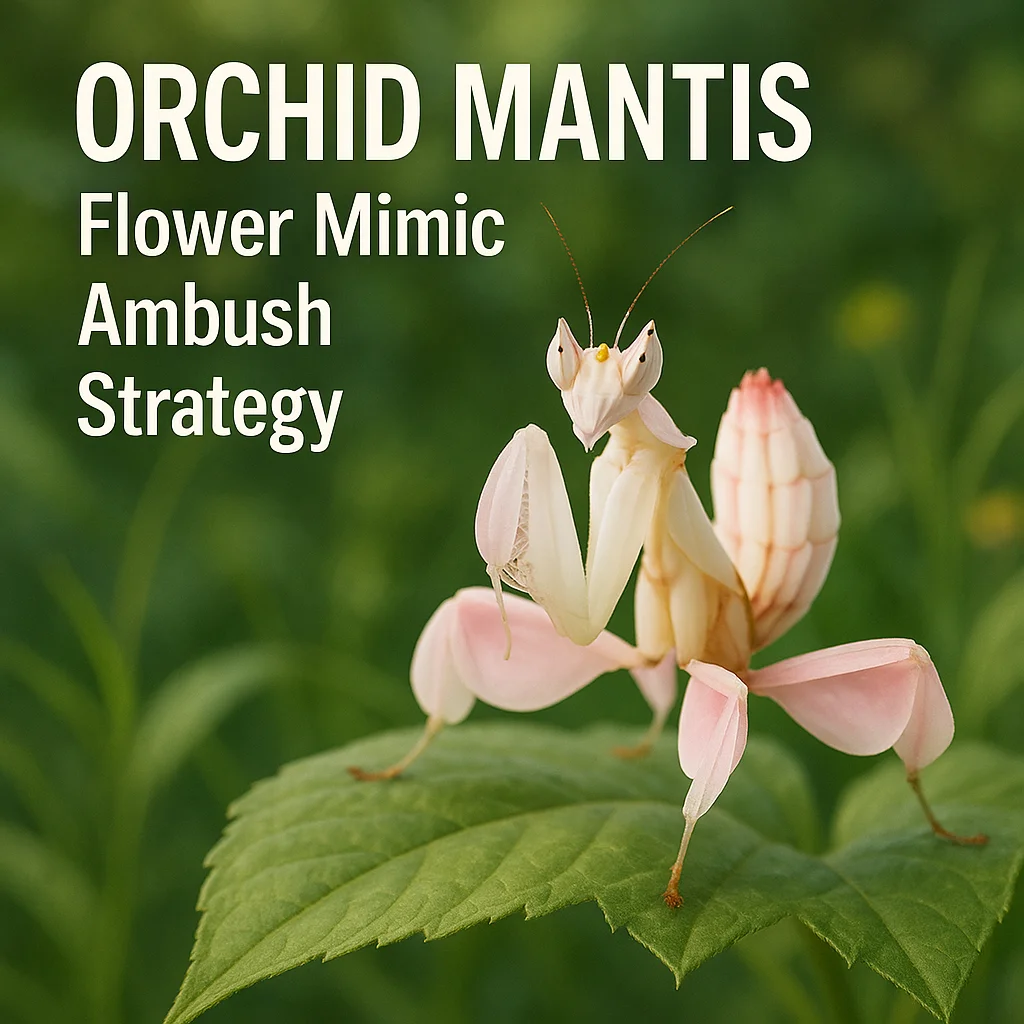
- Common names: Orchid mantis
- Scientific name: Hymenopus coronatus
- Insect or not: Yes, it's an invertebrate
- Order / family: Mantodea / Hymenopodidae
- Typical size range (adult): 4 to 6 cm in length
- Key colors/patterns: White, pink with petal-like extensions
- Activity: Primarily diurnal (active during the day)
- Typical habitats: Tropical forests, gardens, areas with abundant flowers
- Where in the world it occurs: Southeast Asia, including Malaysia, Indonesia, and Thailand
- Seasonality: Often more visible during the wet season when flowers are abundant
🔍 Identification
Identifying the orchid mantis can be challenging due to its excellent disguise resembling the orchids it often hides in. Here are some specific features to look for:
- Body shape and silhouette: The orchid mantis has a robust yet delicate body with wide, petal-like lobes on its legs, giving the impression of a flower.
- Antennae type: Filiform antennae that are thin and segmented, aiding in sensing the environment.
- Wing features: Adults possess well-developed wings; females typically cannot fly despite having wings.
- Leg traits and movement style: Raptorial forelegs are used for grasping prey; they have a slow, deliberate movement mimicking swaying flowers.
- Distinguishing look-alikes: While it may resemble certain flowers, distinct mantis features like the structure of its legs and antennae help differentiate it from actual floral parts.
- Top ID Tips
- Look for petal-like leg lobes
- Notice the color blend of white and pink
- Check for raptorial forelegs
- Observe the deliberate swaying movement
- Antennae offer a distinct key characteristic
- Winged yet typically non-flying females
🧠 Basic Body Structure
The orchid mantis shares the fundamental body structure typical of insects, comprising a head, thorax, and abdomen. It has six legs, which are characteristic of the insect class, and an exoskeleton that provides protection and support.
Insects like the orchid mantis are invertebrates, meaning they do not have a backbone. Instead, their strength and structure come from their exoskeleton. Regular molting occurs as they grow, shedding the old exoskeleton to form a new one. Adults possess wings, although only males are agile fliers.
🌍 Habitat & Distribution
The natural habitat of the orchid mantis is lush with abundant flowers. They thrive in tropical forests where humidity and warmth create ideal conditions. In addition to forests, these mantises are often found in gardens and regions where flowers are plentiful.
Geographically, the orchid mantis predominantly resides in Southeast Asia, favoring the regions' tropical climates. Their visibility is seasonally influenced by the presence of flowers; thus, habitat changes, such as deforestation or urban expansion, can alter how commonly they are seen.
📅 Seasonal Appearance & Activity
The orchid mantis can be spotted more frequently during specific times of the year. They are primarily diurnal, preferring daylight to perform their hunting and mimicry activities. Varying by region and climate, rainier seasons that promote floral growth tend to align with increased mantis activity.
- Best Time to Spot It
- During the wet season for higher flower presence
- In daylight hours when they are most active
- Post-rainy day when humidity is balanced
- In regions abundant with native orchids
🥚 Reproduction & Egg-Laying
Orchid mantis mating behaviors appear to be influenced by visual cues and pheromones. The male approaches the female cautiously, often with specific movements or vibrations as part of the courtship.
Eggs are laid in protective cases known as oothecae, which are secured on plant leaves or stems to safeguard them from predators. The number of eggs varies, with larger oothecae containing several dozen eggs due to protective environmental conditions.
🌀 Metamorphosis & Life Cycle
The orchid mantis undergoes incomplete metamorphosis, comprising three distinct life stages: egg, nymph, and adult. This means there is no pupal stage common in complete metamorphosis.
After hatching from the ootheca, the mantis nymphs, resembling miniature adults, begin hunting small insects. They moult several times, growing larger with each stage. Adult mantises primarily feed on other insects, continuing their flower mimicry to ambush prey. Lifespan varies but usually aligns with climate conditions, spanning several months.
🍽️ Diet & Feeding Behavior
Orchid mantis nymphs and adults share a predatory nature, preying on insects that venture too close, mistakenly attracted by their floral mimicry. Equipped with raptorial forelegs, they catch unwary prey with swiftness.
They primarily consume pollinating insects like bees and butterflies, using chewing mouthparts to ingest prey. Orchid mantises play a notable role as both predator and participant in the natural control of pollinator populations.
🦉 Predators & Defense
The orchid mantis employs several defense mechanisms to avoid predation. Its main defense is its extraordinary camouflage, blending seamlessly with orchid flowers, which deters predators like birds and reptiles.
Other defense strategies include sudden displays of its forelegs to startle predators and mimicry of unpalatable organisms. They might also use agility and rapid movement to escape threats.
- Defense Highlights
- Floral mimicry for camouflage
- Startle displays with forelegs
- Aggressive posturing to deter predators
- Quick, agile escapes when threatened
👥 Social Behavior & Swarms
The orchid mantis is typically a solitary creature. Solitary living revolves around establishing itself within a suitable flower-rich environment for feeding and protection.
Mating encounters occur during the breeding season, where males seek out receptive females. Outside of these brief interactions, the mantis spends its time primarily on individual hunting and survival.
🧭 Senses & Communication
Orchid mantises rely heavily on their keen vision to detect prey and predators. Their eyes are adapted for detecting movement, vital in ensuring efficient hunting.
Communication with potential mates may involve pheromones and motion display, particularly during mating approaches. Tactile feedback from antennae helps in close-range environmental sensing.
🌱 Role in the Ecosystem
The orchid mantis plays a crucial role in the ecosystem as both predator and prey. By feeding on pollinator insects, they help balance local insect populations. They contribute indirectly to the pollination process due to their interactions with pollinators.
As prey, they are key in supporting biodiversity, being a food source for many larger insects and small vertebrates. The relationships with flowers they mimic highlight mutualism aspects without directly influencing floral reproduction.
📉 Population & Conservation Notes
The conservation status of the orchid mantis is not well documented, though it is often reported as locally abundant in suitable habitats. Habitat destruction and changes due to human activity can affect their populations, as can pesticides.
- How to Help (Low-Impact)
- Plant and protect native flowers to support natural habitats
- Avoid pesticide use in gardens
- Preserve forested areas where mantises thrive
- Create floral gardens that mimic natural habitats
⚠️ Human Interaction & Safety
The orchid mantis is generally harmless to humans and does not bite or sting. They may pinch if handled roughly, but this is rare. When interacting with them, it is crucial to observe respectfully and avoid disturbing their natural behavior.
If coming into contact with mantises, one should wash the area gently and seek professional advice only if any allergic reactions occur, though this is unlikely. Observational enjoyment rather than collection is encouraged to support their conservation.
📌 Summary
- Distinctive floral mimicry for camouflage
- Tropical habitats in Southeast Asia
- Primarily active and visible during the wet season
- Incomplete metamorphosis lifecycle
- Predatory role in controlling insect populations
- Defense through camouflage and mimicry
- Solitary nature with brief mating interactions
- Ecological role as predator and prey
- Population impact by habitat changes and pesticides
- Non-harmful to humans, respect in observation