🕷️ Mantises Myths and Facts
Mantises are captivating creatures that have fascinated people for centuries due to their intriguing appearance and behaviors. Known for their predatory skills and distinctive posture, they are often surrounded by myths and misconceptions. This article delves into the fascinating world of mantises, providing clear and educational insights into these remarkable insects.
🧾 Quick Facts
Mantises, also known as praying mantises due to their posture, are a diverse group of insects that can be found in various parts of the world. Here are some quick facts to help you understand these incredible creatures:
- Common names: Praying Mantis
- Scientific name: Varies
- Insect or not: Yes, they are insects and invertebrates
- Order / family: Mantodea
- Typical size range (adult): 1 to 6 inches
- Key colors/patterns: Green, brown, camouflage patterns
- Activity: Mostly diurnal
- Typical habitats: Gardens, grasslands, forests
- Where in the world it occurs: Worldwide, especially tropical regions
- Seasonality: Most visible in late spring through fall
🔍 Identification
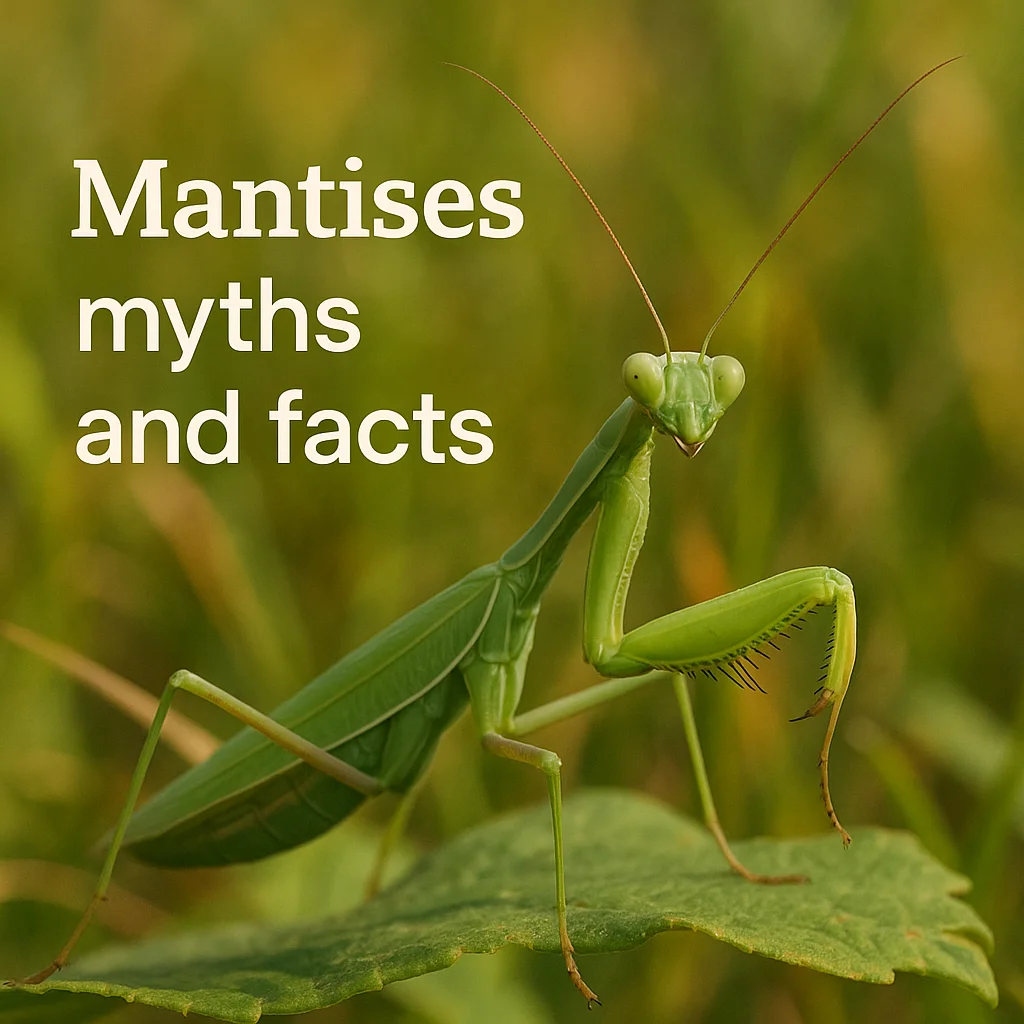
Identifying a mantis in the wild is an exciting activity. They are easily recognizable by their elongated bodies and the way they hold their front legs as if praying. Here’s how you can identify them:
Their body shape is generally elongated and slender, aiding in camouflage with surrounding vegetation. They possess two large compound eyes and might have additional simple eyes located between them for acute vision.
Antennae are typically short and filamentous, contributing to their sensory perception, though not often a primary feature for identification.
The wings of mantises, present in adults, may vary between species from well-developed to almost absent. They often have a leathery texture that blends with the body coloration.
Front legs are adapted for grasping prey, with strong femora and tibia lined with spikes to securely hold their prey. Their movement is characterized by slow stalking motions followed by rapid strikes.
Mantises can often be confused with other insects like stick insects due to their slender bodies, but their distinctive front legs and triangular heads set them apart.
- Top ID Tips:
- Look for a triangular head with large, compound eyes.
- Notice the characteristic "praying" stance of their front legs.
- Check for camouflage colorations, like green or brown.
- Observe their slow, deliberate movement style.
- Distinguish from stick insects by their predatory posture.
- Wings may be visible in adults, usually lying flat along the body.
🧠 Basic Body Structure
Mantises, like all insects, are composed of three main body parts: the head, thorax, and abdomen. They possess six legs and an exoskeleton which provides support and protection. Their exoskeleton must be shed periodically through a process known as molting to allow for growth.
Mantises are invertebrates, meaning they do not have a backbone. Instead, their rigid exoskeleton offers the necessary structural support and shape. Wings, in some species, aid in flight and further differentiation among the enclosure of predators.
🌍 Habitat & Distribution
Praying mantises thrive in a variety of environments, including gardens, grasslands, tropical forests, and even urban gardens and parks. Their presence is often tied to areas with ample vegetation where they can camouflage effectively. They also use these habitats as hunting grounds due to the abundance of potential insect prey.
Mantises occur on every continent except Antarctica, with the greatest diversity found in tropical regions where climates tend to stay warmer and stable, ensuring ample food supply and breeding conditions.
Habitat changes, including urbanization and agriculture, can affect the local sightings of mantises as they adapt or are forced to find new habitats in suitable climates.
📅 Seasonal Appearance & Activity
The best time to observe mantises is during warmer months when they are most active. Their visibility peaks in late spring through to fall, with activity mainly occurring during daylight when they hunt prey using their excellent vision.
Weather variations, like a significant drop in temperature or increased precipitation, can move them to seek shelter and may reduce local sightings temporarily.
- Best Time to Spot It:
- Late spring to early summer for active hunting adults.
- Warm, sunny afternoons enhance visibility.
- Avoid cold, rainy periods when they become less active.
- Early autumn may reveal egg-laying females.
🥚 Reproduction & Egg-Laying
Reproduction in mantises is a complex behavior that involves elaborate courtship rituals, which may include the male approaching the female cautiously to avoid being mistaken for prey. In some species, the female may consume the male after mating, although this is not a universal truth across all mantis species.
Egg-laying occurs on plants, sticks, or grass stems, where females deposit an egg case known as an ootheca. This hardened case can contain dozens to hundreds of eggs, which will eventually hatch into tiny nymphs.
🌀 Metamorphosis & Life Cycle
Praying mantises undergo incomplete metamorphosis, consisting of three stages: egg, nymph, and adult.
In the egg stage, mantises are protected within an ootheca. The duration depends on climate, generally lasting months through overwintering stages.
Nymphs, which are miniature versions of adults, emerge and are highly active in finding food to sustain growth. This stage can last several months, with multiple molting events required to reach maturity.
During the adult stage, mantises become reproductive and continue to feed on a wide array of insects to maintain their energy levels.
🍽️ Diet & Feeding Behavior
Mantises are voracious predators, primarily feeding on other insects throughout their life stages. Nymphs and adults both employ powerful front legs equipped with spines to capture prey firmly.
They have chewing mouthparts that allow them to devour their prey efficiently. As they are higher up in the food chain, mantises play a critical role in controlling pest populations, acting as natural pest managers in ecosystems.
🦉 Predators & Defense
Mantises face predation from birds, reptiles, larger amphibians, spiders, and mammals. Their main defense strategy is camouflage, allowing them to blend seamlessly with the environment and elude predators.
Some species may display deimatic behavior, such as startling displays with wings or hissing noises, to discourage attackers. Immobility and quick hiding maneuvers can protect them further from becoming an easy meal.
- Defense Highlights:
- Effective use of camouflage colors.
- Startling displays when threatened.
- Ability to remain immobile for extended periods.
- Quick reflexes and hiding skills.
👥 Social Behavior & Swarms
Mantises are primarily solitary creatures, meeting only during brief mating periods. They are territorial and use space efficiently for hunting necessities. This solitary nature aids in maximizing individual survival without the competition pressures present in group environments.
Migrations or swarming behaviors are not characteristic of mantis behavior, allowing them to focus on maintaining suitable territories.
🧭 Senses & Communication
Vision is one of the mantis's most acute senses, helping them accurately judge distances for hunting. Their capability to turn their heads and perceive movement gives them an advantage in ambushing prey.
The role of smell is less prominent but nonetheless contributes to identifying food or potential mates through pheromonal communication. Vibration sensitivity plays a minor role in environmental awareness, alerting them to larger predators or competition.
🌱 Role in the Ecosystem
Mantises are crucial for pest control as they help balance insect populations within ecosystems by preying on abundant species. As part of the food web, they serve as both predator and prey, ensuring energy transfer across different trophic levels.
Though not major pollinators, their presence can indirectly influence plant health by controlling herbivorous insects, offering environmental benefits without direct mutualistic relationships.
📉 Population & Conservation Notes
Mantises are generally common in their suitable habitats, aided by their adaptability to various environments. However, their populations can be susceptible to pesticide use and habitat destruction due to urban and agricultural developments.
- How to Help (Low-Impact):
- Encourage native plant growth to provide natural habitats.
- Avoid the use of broad-spectrum insecticides.
- Leave leaf litter to maintain ground cover habitats.
- Create insect-friendly spaces in gardens and balconies.
⚠️ Human Interaction & Safety
Mantises generally pose no threat to humans and are incapable of delivering harmful bites or stings. They should be approached with respect and observed at a safe distance without attempts to capture or handle them, reducing stress on the animal.
In case of a rare defensive bite, gentle washing with soap and water is recommended, with professional advice sought for any signs of allergic reaction or severe symptoms.
📌 Summary
- Mantises are fascinating insects easily recognizable by their "praying" stance.
- They thrive in gardens, grasslands, and forests, especially in warmer climates.
- Available most in late spring to fall, offering valuable pest control.
- They undergo incomplete metamorphosis: egg, nymph, adult stages.
- As predators, they maintain ecological balance by regulating insect populations.
- Clever camouflage and startling displays aid in their defense.
- Solitary lifestyle, mainly interacting for mating purposes.
- Vital components of the ecosystem, contributing to natural pest control.
- Conservation can be supported by planting native flora and minimizing pesticide use.