🕷️ How mantises see and strike prey
🧾 Quick Facts
Mantises are fascinating creatures, known for their distinctive hunting techniques. Here are some quick facts to help you understand more about these predators.
- Common names: Praying mantis, mantid
- Scientific name: Varies; common genus includes Mantis, Tenodera
- Insect or not: Yes, an insect
- Order / family: Mantodea / Mantidae
- Typical size range: 2-15 cm (0.8-6 inches)
- Key colors/patterns: Greens, browns, with some species displaying bright colors
- Activity: Primarily diurnal
- Typical habitats: Grasslands, forests, gardens
- Where in the world it occurs: Worldwide presence, especially in tropical and temperate regions
- Seasonality: Most visible during warmer months
🔍 Identification
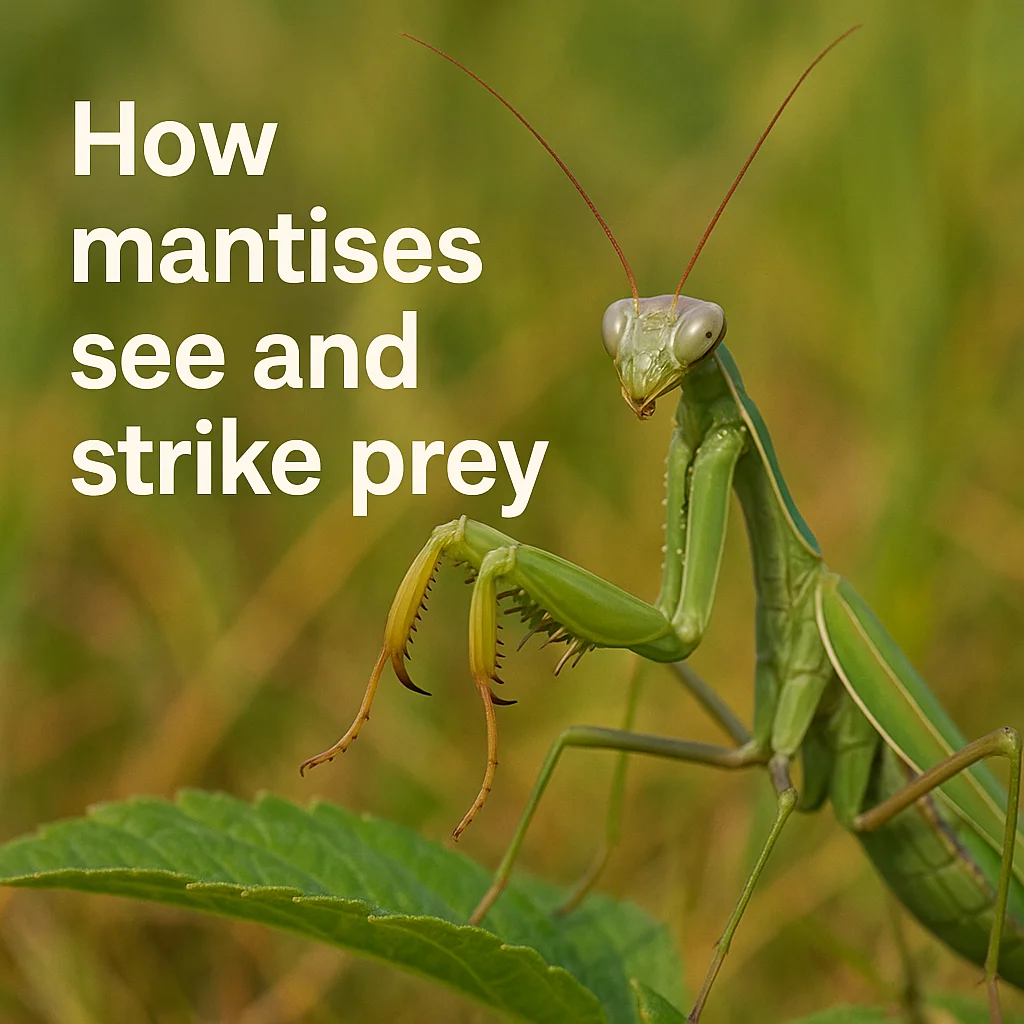
The mantis is easily recognizable by its raptorial forelegs, elongated body, and triangular head. Below are some identification tips to help you spot them.
- Top ID Tips:
- Triangular head with large eyes
- Long, slender body with elongated thorax
- Raptorial forelegs configured for grasping
- Wings generally folded around body (if not absent)
- Slow, deliberate movement style
- Distinguished from stick insects by shorter body and presence of wings
🧠 Basic Body Structure
Mantises showcase the basic structure typical of insects, which includes three main body segments: head, thorax, and abdomen. They have six legs and wings, though in some species the wings are reduced or absent. Mantises are charismatic as invertebrates, meaning they have an exoskeleton rather than a backbone. This exoskeleton must be periodically shed through molting to allow for growth.
🌍 Habitat & Distribution
Mantises inhabit a wide range of environments, preferring spaces where they can blend into the surroundings while hunting or avoiding predators. They are found in grasslands, forests, gardens, and sometimes urban areas. Typical microhabitats include under leaves, among branches, or even on flowers where they await prey. Their distribution is broad, living in almost any region that offers a warm climate.
📅 Seasonal Appearance & Activity
Mantises are generally most visible during the warmer months when they can be found actively hunting during the day. They are diurnal creatures, which means they are active during daylight hours. Weather patterns, like warmth and humidity, may influence their activity levels.
- Best Time to Spot It:
- Warm spring and summer months
- During daylight hours
- After rain when prey is abundant
🥚 Reproduction & Egg-Laying
Mantises engage in visually fascinating courtship displays. Mating involves the transfer of spermatophores from male to female. Females often lay their eggs in a foam-like substance that hardens into a protective case known as an ootheca. This is commonly attached to plant stems or under leaves. Egg-laying strategies and numbers can vary widely among different species of mantis.
🌀 Metamorphosis & Life Cycle
Mantises undergo incomplete metamorphosis, which includes three stages: egg, nymph, and adult. Nymphs hatch from the eggs in a form that resembles small adults but without fully developed wings. They mainly use stealth to ambush prey, feeding opportunistically on insects smaller than themselves. With each molt, nymphs grow in size and gradually acquire the adult features, including wings in species that have them. The life cycle duration varies but generally spans one to six months.
🍽️ Diet & Feeding Behavior
Mantises are primarily carnivorous and are well-equipped predators in the insect world. They feed using their strong, spiny front legs to grasp and hold onto prey while consuming it with chewing mouthparts. Mantises typically prey on insects such as flies, crickets, and other small arthropods, playing an essential role in controlling pest populations.
🦉 Predators & Defense
Mantises are preyed upon by various birds, reptiles, amphibians, and larger arthropods. As a defense mechanism, many mantises use camouflage to blend into their surroundings. Some species may have defensive displays, showing off bright colors on their wings to startle predators. The tough exoskeleton offers some level of protection against minor predators.
- Defense Highlights:
- Excellent camouflage abilities
- Startle displays with wings
- Quick reflexes to grasp or escape predators
- Use of natural cover in their habitat
👥 Social Behavior & Swarms
Mantises are largely solitary insects, coming together primarily for mating purposes. They do not form swarms, and their interactions are limited to occasional mating encounters and competition over territory or food resources.
🧭 Senses & Communication
Mantises have highly developed vision, relying on their pair of compound eyes to detect movement from afar. They also utilize smell and vibrations to perceive their environment. While not known for elaborate communication, mantises rely on body language and positioning during their sporadic interactions.
🌱 Role in the Ecosystem
Mantises serve vital ecological roles, particularly in controlling insect populations. As efficient predators, they help balance ecosystems by consuming pests that might otherwise damage vegetation or crops. Though not primary pollinators, their movement between plants may sometimes contribute to pollination inadvertently.
📉 Population & Conservation Notes
The population status of mantises varies regionally. In many areas, they are common in suitable habitats but face threats from habitat loss, pesticide use, and changes in climate. Data on specific population trends can be limited but supporting native habitats helps maintain healthy populations.
- How to Help (Low-Impact):
- Plant native vegetation in gardens
- Avoid using chemical pesticides
- Preserve natural habitats
- Leave fallen leaves and branches in gardens
- Create insect-friendly environments
⚠️ Human Interaction & Safety
Mantises are generally harmless to humans. They do not sting or possess venomous bites, making them safe to observe respectfully in the wild. Should an individual come into contact with mantis defense displays, it should be considered harmless. Observing mantises from a distance and appreciating their role in nature without interference is recommended.
📌 Summary
- Recognizable for their triangular heads and raptorial forelegs
- Found in a variety of warm habitats where they act as predators
- Most active and visible during warm daytime hours in spring/summer
- Experience incomplete metamorphosis from egg to nymph to adult
- Carnivorous feeders essential for pest control
- Solitary creatures with excellent camouflage and defensive displays
- Play a vital role in maintaining ecosystem balance
- Safe to observe, beneficial to gardens, and require conservation efforts