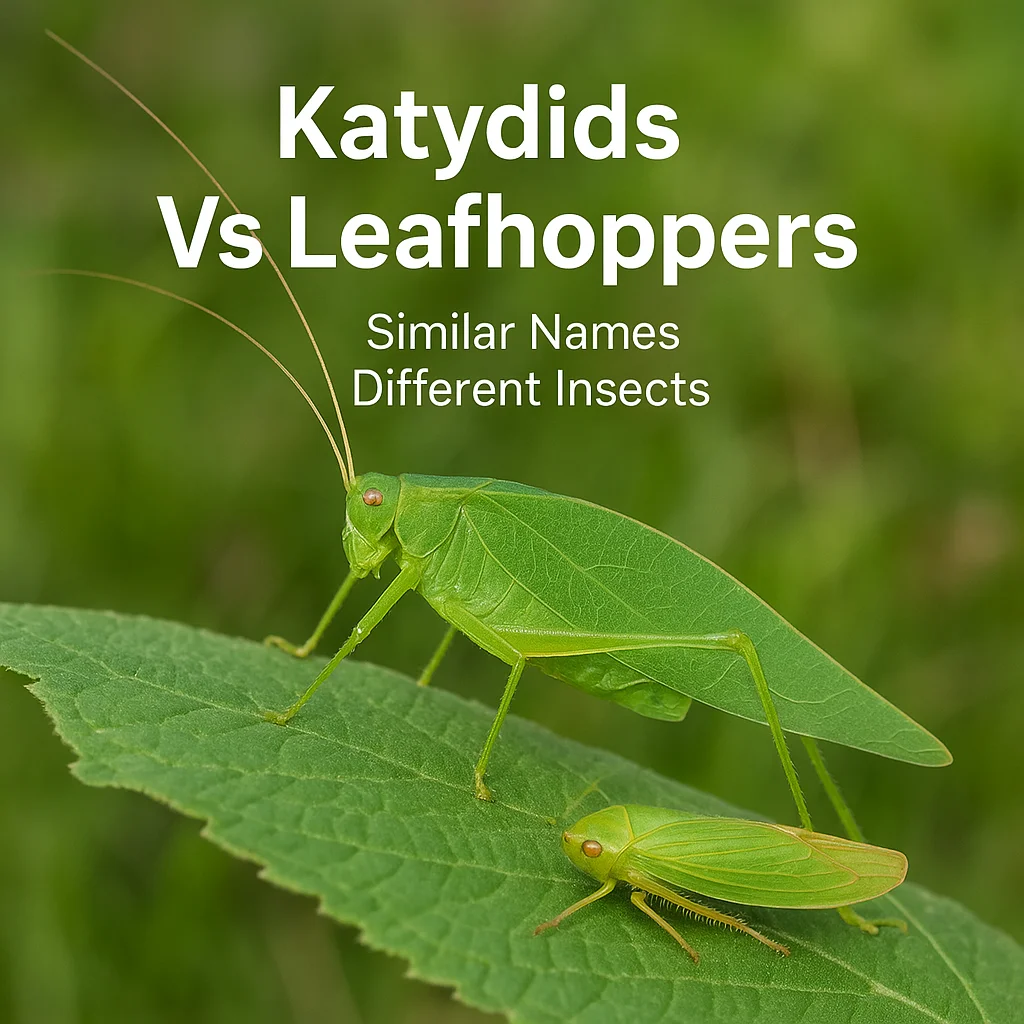
🕷️ Katydids Vs Leafhoppers Similar Names Different Insects
🧾 Quick Facts
Katydids and leafhoppers may share some similarities in name and occasionally in appearance, but they belong to different families and play distinct roles in their ecosystems. This profile highlights the basic differences and interesting facts about these two groups of insects.
- Common names: Katydids also known as "bush crickets," and leafhoppers
- Scientific name: Varies
- Insect or not: Both are insects and therefore invertebrates
- Order / Family: Katydids belong to the order Orthoptera, family Tettigoniidae; Leafhoppers are in the order Hemiptera, family Cicadellidae
- Typical size range (adult): Katydids: 1 to 5 cm, Leafhoppers: 0.3 to 1.5 cm
- Key colors/patterns: Katydids: green, brown; Leafhoppers: varied, often bright colors
- Activity: Katydids are mostly nocturnal, leafhoppers are usually diurnal
- Typical habitats: Katydids favor forests, leaf litter; Leafhoppers can be found on grasses, plants
- Where in the world it occurs: Katydids: worldwide except Antarctica; Leafhoppers: globally
- Seasonality: Most visible in warm months
🔍 Identification
Recognizing katydids and leafhoppers in the field requires understanding their distinct features.
Katydids typically have a robust body, with a noticeable resemblance to leaves. Their antennae are long and filamentous. The wings are either long or short, with a camouflage pattern typically matching their habitat, and they have powerful hind legs well suited for jumping.
Leafhoppers often have wedge-shaped bodies and shorter antennae. Their wings are held roof-like over the abdomen, and they possess strong hind legs for jumping. The variety in coloration can make them diverse in appearance.
- Katydids have long antennae, while leafhoppers have shorter antennae.
- Katydids' leaf-like appearance aids in camouflage.
- Leafhoppers show vibrant colors, unlike the typically green or brown katydids.
- Both have powerful hind legs suited for jumping.
- Katydids are nocturnal, seen at night, leafhoppers are diurnal.
- Katydids are larger in size than leafhoppers.
- Leafhopper wings may have striking patterns.
🧠 Basic Body Structure
Both katydids and leafhoppers share the common insect anatomy which includes the head, thorax, and abdomen, complemented by six legs. They possess an exoskeleton that provides protection and support. Katydids and leafhoppers both undergo molting to allow growth. Katydids have wings that can either be fully functional or reduced, while leafhoppers typically have functional wings.
As insects, both katydids and leafhoppers are invertebrates, meaning they lack a backbone and rely on their exoskeleton for structure and defense.
🌍 Habitat & Distribution
Katydids generally inhabit forests, shrublands, and gardens, thriving among dense vegetation where their coloring provides camouflage. Some species prefer open grasslands or savannas.
Leafhoppers, on the other hand, are versatile and can be found in a range of habitats, including grasslands, agricultural fields, and gardens. They are commonly associated with plants they feed on.
Geographically, katydids and leafhoppers are found worldwide, from temperate to tropical climates, adapting to local environmental conditions. Habitat alterations such as deforestation or urbanization can impact their presence and abundance.
📅 Seasonal Appearance & Activity
Katydids are typically heard rather than seen during warm, summer nights. Leafhoppers are more active during the day, especially visible in the brightness of spring and summer.
Their activity tends to increase with favorable weather—warm temperatures and high humidity maximize their presence.
- Best seen during warm season.
- Katydids appear mostly at night.
- Leafhoppers are active throughout the day.
- Most prominent after rain when vegetation is lush.
- In temperate regions, late spring to early autumn is prime time.
🥚 Reproduction & Egg-Laying
Katydids have elaborate mating rituals that often involve sound production; males produce a chorus to attract females. Eggs are usually laid on plant material or inserted into plant tissue.
Leafhoppers rely on sound and vibration for mating signals. Their eggs are laid on or inside plant tissues, with each female laying numerous eggs during her lifespan.
The number of eggs laid and their development varies depending on the species and environmental conditions.
🌀 Metamorphosis & Life Cycle
Both insects undergo incomplete metamorphosis, consisting of three stages: egg, nymph, and adult.
The nymph stage closely resembles the adult but lacks wings and reproductive capability. Nymphs feed voraciously to fuel their growth, molting several times as they mature.
Completion of their life cycle, from egg to adult, can vary from weeks to months, influenced by environmental conditions and species-specific traits.
🍽️ Diet & Feeding Behavior
Katydids are primarily herbivorous, feeding on leaves, flowers, and occasionally small insects. They possess chewing mouthparts ideal for grinding vegetation.
Leafhoppers are equipped with piercing-sucking mouthparts, allowing them to feed on plant sap, which sometimes causes damage to host plants. As a result, they are considered minor pests in agriculture.
Both fulfill roles as herbivores within their ecosystems, with katydids occasionally acting as opportunistic predators.
🦉 Predators & Defense
Natural predators of katydids include birds, bats, small mammals, and arachnids. Leafhoppers face threats from similar predators, including predatory insects.
Katydids rely heavily on camouflage to blend into leafery, avoiding detection by predators. Leafhoppers employ their agility and speed as primary defense mechanisms.
Some species use mimicry and chemical deterrence to ward off threats.
- Camouflage techniques.
- Mimicry of vegetation.
- Quick jumping escapes.
- Katydids' sound production for distraction.
👥 Social Behavior & Swarms
Katydids are generally solitary creatures, only coming together during mating season or when abundant resources are available. Leafhoppers can exhibit aggregative behavior, not triggered by sociality but rather by resource availability.
Neither katydids nor leafhoppers are known to form swarms like locusts or other insects.
🧭 Senses & Communication
Katydids rely heavily on their auditory senses for communication, with males stridulating to attract females. Their hearing organs are located on their forelegs.
Leafhoppers use both visual signals and vibrations through plant surfaces to communicate, playing an essential part in their mating behavior.
Both groups possess well-developed vision and, in many cases, use pheromones for hunting mates or food sources.
🌱 Role in the Ecosystem
Katydids play a role as both herbivores and minor pollinators. Their feeding habits aid in plant population control, contributing to ecological balance.
Leafhoppers, influential in their roles as herbivores, can act as both pests and beneficial insects by subject to their relationships with host plants. They can also have indirect ecological impacts by transmitting plant pathogens, thereby influencing plant health and agriculture.
Both are crucial links in their respective food webs, serving as prey for numerous predators.
📉 Population & Conservation Notes
As a group, katydids are generally considered to be of low conservation concern, but specific species may be threatened by habitat loss and pesticide use. Leafhoppers are largely abundant; however, like katydids, they face population changes due to pesticide use and habitat alterations.
- Plant native vegetation to support a healthy ecosystem.
- Avoid using pesticides that harm non-target species.
- Retain leaf litter for habitat sheltering.
- Engage in conservation efforts for habitat preservation.
⚠️ Human Interaction & Safety
Neither katydids nor leafhoppers pose significant threats to humans. They are harmless and do not bite or sting. If handling is necessary, do so gently to avoid causing harm to these insects.
Observe these creatures respectfully in their natural environments, and avoid collecting wild specimens to contribute to biodiversity conservation.
📌 Summary
- Katydids and leafhoppers belong to different families but share similar names.
- Katydids have a leaf-like body shape and are nocturnal, while leafhoppers have varied colors and are diurnal.
- Both insects are herbivorous, with katydids also occasionally feeding on insects.
- Katydids use sound for mate attraction, leafhoppers use vibration communication.
- Both play essential roles in ecosystems as herbivores and prey.
- While generally common, habitat loss and pesticides pose threats to specific species.
- They are harmless to humans, offering excellent opportunities for learning through observation.