🕷️ Grasshoppers: jumping anatomy explained
🧾 Quick Facts
Grasshoppers are fascinating insects renowned for their remarkable jumping ability. This field guide profile will provide you with an understanding of their anatomy and life cycle, perfect for nature enthusiasts and budding entomologists.
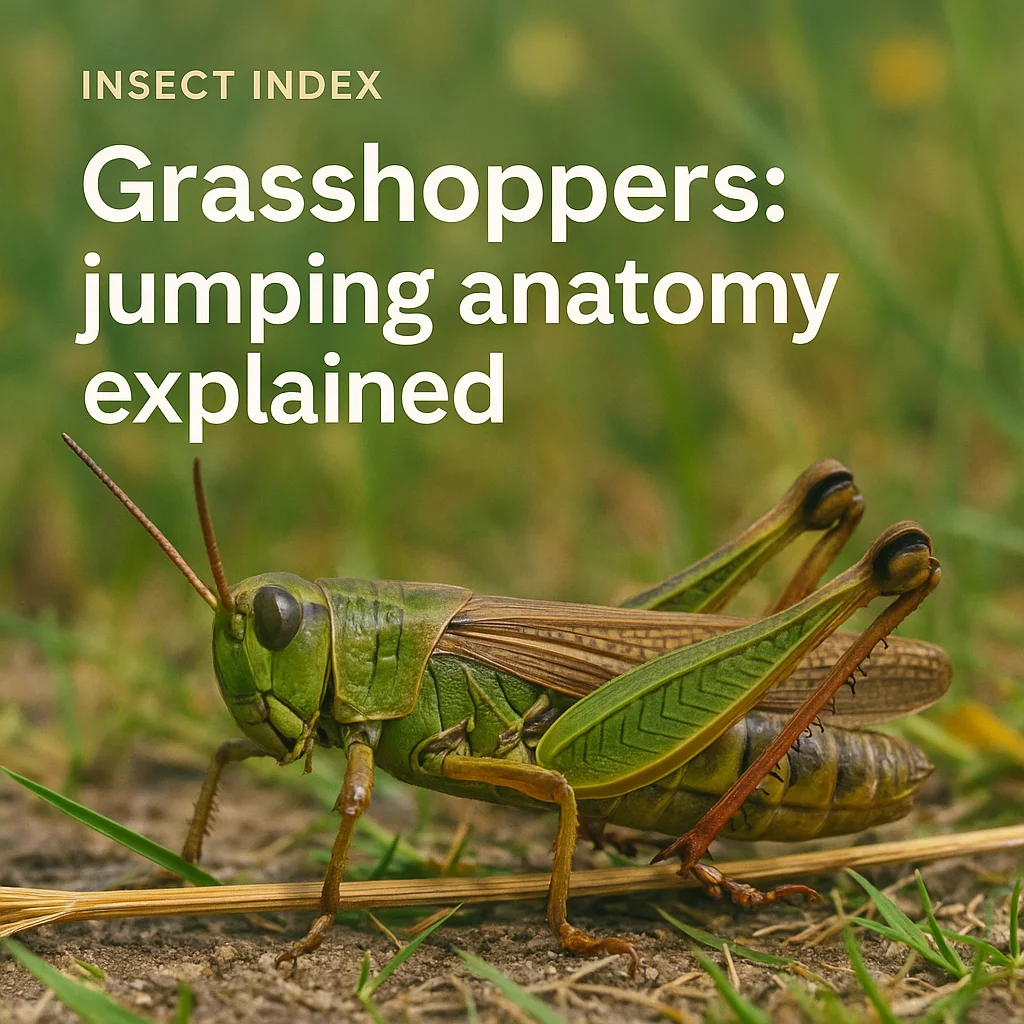
- Common names: Grasshopper
- Scientific name: Varies by species
- Insect: Yes, they are invertebrates
- Order / Family: Orthoptera / varies
- Typical size range (adult): 1–7 cm
- Key colors/patterns: Green, brown, gray with variations
- Activity: Diurnal (during the day)
- Typical habitats: Grasslands, forests, wetlands
- Where in the world it occurs: Worldwide, except Antarctica
- Seasonality: Most visible in warmer months
🔍 Identification
Recognizing grasshoppers in the field can be an intriguing challenge due to their varied appearances across different regions. Most share a similar body shape, distinct for their elongated bodies, strong hind legs, and relatively short antennae.
Their wings, when present, are folded over the body, with some species displaying colorful hind wings. Grasshoppers are adept jumpers, employing their powerful hind legs as a primary mode of movement.
Careful observation is required to distinguish grasshoppers from similar insects like crickets and locusts. Typically, grasshoppers have shorter antennae and different song patterns.
- Elongated abdomen and thorax
- Short antennae compared to crickets
- Powerful hind legs adapted for jumping
- Variety of body colors, primarily green and brown
- Folded wings with potential for colorful displays
- Distinctive jumping motion as key identifier
🧠 Basic Body Structure
Grasshoppers, like all insects, have three primary body parts: the head, thorax, and abdomen. They possess six legs and an exoskeleton that provides structural support and protection. As invertebrates, they lack a backbone.
Their exoskeleton must be periodically shed through a process known as molting, allowing the grasshopper to grow. Many species have wings, although not all use them for flight.
🌍 Habitat & Distribution
Grasshoppers thrive in a wide variety of environments, from open grasslands and savannas to woodlands and agricultural fields. They can be found on every continent except Antarctica, adapting well to diverse climates.
They favor areas where they have easy access to vegetation, both for food and for laying eggs. Changes in habitat such as urban development can affect their distribution and population density dramatically.
📅 Seasonal Appearance & Activity
Grasshoppers are most commonly observed during warmer months when temperatures are conducive to their activity. They are primarily active during the day, taking advantage of sunlight for warmth.
Weather can significantly influence their visibility; warm, dry conditions typically lead to higher activity levels.
- Most visible in summer
- Prefer warm, dry weather
- Diurnal activity pattern
- Less active in cold weather
🥚 Reproduction & Egg-Laying
Grasshopper courtship often involves visual and auditory signals, with males performing specific calls to attract females. Egg-laying typically occurs in soil, where the female deposits clusters of eggs.
The number of eggs can vary widely, often influenced by environmental conditions. They are generally laid in safe, secure places to protect against predators and extreme weather.
🌀 Metamorphosis & Life Cycle
Grasshoppers undergo incomplete metamorphosis, consisting of three stages: egg, nymph, and adult. Unlike complete metamorphosis, there is no pupal stage.
Nymphs are miniature versions of adults but lack fully developed wings. They molt several times, gradually developing into full-grown grasshoppers. Diet during all life stages primarily consists of plant material, often grasses and leaves.
🍽️ Diet & Feeding Behavior
Their feeding behavior categorizes them as herbivores, primarily consuming a diet of grasses, leaves, and other vegetation. Grasshoppers use chewing mouthparts to efficiently process plant material.
They play a crucial role in their ecosystems as primary consumers and can influence the composition and distribution of plant life.
🦉 Predators & Defense
Grasshoppers face predation from a variety of animals, including birds, reptiles, amphibians, and spiders. They employ several defense mechanisms to evade capture.
Camouflage is a key strategy; their coloring often blends with their environment. Some species will actively jump to escape threats, utilizing their strong hind legs. Others may use startling displays or noxious chemicals to deter predators.
- Effective camouflage
- Swift jumping escape
- Startle displays with wings
- Chemical deterrents in some species
👥 Social Behavior & Swarms
Grasshoppers are typically solitary insects. However, certain conditions can lead to swarm behavior, notably when resources are plentiful. Such swarms are often temporary.
During mating seasons, temporary aggregations can occur. The triggers for swarm formation are complex and can include environmental factors like food availability and weather conditions.
🧭 Senses & Communication
Grasshoppers possess several sensory adaptations for navigation and communication. They rely on eyesight for detecting movement and potential mates. Through sound production known as stridulation, they create calls to communicate, especially during mating.
Vibration sensing aids in detecting predators and other environmental cues, ensuring they remain alert to dangers in their surroundings.
🌱 Role in the Ecosystem
Grasshoppers are vital components of their ecosystems. As herbivores, they help regulate plant growth and contribute to nutrient cycling. They are also essential prey for a range of predators, forming a crucial link in the food web.
Their presence can indicate ecosystem health, as they respond quickly to changes in environmental conditions. Their population dynamics, however, can sometimes lead to agricultural impacts, necessitating management efforts.
📉 Population & Conservation Notes
While many grasshopper species are common and resilient, some are affected by threats like habitat destruction and pesticide use. Climate change also poses challenges, altering their habitats and contributing to population fluctuations.
Conservation efforts focus on sustainable practice and habitat preservation to ensure these insects continue to thrive.
- Encourage native plant growth
- Minimize pesticide use
- Preserve natural habitats
- Support ecosystem health
⚠️ Human Interaction & Safety
Grasshoppers generally pose little threat to humans. They do not typically bite, and interactions can often be peaceful. Nevertheless, handling them is usually discouraged to avoid stress to the insect.
For those who experience allergies or negative reactions upon contact, it is advisable to wash the affected area and consult a professional if severe symptoms occur. Observing these insects respectfully in their natural habitats helps to promote their conservation.
📌 Summary
- Grasshoppers are diverse and widely distributed insects.
- They thrive in open, vegetative habitats worldwide.
- Active primarily during warm, daylight hours.
- Undergo incomplete metamorphosis: egg, nymph, adult.
- Legs adapted for powerful jumps as a key ID feature.
- Feeding: primarily herbivorous, consuming grasses and leaves.
- Predators include birds, reptiles, and amphibians.
- Play an important role in plant control and food webs.
- Population dynamics influenced by environmental changes.
- Low human threat but worthy of ecological respect.