🕷️ Grasshoppers in agriculture: damage overview
🧾 Quick Facts
Grasshoppers, belonging to the order Orthoptera, are common insects known for their jumping ability and impact on agriculture. Here is a quick overview of these intriguing creatures often linked to crop damage.
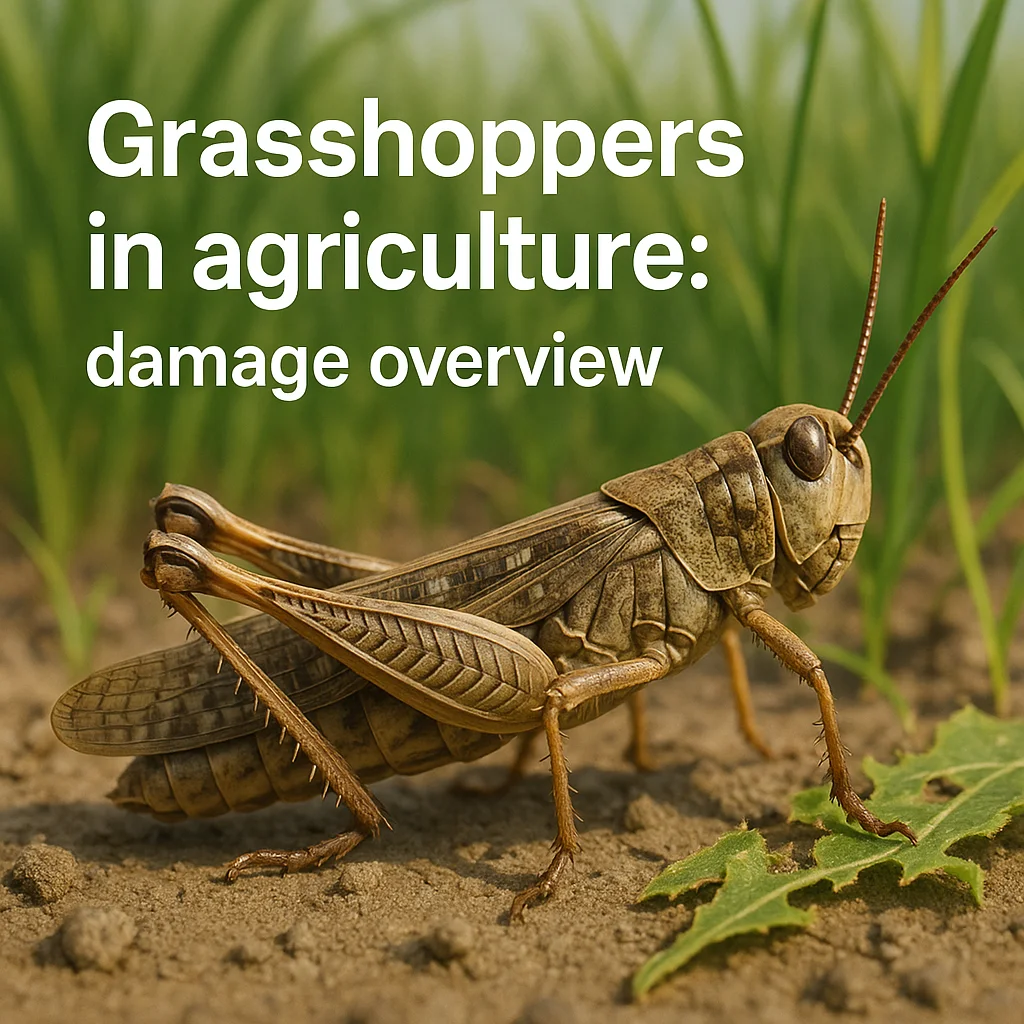
- Common names: Grasshoppers, Locusts (when swarming)
- Scientific name: Varies
- Insect or not: Insect (invertebrate)
- Order / family: Orthoptera / Acrididae (varies)
- Typical size range: 1.5 to 4 inches (4-10 cm)
- Key colors/patterns: Green, brown, yellow, with some having stripes
- Activity: Primarily diurnal
- Typical habitats: Grasslands, fields, forests, even urban gardens
- Where in the world it occurs: Almost all continents, primarily in temperate and tropical regions
- Seasonality: Most active in the warmer months, typically spring to fall
🔍 Identification
Grasshoppers are easily recognized by their elongated bodies, large hind legs adapted for jumping, and relatively short antennae. Their wings, when present, are covered by a harder forewing with a more flexible hindwing underneath, aiding in flight. Grasshoppers are often confused with crickets or katydids, which have different body proportions and longer antennae.
- Top ID Tips:
- Elongated, cylindrical body shape
- Short antennae that usually do not exceed half their body length
- Visible hind legs adapted for jumping
- Usually muted colors blending with vegetation
- Forewings thicker, protecting the more functional hindwings
- Lack of long antennae typical of crickets or katydids
🧠 Basic Body Structure
As insects, grasshoppers have the typical tripartite body structure: head, thorax, and abdomen, and are equipped with an exoskeleton that they shed as they grow. They possess six legs, with the hind pairs much larger and stronger than the forelegs. Grasshoppers are invertebrates, meaning they lack a backbone and rely on their exoskeleton for structural support.
🌍 Habitat & Distribution
Grasshoppers thrive in a variety of environments, including fields, meadows, and open forests. They prefer areas with ample vegetation for feeding and are often found in large numbers in grasslands. Microhabitats include leafy canopies and underbrush. They are distributed widely across continents, enjoying both temperate and tropical climates. Changes in land use and climate can alter their distribution and abundance.
📅 Seasonal Appearance & Activity
Grasshoppers are primarily visible during warmer months, often from spring through fall. They are most active during the day and prefer sunny conditions, becoming less active in cooler or rainy weather.
- Best Time to Spot It:
- Spring to early fall
- Warm, sunny days
- Midday, when temperatures peak
- After rainy seasons when vegetation is abundant
🥚 Reproduction & Egg-Laying
Grasshopper mating involves males attracting females through visual displays and sound production, often by rubbing their hind legs against their forewings. Females lay eggs in pods within soil or under vegetation, as this offers protection. The number of eggs varies with species and environmental conditions but may range from dozens to hundreds per batch.
🌀 Metamorphosis & Life Cycle
Grasshoppers undergo incomplete metamorphosis, with three main stages: egg, nymph, and adult. Eggs overwinter in soil and hatch in spring as nymphs. Nymphs resemble miniature adults but without wings, growing through successive molts until reaching full size.
Nymphs feed on plant matter, affecting crops from emergence through several molts. The total life cycle from egg to adult can take a few months, although this can vary depending on species and environmental conditions.
🍽️ Diet & Feeding Behavior
Grasshoppers are primarily herbivores, feeding on a wide range of grasses and leafy plants at all life stages. They possess powerful mandibles for chewing through vegetation. While their direct impact as plant consumers is significant, they also play roles in controlling plant growth and contributing to the nutrient cycle.
🦉 Predators & Defense
Grasshoppers face predation from birds, reptiles, spiders, and small mammals. They employ various defensive tactics such as camouflage and their remarkable jumping ability to escape threats. Some species may have bright warning colors that deter predators or emit defensive odors when threatened.
- Defense Highlights:
- Camouflage with their environment
- Powerful hind-leg jumps for escape
- Some species exhibit startle displays
- Emit chemical deterrents (varies)
👥 Social Behavior & Swarms
Grasshoppers are typically solitary, but under certain conditions, they can form large groups or swarms, often referred to as locusts. Swarming is usually triggered by environmental cues such as population density, food availability, and weather conditions, leading to locusts moving en masse across regions, dramatically increasing their impact on agriculture.
🧭 Senses & Communication
Grasshoppers rely on a strong sense of vision and sound. They communicate through stridulation, producing sounds by rubbing their legs or wings. This communication plays a significant role in attracting mates and signaling territory. Chemical signals are also crucial for swarm coordination.
🌱 Role in the Ecosystem
In their ecological role, grasshoppers act as both consumers and prey within food webs. They contribute to the breakdown of plant matter, aiding decomposition and nutrient cycling in ecosystems. While large populations can damage crops, they also serve as a critical food source for a variety of wildlife, maintaining the ecological balance.
📉 Population & Conservation Notes
Grasshopper populations are generally common in suitable habitats. However, they face threats from habitat loss, pesticide use, and climate change, which can alter their habitats and life cycles. While some species are abundant enough to become agricultural pests, others help maintain ecological balance.
- How to Help (Low-Impact):
- Plant native vegetation to support diverse insect life
- Practice organic farming to reduce pesticide use
- Allow natural vegetation borders in gardens and fields
- Encourage habitat conservation through local initiatives
⚠️ Human Interaction & Safety
Generally, grasshoppers are harmless to humans and do not bite or sting. If swarms arise, they can become agricultural pests, causing significant damage to crops. While observing these insects, it is important to respect their role in nature and avoid capturing or disturbing them unnecessarily.
📌 Summary
- Recognizable by their elongated body and jumping legs
- Commonly found in grasslands and fields during warmer months
- Undergo incomplete metamorphosis: egg, nymph, adult
- Herbivores feeding on plant matter; significant crop impact when swarming
- Preyed upon by birds, reptiles, and mammals
- Serve vital ecological roles in nutrient cycling and food webs
- Population influenced by habitat changes and climate conditions
- Observe respectfully and support sustainable agricultural practices