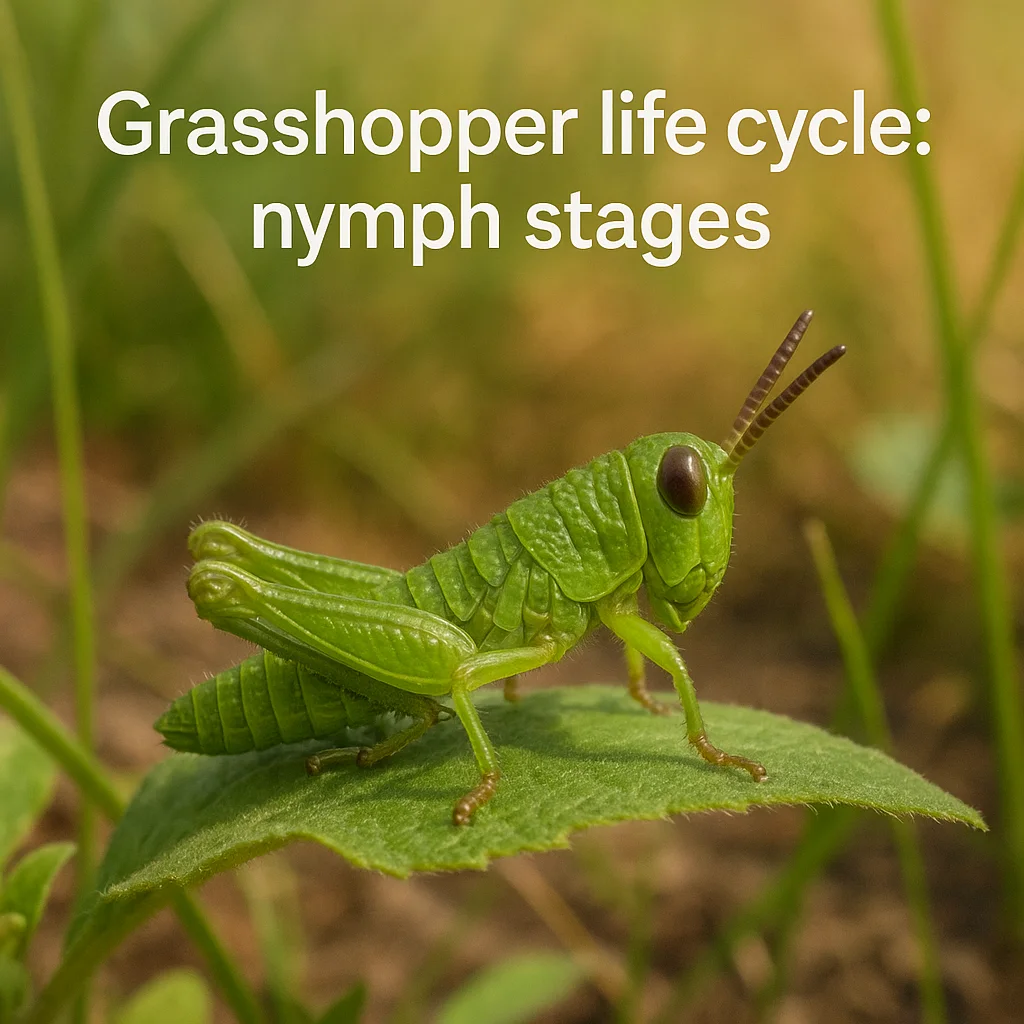
🕷️ Grasshopper life cycle: nymph stages
🧾 Quick Facts
The grasshopper is a fascinating insect found in numerous habitats around the world. Known for their powerful legs and agile jumping ability, grasshoppers are a common sight in many natural settings.
- Common names: Grasshopper, Orthoptera
- Scientific name: Varies by species
- Insect or not: Yes, it is an invertebrate
- Order / family: Orthoptera / Acrididae
- Typical size range (adult): 1 to 4 inches
- Key colors/patterns: Green, brown, camouflaged patterns
- Activity: Diurnal (active during the day)
- Typical habitats: Grasslands, forests, agricultural fields
- Where in the world it occurs: Worldwide, except Antarctica
- Seasonality: Most active during warm months
🔍 Identification
Grasshoppers are easily recognized by their elongated bodies, prominent hind legs, and relatively short antennae. They exhibit a shape that is aerodynamic with a prominent head, thorax, and abdomen. The wings are folded neatly over their back, allowing them to jump and fly effectively. The hind legs are specialized for jumping, making grasshoppers capable of covering significant distances in a single leap.
- Top ID Tips:
- Elongated body with segmented thorax and abdomen
- Short, robust antennae
- Strong, long hind legs specially adapted for jumping
- Wings present, folded flat over back
- Coloration helps with camouflage in vegetation
- Can be confused with locusts; distinguishable by behavior and regions
- Smaller and different antennal structure compared to katydids
- Movement style: short flights interspersed with jumps
🧠 Basic Body Structure
Grasshoppers have a typical insect body structure consisting of a head, thorax, and abdomen. They have six legs, with the hind pair being significantly larger and more powerful, adapted for jumping. Grasshoppers possess an exoskeleton that provides protection and support. They undergo molting as they grow, shedding their exoskeletons to allow further development. Grasshoppers are invertebrates, meaning they lack a backbone.
🌍 Habitat & Distribution
Grasshoppers thrive in a variety of habitats including grasslands, forests, and agricultural fields. They can also be found in urban gardens and other areas with abundant vegetation. Grasshoppers prefer environments with plenty of food resources and adequate shelter. They are adaptable and are found on every continent except Antarctica. Their habitat preferences can dictate their abundance and sightings in different regions.
📅 Seasonal Appearance & Activity
Grasshoppers are most visible during the warmer months, when they are actively feeding and reproducing. They are diurnal creatures, most active during daylight hours. Temperature and humidity can influence their activity, with optimal conditions occurring during warm and moderately humid weather.
- Best Time to Spot It:
- Spring through late summer
- During midday when sun is at peak
- Warm, sunny weather facilitates visibility
- After rainfall when vegetation is lush
🥚 Reproduction & Egg-Laying
Grasshopper mating involves courtship behaviors, often including sound signaling or visual displays. After mating, females lay eggs in the soil, preferring soft, moist ground. This strategic egg-laying helps protect the offspring from environmental extremes. The number of eggs per clutch varies, typically ranging from tens to hundreds depending on the species and environmental conditions.
🌀 Metamorphosis & Life Cycle
Grasshoppers undergo incomplete metamorphosis which consists of three stages: egg, nymph, and adult. Nymphs bear a strong resemblance to adult grasshoppers but are smaller and lack fully developed wings. The nymph stage involves multiple molts, during which the insect grows and gradually develops more adult-like features. This stage can last from several weeks to months, depending on the species and environmental factors.
🍽️ Diet & Feeding Behavior
Grasshoppers are primarily herbivorous, feeding on a variety of plants and grasses. They use chewing mouthparts to consume leaves and stems. As nymphs, they feed voraciously to fuel their growth and development. As adults, they continue to feed on vegetation, often in sizable amounts. While they are not typically predators, their feeding can sometimes impact agriculture negatively.
🦉 Predators & Defense
Grasshoppers face numerous natural predators including birds, reptiles, amphibians, spiders, and parasitoid wasps. To avoid predation, they employ various defense mechanisms such as camouflage and mimicry, blending into their environment to avoid detection. Some species may also use startle displays by flashing bright wing colors to deter predators.
- Defense Highlights:
- Camouflage in natural surroundings
- Startle displays with wings
- Quick escape through jumping and short flights
- Predator confusion due to group movement
- Armor-like exoskeleton provides protection
👥 Social Behavior & Swarms
Grasshoppers are primarily solitary, but some species can form swarms, notably the locusts (a type of grasshopper). These swarms can travel long distances and are typically triggered by environmental factors like drought or population density increase. In such cases, swarming is a survival strategy for finding new food sources.
🧭 Senses & Communication
Grasshoppers rely on multiple senses for survival. Their vision is well-developed, allowing them to detect movement and light changes. They use antennae for smell and to detect pheromones. Grasshoppers also communicate through stridulation, where sound is produced by rubbing body parts together. This is often used in mating calls and territorial displays.
🌱 Role in the Ecosystem
Grasshoppers play a significant role in ecosystems as primary herbivores, influencing plant community dynamics. They serve as a crucial food source for a variety of predators, contributing to the energy flow within food webs. While they can be agricultural pests, consuming crops, they also participate in natural plant regulation and serve as prey items for beneficial wildlife.
📉 Population & Conservation Notes
Grasshopper populations are generally abundant and not currently threatened. However, specific species may be affected by habitat loss, pesticide use, and climate change. Monitoring population trends is essential for understanding their ecological impacts and conservation needs.
- How to Help (Low-Impact):
- Promote habitat diversity with native plants
- Minimize pesticide use in gardens and agriculture
- Preserve grassland habitats
- Encourage organic farming practices
⚠️ Human Interaction & Safety
Grasshoppers do not pose a significant threat to humans. They can bite if handled improperly, but such incidents are rare and generally harmless. If bitten, washing the area with soap and water is advised. For severe reactions, seek professional advice. Observing grasshoppers respectfully and from a distance can ensure safe interaction and minimize stress on the insects.
📌 Summary
- Recognizable by robust body, long hind legs
- Adapt to grasslands and diverse habitats worldwide
- Active during warm months, when they can be easily spotted
- Incomplete metamorphosis with visible nymph stages
- Primarily herbivores impacting plant community dynamics
- Prey for multiple natural predators
- Play an essential ecological role within food webs
- Human interactions are generally safe and educational