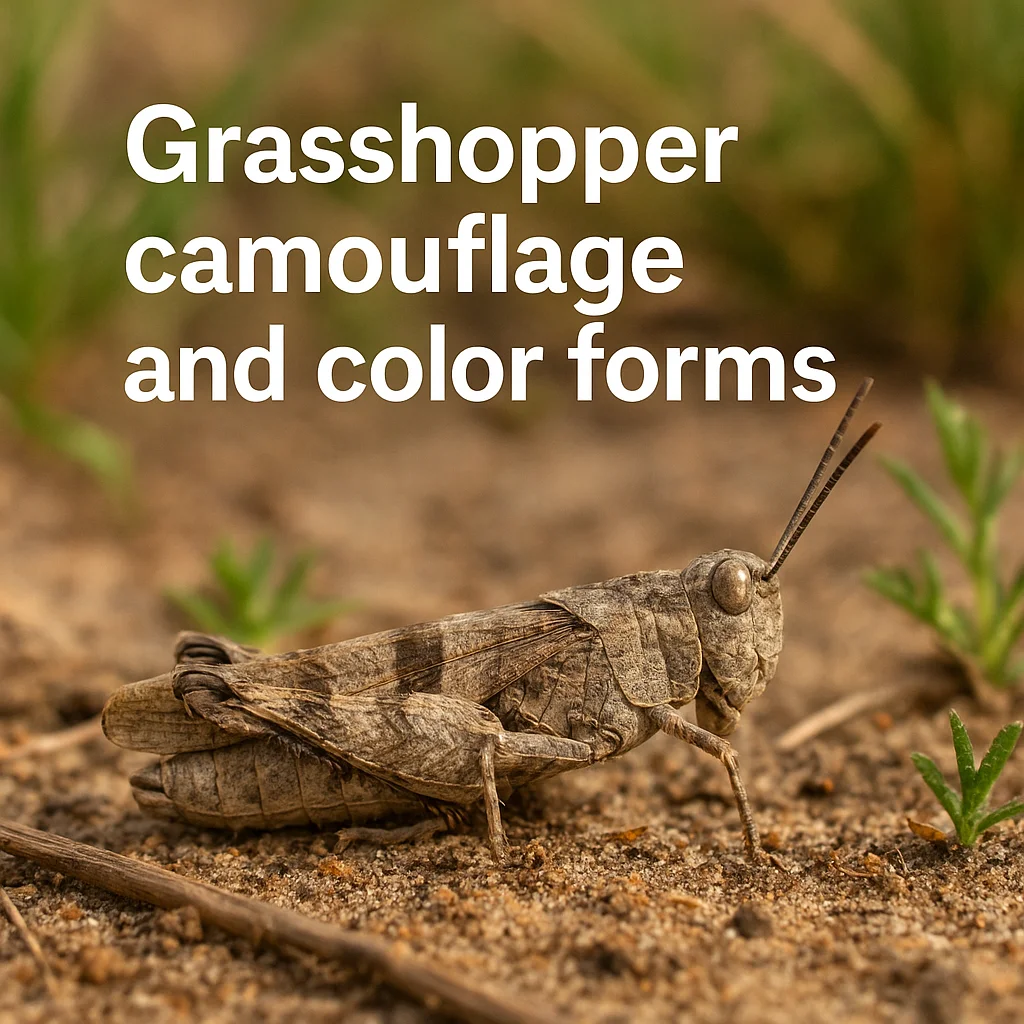
🕷️ Grasshopper camouflage and color forms
🧾 Quick Facts
Grasshoppers are fascinating insects known for their remarkable ability to blend into their environments through various camouflage and color forms. They belong to a diverse group with varying adaptations depending on the region they inhabit.
- Common names: Grasshopper, locust (for swarming species)
- Scientific name: Varies by species
- Insect or not: Insect; invertebrate
- Order / family: Orthoptera / Acrididae
- Typical size range (adult): 1 to 4 inches (2.5 to 10 cm)
- Key colors/patterns: Green, brown, gray, striped, spotted
- Activity: Diurnal (active during the day)
- Typical habitats: Grasslands, forests, agricultural fields, deserts
- Where in the world it occurs: Globally, except Antarctica
- Seasonality: Most visible in warm weather months
🔍 Identification
Grasshoppers can be recognized in the field by their robust bodies, elongated hind legs used for jumping, and their tendency to be found in areas with ample vegetation.
- Body shape and silhouette: Cylindrical body with pronounced hind legs
- Antennae type: Short and filamentous in most species
- Wing features: Some have fully developed wings, others have reduced or no wings
- Leg traits and movement style: Strong hind legs for jumping
- Distinguishing look-alikes: May be confused with crickets and katydids
- Top ID Tips:
- Look for robust body and large hind legs
- Note short antennae compared to crickets
- Varied color forms adapted to local environments
- Check for presence of wings and their length
- Presence in open, vegetated areas
- Characteristic quick movements
🧠 Basic Body Structure
Grasshoppers, like all insects, have a body divided into three main parts: the head, thorax, and abdomen. They possess six legs, a defining feature of insects, and a hard outer exoskeleton that they molt as they grow.
Grasshoppers are invertebrates, meaning they do not have a backbone. Their exoskeleton provides the necessary support and structure.
🌍 Habitat & Distribution
Grasshoppers are commonly found in varied habitats, including grasslands, forests, agricultural fields, and even deserts. They thrive in environments where there is ample vegetation to feed on and space to jump and navigate.
Microhabitats like the underside of leaves and within tall grasses are common, providing them shelter and protection from predators. They occur worldwide, experiencing habitat changes due to human activities and climate variations.
📅 Seasonal Appearance & Activity
Grasshoppers are mostly active during warmer months, typically from spring through fall. They are diurnal, basking in the sun and maximizing their feeding opportunities during daylight.
- Best Time to Spot It:
- Spring and summer months
- During dry, warm weather
- Midday when the sun is out
- In fields with plenty of grasses and shrubs
🥚 Reproduction & Egg-Laying
Mating behavior in grasshoppers often involves males producing sounds to attract females, a process known as stridulation. Eggs are typically laid in the soil, where they are protected until they hatch.
The number of eggs laid varies by species, with some laying in clusters to increase survival chances.
🌀 Metamorphosis & Life Cycle
Grasshoppers undergo incomplete metamorphosis, progressing through the stages of egg, nymph, and adult. Nymphs, resembling small adults, lack wings and undergo several molts.
Nymphs feed on the same vegetation as adults, growing larger with each molt until they reach adulthood, a process that can last several weeks to months, depending on the climate and species.
🍽️ Diet & Feeding Behavior
Grasshoppers are herbivores, primarily consuming leaves, grasses, and other plant materials throughout their life. Their chewing mouthparts are highly adapted to their plant-based diet.
In ecosystems, they serve an essential role as primary consumers and occasionally prey. Their feeding can influence plant community structures.
🦉 Predators & Defense
Grasshoppers face predation from birds, reptiles, amphibians, spiders, and mammals. They employ various defense strategies, including camouflage, rapid jumping, and sometimes loud chirping to startle predators.
- Defense Highlights:
- Effective camouflage with surrounding environment
- Sudden, powerful jumps to escape
- Startle displays with wing coloration
- Hiding in dense foliage or under leaves
👥 Social Behavior & Swarms
Most grasshoppers are solitary; however, some species can form swarms, particularly under certain environmental conditions. Swarming behavior, seen in locusts, is triggered by crowding and can lead to massive migrations.
🧭 Senses & Communication
Grasshoppers have well-developed senses for navigation and communication. They use sight and vibration to detect threats and find mates. Sound production, primarily through stridulation, helps in attracting females and warding off rivals.
🌱 Role in the Ecosystem
Grasshoppers play a crucial role in the ecosystem as primary herbivores, helping control plant populations. They are also a vital food source for various predators, linking different trophic levels within food webs.
Their feeding can impact agriculture, sometimes decreasing crop yields during population booms, but they also contribute to nutrient cycling in natural settings.
📉 Population & Conservation Notes
Grasshopper populations fluctuate widely depending on environmental conditions. They are generally common but can be threatened by habitat destruction, pesticide usage, and climate change.
- How to Help (Low-Impact):
- Plant native flora to provide habitat
- Avoid using pesticides in gardens
- Leave leaf litter for natural habitat cover
- Encourage local biodiversity with pollinator gardens
⚠️ Human Interaction & Safety
Grasshoppers do not bite or sting humans. They are generally harmless but can be considered agricultural pests under outbreak conditions. Observers should enjoy watching them without attempting to collect, as they are essential parts of their local ecosystems.
For those handling them, it's always wise to wash hands to avoid irritation from plant residues or allergens they may carry.
📌 Summary
- Grasshoppers are adaptable insects with diverse color forms
- Found in grasslands and forests worldwide
- Most active during warm, sunny months
- Undergo incomplete metamorphosis with nymph stages
- Herbivorous diet impacts vegetation dynamics
- Prey for various predators; rely on camouflage and jumping for defense
- Occasional agricultural pests, essential for ecosystem health
- Enjoy without collecting; contribute to native plant preservation