🕷️ Jerusalem Crickets Big-headed Burrowers Explained
🧾 Quick Facts
The Jerusalem Cricket, known for its distinct, large head, is a fascinating insect native to parts of the Americas. Contrary to its name, it is neither from Jerusalem nor a true cricket.
- Common names: Jerusalem Cricket, Potato Bug, Niño de la Tierra
- Scientific name: Stenopelmatus spp. (varies by species)
- Insect or not: Yes, it is an insect, a type of orthopteran
- Order / family: Orthoptera / Stenopelmatidae
- Typical size range (adult): 3 to 5 cm long
- Key colors/patterns: Brown, amber, with striped abdomen
- Activity: Nocturnal
- Typical habitats: Underground burrows in soil
- Where in the world it occurs: Western United States, Mexico, and parts of Central America
- Seasonality: Most visible in the spring and summer
🔍 Identification
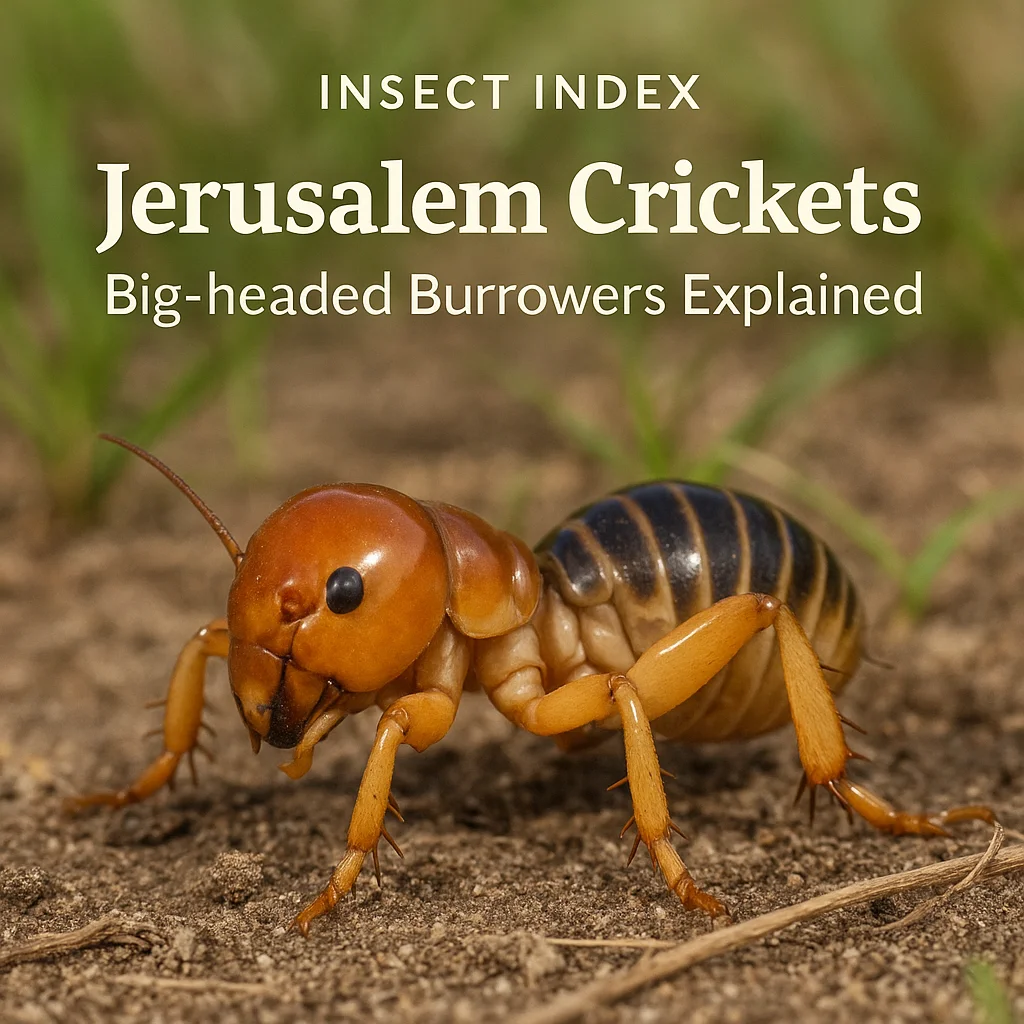
Jerusalem Crickets are easily recognizable by their large, rounded head and stout body. They lack wings, setting them apart from true crickets. Their antennae are pronounced, and their powerful legs are well-suited for digging.
- Top ID Tips:
- Large, bulbous head
- Brown, glossy body with striped abdomen
- Thick legs adapted for burrowing
- No wings; wingless appearance
- Robust, cylindrical body
- Nocturnal presence
- Lack of jumping ability; contrary to typical cricket behavior
🧠 Basic Body Structure
Jerusalem Crickets exhibit the fundamental characteristics of insects, including a distinct head, thorax, and abdomen. They have six legs, with the forelegs specialized for digging. As invertebrates, they have an external skeleton known as an exoskeleton, which they periodically molt to grow. They are wingless and heavily rely on their sense of touch and vibration over other senses.
🌍 Habitat & Distribution
Preferring loose, rich soil, Jerusalem Crickets dwell in areas such as gardens, fields, and beneath logs or stones. They are often found in ecosystems ranging from grasslands to forest edges. Primarily located in the western parts of the US and Mexico, their distribution includes a range of temperatures from cool to moderately warm.
📅 Seasonal Appearance & Activity
These crickets are most active during the warmer months, particularly from late spring through early fall. Nocturnal by nature, they come out after dusk, especially following rain or when the soil becomes easier to burrow through.
- Best Time to Spot It:
- Late spring evenings
- Following rainfall
- Warm nights
- After sunset to dawn
🥚 Reproduction & Egg-Laying
Reproduction in Jerusalem Crickets involves a simple courtship, often with antennal interaction. Females lay their eggs in underground chambers within soil. The number of eggs can vary significantly, dependent on species and conditions.
🌀 Metamorphosis & Life Cycle
Jerusalem Crickets undergo incomplete metamorphosis. From the egg, they hatch into nymphs which resemble small adults and gradually develop through molts. During each stage, they primarily remain underground, feeding on organic matter and decomposing materials.
🍽️ Diet & Feeding Behavior
These crickets are primarily scavengers, feeding on decaying plant material and organic debris. They possess strong mandibles for chewing, allowing them to break down tough substrates. While predominantly scavengers, they may also feed on small insects if available.
🦉 Predators & Defense
Natural predators include birds, rodents, and reptiles. Jerusalem Crickets rely on camouflage and burrowing to evade threats. Their powerful, thick legs allow swift retreat into the ground. Although they have strong mandibles, they seldom use them defensively.
- Defense Highlights:
- Camouflage with soil
- Burrowing abilities
- Robust exoskeleton
- Rare use of mandibles for biting
👥 Social Behavior & Swarms
Jerusalem Crickets are primarily solitary creatures. They do not form swarms or engage in social behavior apart from mating. Encounters are generally limited to these purposes and they remain territorial otherwise.
🧭 Senses & Communication
With limited reliance on vision, Jerusalem Crickets depend heavily on tactile and vibrational senses to navigate their environment. Communication between these insects mostly occurs during mating, likely through pheromones and vibration signals.
🌱 Role in the Ecosystem
By breaking down organic materials, Jerusalem Crickets contribute significantly to soil health and nutrient cycling. Their scavenging behavior aids in decomposition processes, while they themselves serve as prey for a variety of predators, playing a crucial role in the food web.
📉 Population & Conservation Notes
While not widely studied, Jerusalem Crickets generally have a stable population in their suitable habitats. Habitat alterations can impact their prevalence significantly. Conservation efforts emphasize maintaining rich soil habitats and minimizing pesticide use.
- How to Help (Low-Impact):
- Maintain native plant gardens
- Reduce pesticide application
- Preserve natural soil conditions
- Encourage healthy garden ecosystems
⚠️ Human Interaction & Safety
Jerusalem Crickets are generally harmless, though they can bite if provoked due to their strong mandibles. If bitten, it is advisable to clean the area and monitor for any unusual reactions, seeking professional advice if necessary. Respectful observation without handling is encouraged.
📌 Summary
- Identifiable by large head and burrowing capabilities
- Common in western US and Mexico in loose, rich soils
- Active from spring to fall, mostly at night
- Undergo incomplete metamorphosis; nymphs resemble small adults
- Diet consists of decomposing plant material
- Predators include birds and reptiles; rely on burrowing for defense
- Contribute to soil health and act as prey for other animals
- Population stable but sensitive to habitat changes
- Avoid direct handling to reduce stress and potential bites