🕷️ How to tell crickets vs grasshoppers
🧾 Quick Facts
Crickets and grasshoppers are often mistaken for one another due to their similar appearances and habitats. However, several key differences can help you distinguish between these two fascinating insects.
- Common Names: Cricket, Grasshopper
- Scientific Name: Varies across species
- Insect or Not: Both are insects; they are invertebrates
- Order / Family: Orthoptera; Ensifera (crickets), Caelifera (grasshoppers)
- Typical Size Range: Crickets: 1–5 cm; Grasshoppers: 2–8 cm (adult)
- Key Colors/Patterns: Crickets: typically dark brown to black; Grasshoppers: green, brown, or vivid colors with patterns
- Activity: Crickets are mostly nocturnal; Grasshoppers are diurnal
- Typical Habitats: Grasslands, meadows, forests, gardens
- Where It Occurs: Globally, variably in all continents
- Seasonality: Mainly visible during spring and summer months
🔍 Identification
The ability to differentiate between crickets and grasshoppers can enhance your outdoor experience. Here are some key characteristics to help you make the correct identification:
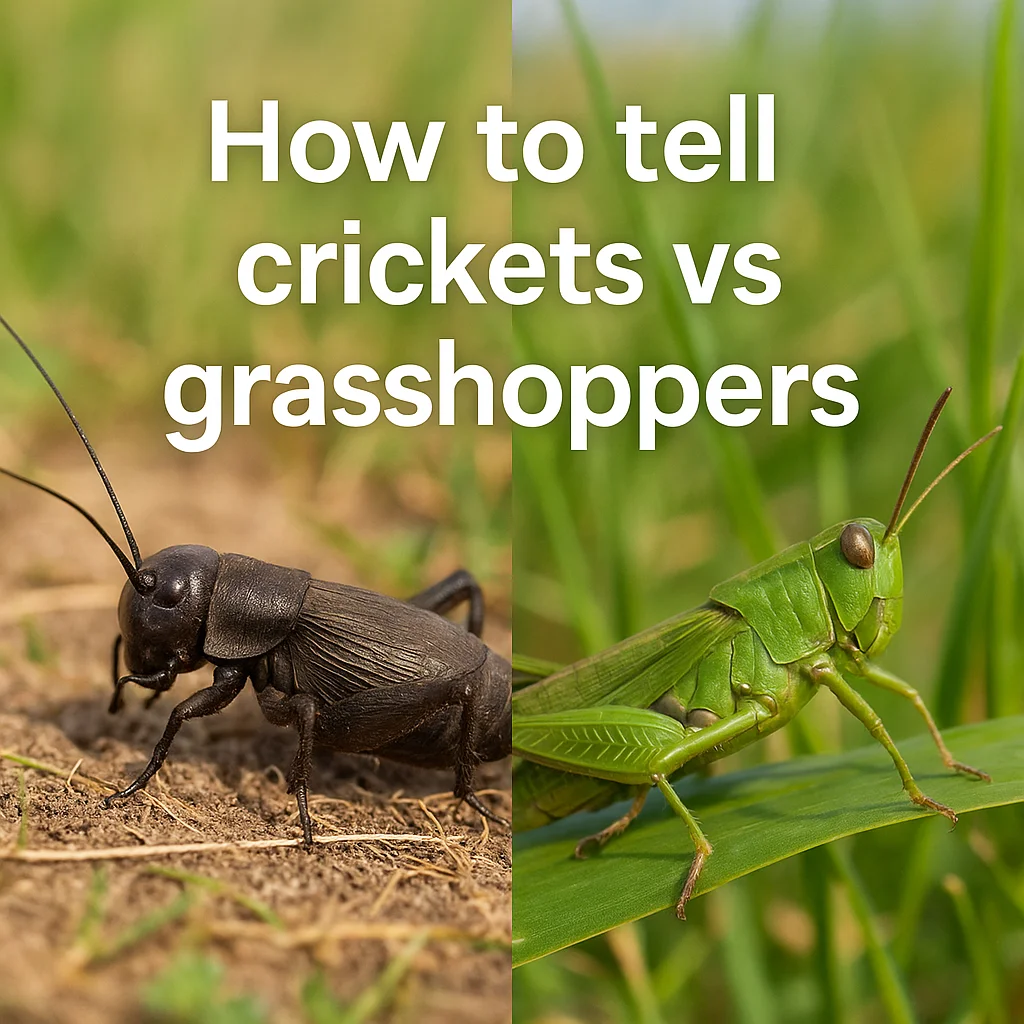
- Body Shape and Silhouette: Crickets have a more flattened body, while grasshoppers appear more cylindrical and sturdy.
- Antennae Type: Crickets possess long, thin antennae; grasshoppers have short, thick antennae.
- Wing Features: Both have wings, but grasshoppers' wings are more pronounced and used for flight; crickets' wings are often used for chirping.
- Leg Traits and Movement Style: Both have powerful hind legs, but grasshoppers are renowned for their distinctive leaping abilities.
- Distinguishing Look-Alikes and Common Confusion: While similar, crickets are generally darker and have longer antennae, whereas grasshoppers boast more colors and shorter antennae.
- Crickets have a more subdued color palette, usually dark brown or black.
- Grasshoppers often exhibit vivid or varied colors, including green and brown patterns.
- Crickets have long, threadlike antennae; grasshoppers have shorter, more robust antennae.
- Listen for chirping: Crickets make this sound, whereas most grasshoppers do not.
- Observe activity time: Crickets mostly at night, grasshoppers during the day.
- Grasshoppers are more likely to leap long distances when disturbed.
🧠 Basic Body Structure
Both crickets and grasshoppers share fundamental insect features:
- Head, Thorax, Abdomen: Both have a clearly segmented body.
- Six Legs: As insects, they each have three pairs of legs.
- Exoskeleton: Both have a rigid protective outer layer composed of chitin.
- Molting: Both undergo molting as they grow.
- Wings: Both have functional wings; grasshoppers frequently use them to fly.
- Vertebrate or Invertebrate: Both are invertebrates, meaning they lack a backbone.
🌍 Habitat & Distribution
Crickets and grasshoppers can be found in a variety of habitats around the world. They are most commonly associated with:
- Preferred Environments: Grasslands, meadows, forests, and urban gardens.
- Microhabitats: Crickets often reside under rocks, vegetation, or logs, whereas grasshoppers prefer open, grassy terrain.
- Geographic Range: They inhabit most continents and thrive in temperate, tropical, and arid climates.
- Habitat Changes: Human encroachment and climate shifts can influence their distribution and visibility.
📅 Seasonal Appearance & Activity
The likelihood of encountering crickets or grasshoppers can be influenced by the time of year and weather conditions:
- Months/Seasons: Primarily during the warmer months from spring to late summer.
- Time of Day: Crickets are predominantly active at night; grasshoppers during the day.
- Weather Influences: Warm, dry conditions are optimal for activity.
- Spring months through late summer provide the best chances.
- Look for crickets after dusk; grasshoppers are active when the sun is out.
- Spot them after warm, dry spells.
- In many areas, both can be heard before seen, listen for sounds.
🥚 Reproduction & Egg-Laying
The reproductive behaviors of crickets and grasshoppers differ but are fascinating to observe:
- Mating Behavior: Many crickets are known for their mating calls, whereas grasshoppers may engage in visual displays.
- Where Eggs Are Laid: Crickets typically deposit eggs in the soil or within plant matter; grasshoppers lay eggs in soil pockets.
- Typical Egg Counts and Strategies: Egg counts and laying strategies are species-specific and can vary greatly.
🌀 Metamorphosis & Life Cycle
Both crickets and grasshoppers undergo incomplete metamorphosis:
- Type of Metamorphosis: Incomplete (egg–nymph–adult)
- Eggs: Laid in clusters in soil or vegetation; require specific environmental conditions to hatch.
- Nymphs: Resemble small adults but without fully developed wings; molt several times as they grow.
- Adults: Fully formed wings; capable of reproduction and continue to be active until cooler weather arrives.
🍽️ Diet & Feeding Behavior
Their dietary habits are tailored to their environments:
- Diet: Primarily herbivorous, feeding on leaves, grasses, and occasionally small insects.
- Feeding Tools: Equipped with chewing mouthparts suited for grinding plant material.
- Role: Act as herbivores and are important in controlling plant growth.
🦉 Predators & Defense
Crickets and grasshoppers deploy various defenses and face numerous natural predators:
- Natural Enemies: Birds, reptiles, amphibians, mammals, and spiders.
- Defense Strategies: Camouflage, rapid flight or jumping, and in some cases, release of dissuasive chemicals.
- Rely on camouflage to blend into their environment.
- Rapid escape through jumping or quick flight.
- Some species produce sounds or release chemicals when threatened.
- Armor-like exoskeleton provides protection.
👥 Social Behavior & Swarms
Crickets and grasshoppers exhibit different levels of social behavior:
- Crickets: Primarily solitary, meeting mainly for mating purposes.
- Grasshoppers: Generally solitary but can form large swarms in some species due to environmental pressures, mainly in locusts.
🧭 Senses & Communication
The sensory and communication systems of these insects are well adapted:
- Vision: Compound eyes help detect motion.
- Smell/Pheromones: Useful in locating food and mates.
- Touch and Vibration: Sensitive to ground vibrations.
- Sound: Crickets are famous for chirping; produce sound by rubbing wings together (stridulation).
- Crickets' chirps are used for mating communication.
- Both rely on movement detection via vibration sensitivity.
- Pheromone communication largely facilitates mating and social interaction.
- Surprising ability to detect weak light and movement enhances predator awareness.
🌱 Role in the Ecosystem
Both crickets and grasshoppers play significant roles in the ecosystem:
- Pollination: Although not primary pollinators, their movements can help in the process.
- Decomposition: Consume dead plant material, contributing to nutrient cycling.
- Pest Control: By herbivorous feeding, they can keep some plant species in check.
- Food Web Role: Serve as crucial food sources for many predators.
📉 Population & Conservation Notes
The conservation status of these insects is generally stable, but local populations fluctuate:
- Common/Threat Level: Typically common in favorable habitats.
- Threats: Habitat loss, pesticide use, and climate change are challenges.
- Local Abundance: Varies by region and environmental conditions.
- Plant native vegetation to aid local insect populations.
- Minimize pesticide use to preserve insect communities.
- Maintain natural plant litter as microhabitats.
- Support conservation efforts focused on habitat protection.
⚠️ Human Interaction & Safety
While generally harmless, interaction safety should be observed:
- Bites/Stings: Neither crickets nor grasshoppers are known to bite humans; they pose no medical risk.
- General Guidance: Wash area if any irritation occurs, avoid provoking insects.
- Respectful Observation: Encourage insect appreciation without handling or collecting.
📌 Summary
- Identification: Crickets and grasshoppers can be distinguished by color, antennae, and activity.
- Habitat: Found globally in meadows, forests, and gardens.
- Seasonality: Most visible in warmer months, day (grasshoppers) and night (crickets).
- Life Cycle: Undergo incomplete metamorphosis through egg, nymph, and adult stages.
- Diet: Primarily herbivorous; feed on grasses and leaves.
- Predators: Birds, reptiles, mammals, and spiders employ varied defenses.
- Ecology: Role in decomposition, as food for others, and minor pollination.
- Human Interaction: Safe to observe; minimal interference suggested for conservation.