🕷️ Field crickets: common species overview
🧾 Quick Facts
Field crickets are a captivating group of insects belonging to the Gryllidae family. Known for their distinctive chirping sounds, these insects are found in a variety of habitats across the globe. Here's a quick look at their key features:
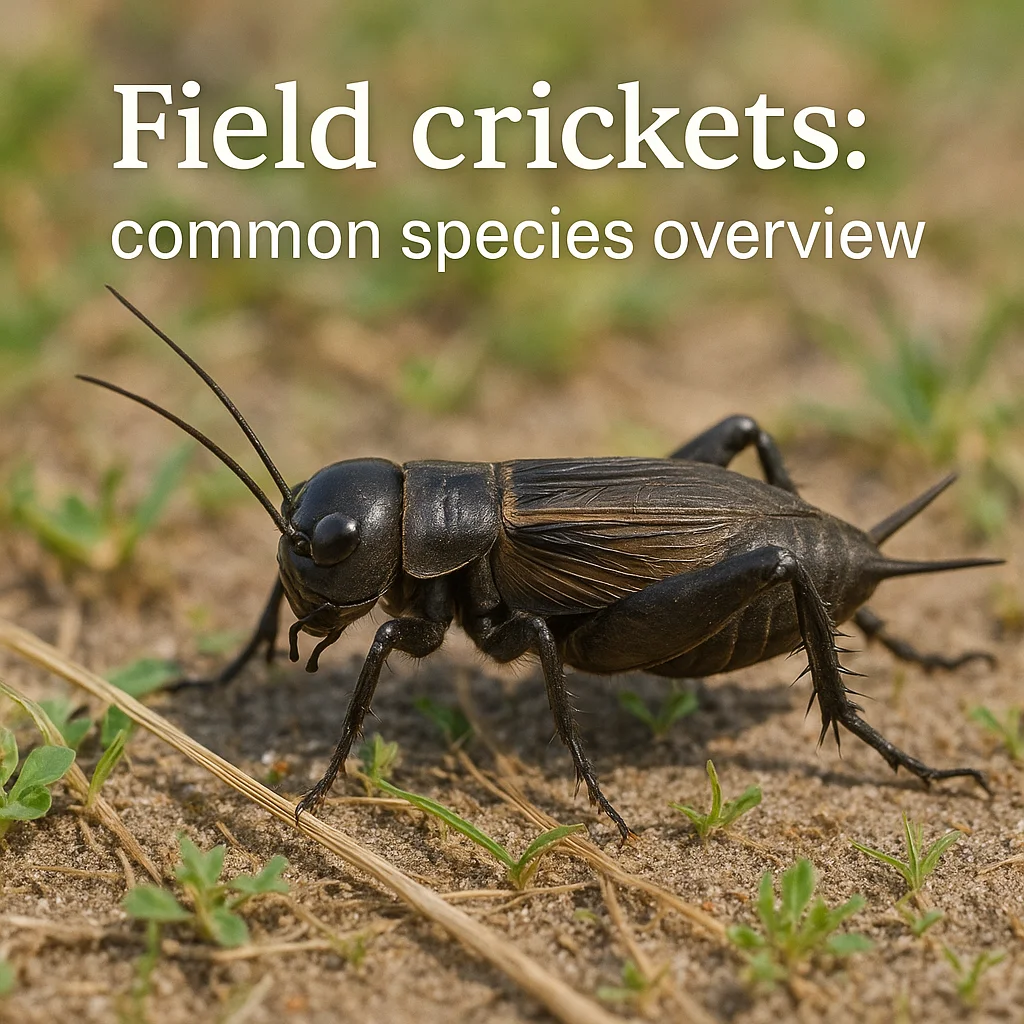
- Common names: Field cricket, Common field cricket
- Scientific name: Varies (e.g., Gryllus pennsylvanicus)
- Insect or not: Insect; as an invertebrate, they lack a backbone
- Order / family: Orthoptera / Gryllidae
- Typical size range: Adults range from 15 to 25 millimeters in length
- Key colors/patterns: Black or dark brown with some species showing lighter stripes
- Activity: Nocturnal
- Typical habitats: Grasslands, forests, gardens, fields
- Where in the world it occurs: Found globally; mainly in Europe, North America, and Asia
- Seasonality: Adults are most visible in late summer and fall
🔍 Identification
Identifying field crickets involves noting specific characteristics that distinguish them from similar insects. They are robust insects with the following features:
- Body shape and silhouette: Stout bodies with a rounded head and tapering abdomen
- Antennae type: Long, slender, and filamentous antennae
- Wing features: Short wings in some species; when present, wings cover the abdomen
- Leg traits and movement style: Powerful hind legs adapted for jumping
- Distinguishing look-alikes: Can be confused with grasshoppers or katydids; however, crickets generally have flatter bodies and longer antennae
- Top ID Tips:
- Look for long, thread-like antennae
- Listen for distinctive chirps, especially at night
- Note the robust, dark-colored body
- Check for short, stout wings on adults
- Observe powerful hind legs suited for jumping
- Compare size and body shape with grasshoppers and katydids
🧠 Basic Body Structure
Field crickets are true insects with a fundamental body structure divided into three parts:
Head: Contains eyes, mouthparts for chewing, and long antennae.
Thorax: Bears three pairs of legs and two pairs of wings; hind legs are enlarged for jumping.
Abdomen: The segmented rear portion housing the digestive and reproductive organs.
As invertebrates, they possess an exoskeleton for support and protection. They undergo molting as they grow, shedding their exoskeleton to form a new one.
🌍 Habitat & Distribution
Field crickets are adaptable and can inhabit diverse environments. They are commonly found in:
Preferred environments: Open grasslands, meadows, forest edges, and urban gardens.
Microhabitats: Under rocks, in leaf litter, or burrowed into soft soil. They often seek shelter in warm, dry places.
Geographic range: Widely distributed across temperate regions in North and South America, Europe, and parts of Asia.
Changing habitats can affect their population and visibility due to urbanization and landscape alterations.
📅 Seasonal Appearance & Activity
Field crickets are most active during specific times and conditions:
Time of year: Predominantly active in late summer and autumn when they reach adulthood and become more noticeable.
Time of day: Nocturnal creatures; most active after dusk.
Weather influences: Prefer warm weather, but are less active during extreme heat or cold conditions.
- Best Time to Spot It:
- Late afternoon and evening during warmer months
- Summer through fall
- After rain when temperatures are moderate
- In calm, humid conditions
🥚 Reproduction & Egg-Laying
Field crickets have fascinating reproductive behaviors:
Mating behavior: Males attract females by producing chirping sounds through stridulation (rubbing wings together) as part of a courtship display.
Where eggs are laid: Females lay eggs in soft soil or among plant stems, using their ovipositor to deposit them.
Typical egg counts and strategies: Egg-laying varies greatly but typically involves multiple batches totaling over 100 eggs over the breeding season.
🌀 Metamorphosis & Life Cycle
Field crickets undergo incomplete metamorphosis, with three developmental stages:
Egg: Laid in the soil, hatching depends on temperature and moisture conditions, usually taking a few weeks.
Nymph: Resemble miniature adults but without fully developed wings and reproductive organs. They spend several weeks or months molting through various instar stages as they grow.
Adult: Capable of reproduction and equipped with wings (in many species) and fully developed body parts. Adults have diverse diets and live for several weeks to months under favorable conditions.
🍽️ Diet & Feeding Behavior
The feeding behavior of field crickets is based on their developmental stage:
Nymphs and adults: Primarily herbivorous, feeding on organic matter, seedlings, and plant detritus. Will also scavenge on insects as a supplementary diet.
Feeding tools: Equipped with chewing mouthparts, they can tear at leaves and stems. Their feeding habits play a role as herbivores and scavengers in the ecosystem.
🦉 Predators & Defense
Field crickets face numerous natural predators, including:
Predators: Birds, small mammals, reptiles, spiders, and certain parasitic insects.
Defense strategies: Defense includes hiding under cover, jumping to escape threats, and camouflage through their darker coloration which blends with the ground.
- Defense Highlights:
- Camouflage with ground colors to avoid predation
- Fast jumping as a primary evasion tactic
- Seeks shelter to avoid open spaces
- Quiet behavior during daytime to remain unnoticed
👥 Social Behavior & Swarms
Field crickets are primarily solitary, interacting mainly for reproduction. However, males will establish territories from which they produce their song to ward off rivals and attract females. They do not form swarms or have defined social structures.
🧭 Senses & Communication
Field crickets utilize various senses and communications:
Vision: Sensitive compound eyes help detect motion.
Smell/pheromones: Used in finding food and mates.
Sound: Crickets are well-known for stridulation - producing sounds by rubbing their wings together for communication, mainly to attract females.
🌱 Role in the Ecosystem
Field crickets play several roles in ecological systems:
Decomposition: They contribute to breaking down plant matter, cycling nutrients back into the soil.
Food web contributions: Act as prey for various animals, supporting biodiversity.
Impact on humans/agriculture: While generally beneficial as decomposers, they can cause minor damage to agricultural crops when in large numbers.
📉 Population & Conservation Notes
Field crickets are commonly encountered in suitable habitats, though they may be subjected to environmental pressures:
- How to Help (Low-Impact):
- Maintain natural vegetation in gardens
- Avoid excessive use of pesticides
- Leave leaf litter to promote natural habitats
- Provide diverse plantings to encourage natural populations
⚠️ Human Interaction & Safety
Field crickets are harmless to humans; they do not bite or sting. Their chirping can be a pleasant addition to a garden's nighttime soundscape. For indoor invasions, manual removal or exclusion practices are advised. Respectful observation is encouraged to appreciate their role in nature without disrupting their lives.
📌 Summary
- Robust, dark-colored insects with long antennae
- Commonly found in grasslands, gardens, and forests
- Nocturnal; most active in late summer and autumn
- Undergo incomplete metamorphosis with egg, nymph, and adult stages
- Feeds on plant material and decomposing organic matter
- Preyed upon by birds, mammals, reptiles, and insects
- Important ecological contributions in nutrient cycling and food webs
- Encounter indoor spaces infrequently and pose no threat to humans