🕷️ Termites vs ants: quick differences
🧾 Quick Facts
Termites and ants are often mistaken for one another due to their small size and social behavior, yet they exhibit distinct differences. Here are some quick facts to help differentiate these fascinating insects:
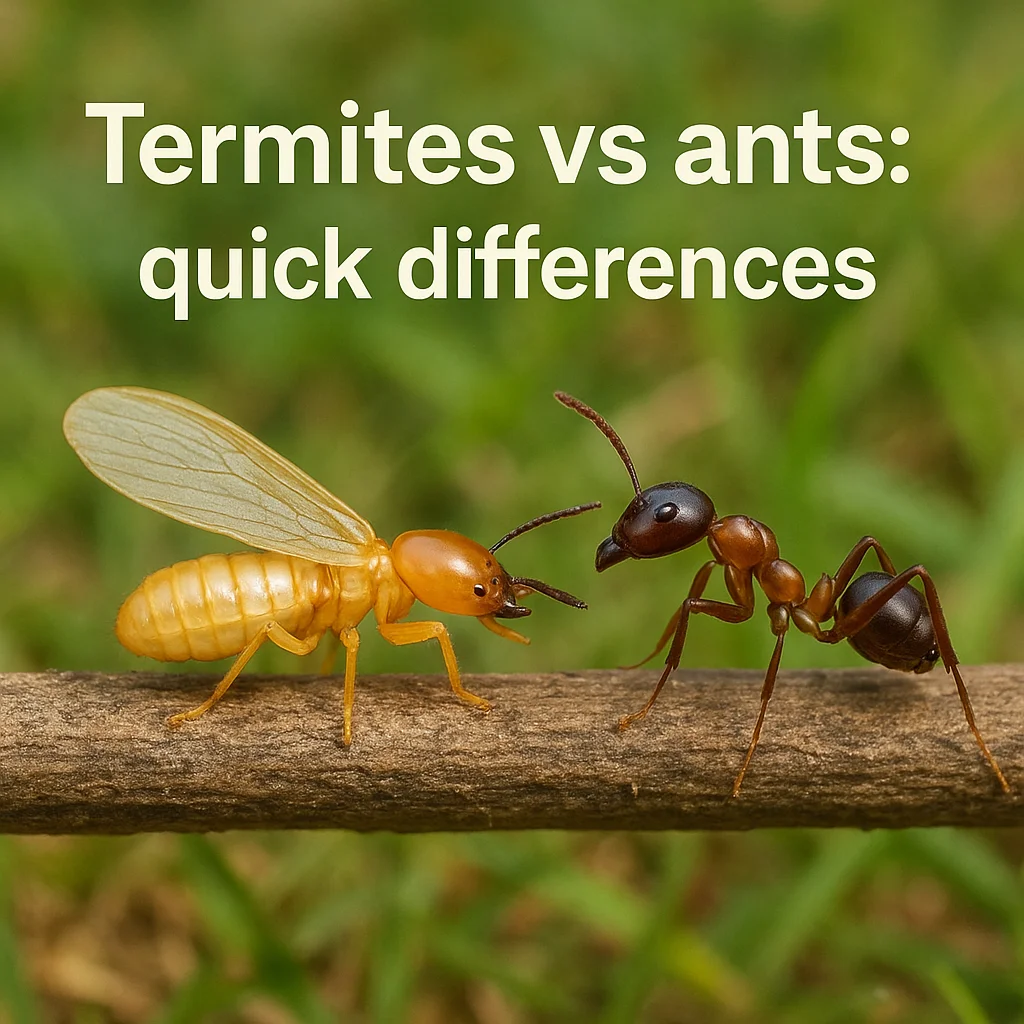
- Common names: Termite, ant
- Scientific name: Varies by species
- Insect or not: Both are insects, as they are invertebrates with three-part bodies and six legs
- Order / family: Termites belong to the order Isoptera, ants to the order Hymenoptera
- Typical size range (adult): 3-12 mm for ants, 3-20 mm for termites
- Key colors/patterns: Termites are typically pale, with a consistent color; ants vary widely, often brown, black, or red
- Activity: Most ants are diurnal; termites can be nocturnal or crepuscular
- Typical habitats: Forests, grasslands, urban areas for both; termites often in wood, ants in soil
- Where in the world they occur: Nearly every continent, primarily tropical and temperate regions
- Seasonality: Active mostly in warmer months; varies with local climate
🔍 Identification
Identifying termites and ants involves observing several key physical characteristics and behaviors:
- Body shape and silhouette: Termites have a more uniform body with no distinct waist, while ants have a pinched waist.
- Antennae type: Termite antennae are straight, while ant antennae are elbowed.
- Wing features: When present, termite wings are equal in size; ant wings have different sizes (forewing larger than hindwing).
- Leg traits and movement style: Both have six legs, but ants are generally quicker and more agile.
- Distinguishing look-alikes and common confusion: Termites are often paler, while ants have a darker and more varied color palette.
- Look for a definite waist on ants; termites lack this feature.
- Check the antennae: straight for termites, bent for ants.
- Observe the wing size if present; termites have uniform wings, ants do not.
- Note activity time: termites might be active at dusk, ants during the day.
- Color can be a clue: termites are often creamy; ants are usually darker.
- Watch their movement: ants move in predictable paths; termites meander.
- Count the size difference: termites are generally more uniform in build.
- Examine the environment: termites in wood; ants often in soil or on plants.
🧠 Basic Body Structure
Both termites and ants are classified as insects, meaning they have the following characteristics:
- Head, thorax, abdomen: Each has a three-part body structure divided into head, thorax, and abdomen.
- Six legs: True to all insects, they have six legs.
- Exoskeleton, molting, wings: Both have an exoskeleton for support, and they molt to grow. Wings may be present during certain life stages.
- Invertebrate: Being invertebrates, they lack a spinal column but have a robust exoskeleton.
🌍 Habitat & Distribution
Termites and ants thrive in various environments across the globe:
- Preferred environments: Both thrive in forests, grasslands, and urban settings.
- Microhabitats: Termites often colonize wood; ants dig tunnels in the soil, under rocks and plants.
- Geographic range: Found on all continents except Antarctica, mainly in tropical and temperate zones.
- Habitat changes: Habitat destruction can lessen sightings, while urbanization can heighten encounters with ants.
📅 Seasonal Appearance & Activity
The visibility and activity levels of termites and ants vary throughout the year:
- Termites are most visible during warmer months, often swarming at dusk or night.
- Ants are more frequently observed in daytime during spring and summer.
- Temperature and weather greatly influence activity levels.
- Best time to spot ants: warm sunny days in late spring and summer.
- Termites most visible: after rainfall creates moist conditions.
- Primary activity hours: ants during daylight, termites often after sunset.
- Look during peak heat: ants are especially active in morning and late afternoon.
🥚 Reproduction & Egg-Laying
Both termites and ants exhibit complex reproductive behaviors:
- Mating behavior: Swarming to form new colonies, often synchronized with weather conditions.
- Egg deposition: Termites lay eggs in wood or soil-based nests; ants often use soil or plant matter.
- Egg counts: Can vary significantly, with termites and ants producing thousands of eggs to ensure colony survival.
🌀 Metamorphosis & Life Cycle
Both termites and ants undergo complete metamorphosis, involving the stages of egg, larva, pupa, and adult:
- Egg: Laid in secure environments; hatch into larvae.
- Larva: Feeds on stored food or special secretions; lacks limbs, often resembles a white grub.
- Pupa: Transition phase, undergoing transformation within protective casing.
- Adult: Emerges as a fully formed insect; roles include workers, soldiers, or reproductive individuals.
🍽️ Diet & Feeding Behavior
Termites and ants have unique dietary preferences and feeding behaviors:
- Termites: Primarily feed on cellulose, digesting wood, leaves, and other plant materials with symbiotic microorganisms.
- Ants: Omnivorous, consuming seeds, nectar, small insects, and various organic materials.
- Feeding tools: Termites have chewing mouthparts for breaking down tough plant fibers; ants utilize mandibles for varied diet.
- Ecological roles: Termites are decomposers, breaking down dead plant material; ants can be predators, scavengers, and pollinators.
🦉 Predators & Defense
Both termites and ants face numerous natural predators and have developed various defense mechanisms:
- Natural enemies: Birds, reptiles, amphibians, spiders, and mammals frequently prey on them.
- Defense strategies include: Camouflage, speed, chemical defenses, and hiding in colonies.
- Termites utilize chemical sprays from soldiers for defense.
- Ants may sting or bite intruders for protection.
- Camouflage: Termites blend into the wood environment.
- Ant's speed allows quick evasion from predators.
👥 Social Behavior & Swarms
Termites and ants are highly social insects living in colonies with structured roles:
- Colony roles: Both have queens (reproductive), workers (maintenance and care), and soldiers (protection).
- Communication: Use pheromones for information and trails; ants may also engage in touch-based communication.
- Swarms: Triggered by environmental factors, primarily for reproduction and new colony formation.
🧭 Senses & Communication
Termites and ants rely heavily on advanced senses and communication methods:
- Vision: Varies greatly; most ants have compound eyes, but some termites are nearly blind.
- Smell/pheromones: Both heavily depend on pheromones for navigation and communication.
- Sound and vibration: Limited use, varies by species; some ant species produce sounds via stridulation.
🌱 Role in the Ecosystem
Both termites and ants play crucial ecological roles:
- Termites: Essential decomposers, recycling nutrients back into the ecosystem, promoting soil health.
- Ants: Important in seed dispersion, soil aeration, pest control, and some pollination.
- Mutual relationships: Ants often form partnerships with plants and other insects, enhancing biodiversity.
- Human interaction: While termites can damage wooden structures, ants can help control pest populations.
📉 Population & Conservation Notes
The population status of termites and ants varies by region and species:
- Many species are common, thriving in suitable habitats due to their adaptability.
- However, habitat loss, pesticides, and climate change have impacted specific populations.
- Data on exact numbers is limited, but general trends show varying local abundance.
- How to Help (Low-Impact): Encourage natural pest control by establishing native plants.
- Reduce pesticide use to protect beneficial insect populations.
- Leave leaf litter in gardens to provide habitats.
- Support conservation initiatives that preserve natural habitats.
⚠️ Human Interaction & Safety
Though encounters with termites and ants are common, safety measures are straightforward:
- Termites generally do not bite or sting humans.
- Some ants can sting or bite, often as a defense mechanism; reactions vary by individual.
- For stings or bites, wash the area with water, avoid scratching, and seek professional advice if a reaction persists.
- Observation should be respectful, avoiding disturbance to colonies and their natural behavior.
📌 Summary
- Identification: Termites lack waists, ants have distinct waists, different antennae.
- Habitat: Both thrive in forests and urban areas, termites in wood, ants in soil.
- Seasonality: Termites often appear after rain, ants during warm days.
- Life cycle: Complete metamorphosis, different colony roles.
- Diet: Termites mainly wood decomposers, ants versatile feeders.
- Predators: Birds, reptiles, and mammals hunt them.
- Ecology: Termites recycle nutrients; ants aid plant growth.
- Human notes: Typically harmless, though ants may sting.