🕷️ Forest roaches: outdoor species explained
🧾 Quick Facts
Forest roaches, commonly found outdoors, are a fascinating group of cockroaches known for their distinct adaptations to forest environments. While they may share some characteristics with household roaches, their lifestyle and habitat preferences set them apart.
- Common Names: Wood roaches, leaf litter roaches
- Scientific Name: Varies by species
- Insect or Not: Insect, a type of invertebrate
- Order/Family: Blattodea; family varies
- Typical Size Range: 1–3 inches (2.5–7.5 cm) in length
- Key Colors/Patterns: Brown, tan, or dark hues with some having distinctive markings
- Activity: Mostly nocturnal
- Typical Habitats: Deciduous and coniferous forests, leaf litter, under logs
- Where in the World: Predominantly in North America, Europe, and parts of Asia
- Seasonality: Most visible in spring and summer
🔍 Identification
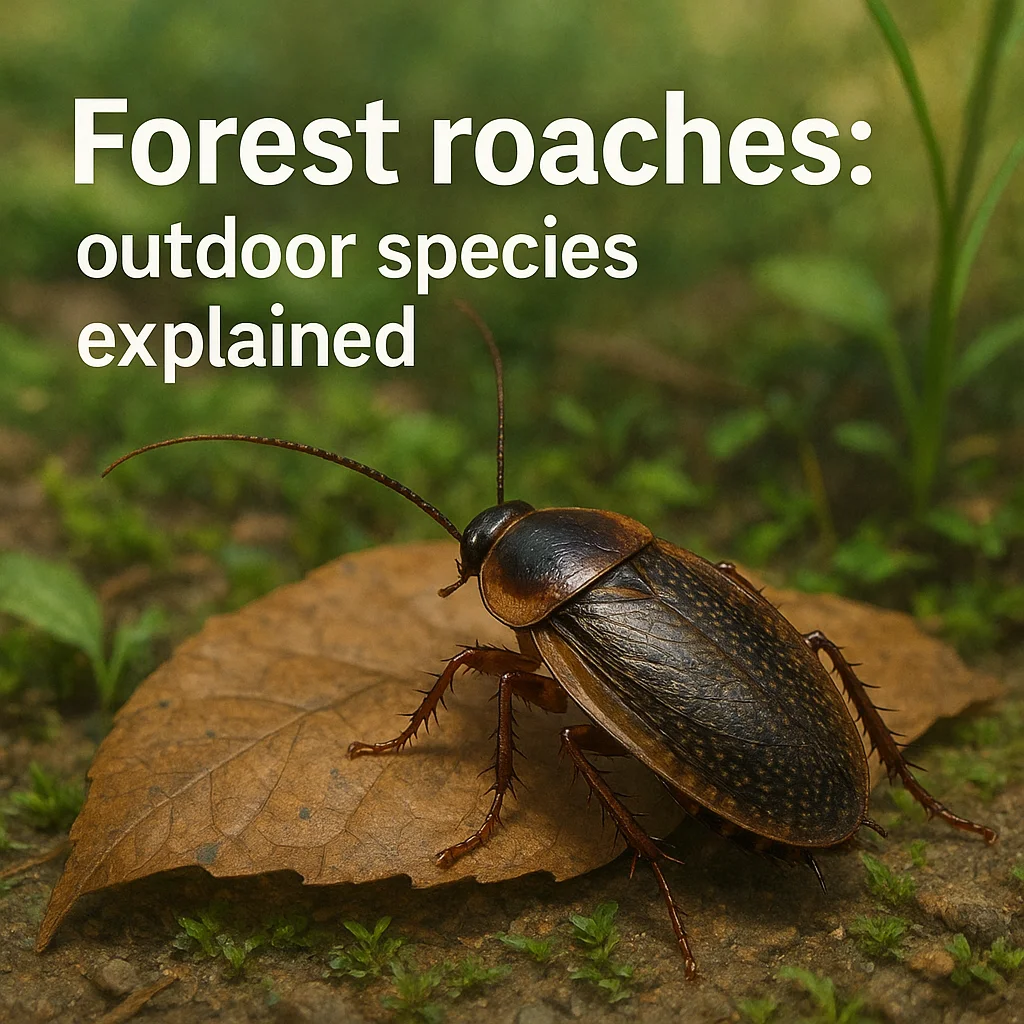
Forest roaches can be identified by their sturdy, flattened bodies and rapid movements. They exhibit varying features based on the specific species, but common characteristics include long antennae, well-developed legs, and the presence of wings in some adults. Their wings may either be fully developed or reduced, and some individuals might be flightless. The body is typically oval-shaped and ranges from light brown to black, often blending with their natural surroundings. Look-alikes include other species of cockroaches and some beetles, but forest roaches can be distinguished by their more prominent antennae and different body proportions.
- Long, filamentous antennae
- Brown to black coloration with potential markings
- Typically has a flattened, oval body shape
- Wing presence varies; often cannot fly despite having wings
- Legs adapted for quick scuttling
- Tendency to hide under logs or leaf litter when disturbed
🧠 Basic Body Structure
Like all insects, forest roaches possess a body divided into three main segments: the head, thorax, and abdomen. They have six legs attached to the thorax, and most species have a pair of wings. Their hard exoskeleton provides protection and requires them to molt as they grow. Forest roaches are invertebrates, meaning they do not have a vertebral column (backbone). This invertebrate structure supports the body while allowing flexibility and movement.
🌍 Habitat & Distribution
Forest roaches inhabit environments abundant in decaying vegetation and organic matter. They are primarily found in forests, thriving in leaf litter, under bark, and within fallen logs. Their preference for moist environments makes forested areas with rich soil and ample vegetation ideal. Geographically, they are spread across various continents, including North America, Europe, and Asia, favoring temperate climates. Changes in habitat, such as deforestation and urbanization, can influence their visibility and distribution.
📅 Seasonal Appearance & Activity
The appearance of forest roaches depends on the season and climate conditions. Generally, they are most active in warmer months such as spring and summer. Being primarily nocturnal, they are often observed at night while seeking food. Humidity and moisture levels are crucial, as dry conditions can limit activity.
- Spring and summer are peak visibility
- Primarily nocturnal
- Increased activity after rainfall
- Active in warm, humid weather
🥚 Reproduction & Egg-Laying
Forest roaches typically exhibit specific behavioral patterns during mating, although exact details can vary among species. Females often lay eggs in secure environments, such as under bark or within leaf litter, to protect them from predators and environmental factors. The number of eggs and the development strategy can vary, with some species producing egg cases known as ootheca.
🌀 Metamorphosis & Life Cycle
Forest roaches undergo incomplete metamorphosis, which involves three stages: egg, nymph, and adult. The nymphs resemble miniature adults and gradually develop through successive molts. During these stages, they feed predominantly on decaying organic material and eventually mature into adults capable of reproduction. The duration of each stage can vary depending on species and environmental conditions, often taking several months to a year to complete the life cycle.
🍽️ Diet & Feeding Behavior
As scavengers, forest roaches play a significant role in decomposing organic matter. Their diet primarily consists of decaying plant material, fungi, and occasionally dead insects or other small animals. They have chewing mouthparts, which enable them to break down tough plant fibers. Their role in the ecosystem involves nutrient recycling and aiding in the breakdown of organic matter.
🦉 Predators & Defense
Forest roaches have several natural predators, including birds, reptiles, amphibians, mammals, and spiders. Their defense mechanisms rely heavily on camouflage due to their cryptic coloration and quick hiding behavior. Some species may also produce unpleasant chemicals to deter predators, but these are harmless to humans. Speed and the ability to quickly skitter into hiding places provide further protection.
- Effective camouflage within leaf litter
- Quick to scuttle into crevices when threatened
- Some with defensive secretions
- Disappearence into dense undergrowth
👥 Social Behavior & Swarms
Forest roaches generally exhibit solitary behavior, although they may be found in groups when suitable resources are abundant. Unlike some other cockroach species, they do not form structured colonies or swarms. Interactions are typically limited to mating activities, with individuals dispersing quickly afterward to avoid predation and competition.
🧭 Senses & Communication
Forest roaches rely on a combination of senses to navigate their environment. Their long antennae are sensitive to touch and chemical signals, aiding in locating food and recognizing mates. While their vision is generally poor in comparison to other insects, they compensate with heightened olfactory senses, which detect pheromones released for communication during mating. Their ability to respond to vibrations also helps in detecting nearby threats.
🌱 Role in the Ecosystem
These roaches play a crucial ecological role in forest ecosystems. Their scavenging activities contribute significantly to decomposition and nutrient cycling, supporting healthy forest environments. By breaking down organic matter, they enhance soil fertility and provide a food source for a range of predators, linking them to various trophic levels within the food web. While they may occasionally invade human spaces, they are usually harmless and beneficial in their natural settings.
📉 Population & Conservation Notes
Forest roaches are generally common in suitable habitats, but local abundance can vary due to factors such as deforestation, pesticide use, and climate change. Data on exact population numbers are limited, but habitat loss remains a significant concern. Conservation efforts that involve preserving native forestland and minimizing chemical use can help maintain their populations.
- Preserve forest habitats
- Avoid pesticide overuse
- Maintain natural leaf litter
- Encourage biodiversity in garden/park settings
⚠️ Human Interaction & Safety
Forest roaches are generally not harmful to humans. They do not bite or sting and are unlikely to cause damage when found outdoors. In the unusual case of indoor invasion, they should be managed with non-lethal methods. Practicing respectful observation, refraining from collecting, and ensuring not to disturb their natural habitat contributes to coexistence.
📌 Summary
- Identified by their oval, flattened bodies and long antennae
- Thrive in moist, forest environments with ample leaf litter
- Most active during spring and summer, especially at night
- Undergo incomplete metamorphosis with nymph stages
- Scavenger diet helps decompose organic matter
- Numerous natural predators, primarily use camouflage for defense
- Critical in nutrient cycling and supporting the forest ecosystem
- Impact from habitat changes makes conservation important
- Harmless to humans; encourage respectful observation