🕷️ Common house roaches: ID overview
🧾 Quick Facts
The term "common house roaches" refers to various species of cockroaches typically found in human dwellings. They are resilient and adaptable insects with a knack for survival in diverse environments.
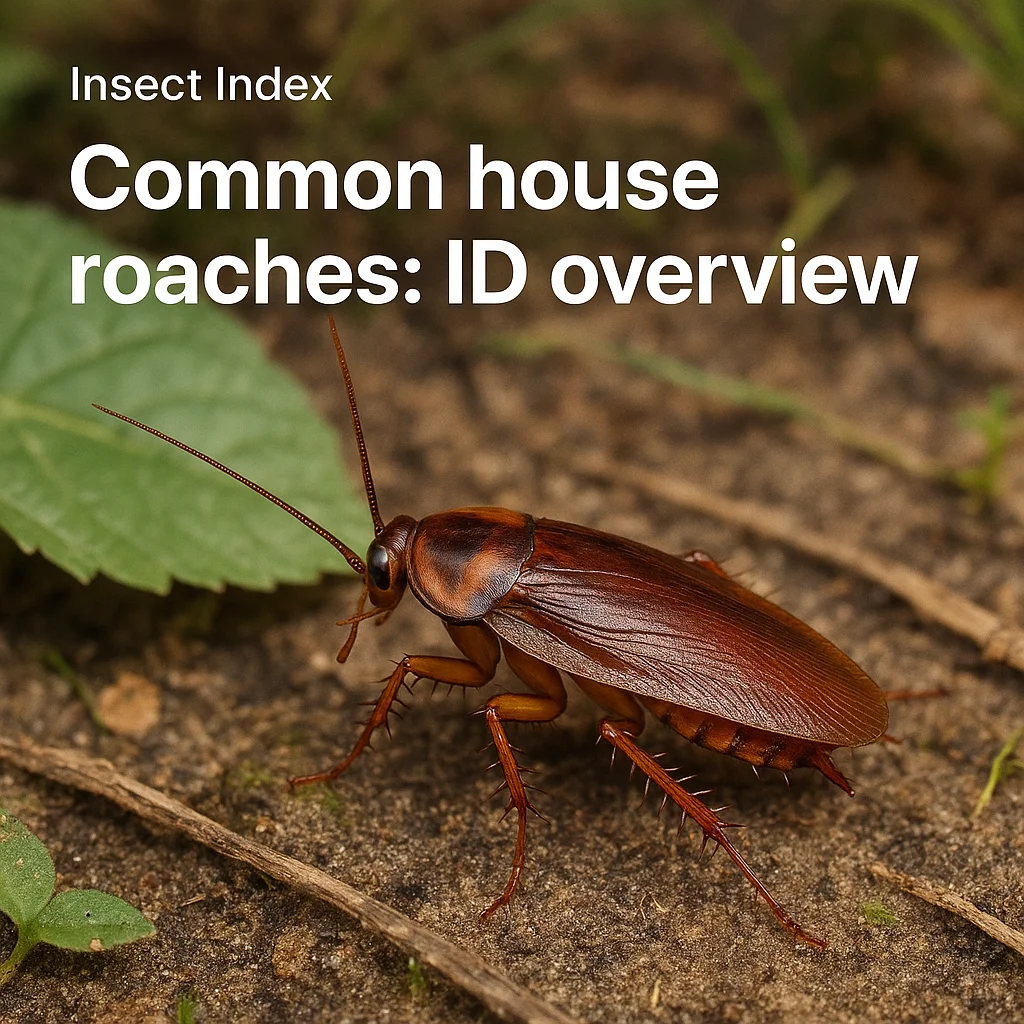
- Common names: House cockroach, Domestic roach
- Scientific name: Varies (includes Periplaneta americana, Blattella germanica, among others)
- Insect or not: Yes, they are insects, which are a type of invertebrate.
- Order / family: Blattodea / varies
- Typical size range: 0.5 to 2 inches long
- Key colors/patterns: Light brown, dark brown, or reddish-brown with some having distinct banding
- Activity: Nocturnal
- Typical habitats: Human homes, especially warm, humid areas
- Where in the world it occurs: Globally
- Seasonality: Year-round, but more active in warmer months
🔍 Identification
Identifying common house roaches involves examining their body structure and behavior. They typically have a flattened, oval body with long antennae and six spiny legs that allow for quick movements. Some species have wings, although not all are adept fliers.
- Body shape and silhouette: Flat, oval
- Antennae type: Long, slender, and sensitive
- Wing features: Present in some; often cover the body but not always used for flying
- Leg traits and movement style: Spiny legs; rapid running
- Distinguishing look-alikes: Often confused with beetles, which have shorter antennae and thicker bodies
- Observe long, slender antennae
- Check for a flattened, oval body
- Look for their rapid scuttling movement
- Note any brown/blackish coloration
- Identify distinct body segments visible from above
- Check for wings hidden under a protective shell in many species
🧠 Basic Body Structure
Common house roaches exhibit typical insect anatomy featuring a head, thorax, and abdomen. They are equipped with six legs, a hallmark of insects, and have an exoskeleton that offers protection and support. To grow, they undergo molting, shedding their outer shells.
Common house roaches are invertebrate, meaning they lack a spinal column. Their rigid exoskeletons serve as a support system instead.
🌍 Habitat & Distribution
These tenacious creatures are found in various habitats, though they thrive in warm, moist environments. Common locales include basements, kitchens, and bathrooms where water and food are plentiful. In the wild, they can inhabit tropical forests and underground burrows.
Globally, common house roaches live primarily in urban and suburban areas, favoring regions with milder to warmer climates. The adaptation to diverse environments ensures they can be found across continents, from temperate zones to tropical climates.
📅 Seasonal Appearance & Activity
House roaches are visible year-round but are primarily active during warmer months when temperatures rise. Being nocturnal creatures, they are more readily spotted at night, especially around food sources and damp areas.
- Active throughout the year in warm climates
- Most visible during spring and summer
- Best seen at night due to nocturnal habits
- More active during humid, rainy conditions
🥚 Reproduction & Egg-Laying
Common house roaches engage in a variety of mating behaviors, usually involving pheromone signals. Females lay eggs in protective cases called oothecae, which are deposited in sheltered locations such as cracks, crevices, and hidden corners.
The typical number of eggs per ootheca varies by species but can range from 16 to 50 eggs. The placement strategy ensures a higher survival rate for the offspring by safeguarding them from predators.
🌀 Metamorphosis & Life Cycle
House roaches undergo incomplete metamorphosis, cycling through three stages: egg, nymph, and adult. Eggs hatch into nymphs resembling smaller adult roaches but without fully developed wings.
Nymphs rely on consistent feeding for growth, shedding their exoskeleton multiple times before reaching full maturity. The duration of each life cycle stage can vary based on environmental conditions, from several weeks to over a year.
🍽️ Diet & Feeding Behavior
Omnivorous and opportunistic, house roaches consume a wide assortment of organic materials. Their chewing mouthparts facilitate feeding on items like rotting food, paper products, and even book bindings. As scavengers, their role includes breaking down decaying matter.
At different stages, the diet remains consistent, supporting rapid growth and development throughout their life cycle.
🦉 Predators & Defense
Natural enemies of house roaches include birds, reptiles, amphibians, spiders, and some mammals. To survive, roaches employ various defense strategies, including rapid movement, seeking shelter in narrow spaces, and, in some species, producing repellent chemicals.
- Quick escape tactics
- Hiding in tight, inaccessible spaces
- Utilizing speed to outrun predators
- Chemical deterrents to ward off threats
👥 Social Behavior & Swarms
Common house roaches are primarily solitary, but under certain conditions, they can form aggregations, driven mostly by resource availability rather than social interaction. Encounters with one another often revolve around food sources, not true community living.
Swarming behavior is rare and typically results from environmental pressures or sudden changes in habitat conditions.
🧭 Senses & Communication
Roaches possess acute senses that aid in survival, including well-developed olfactory receptors to detect pheromones and environmental cues. They rely heavily on tactile and chemical communication, using pheromones for mating and aggregation. Their vision, while not highly developed, suffices for wary navigation in low-light conditions.
🌱 Role in the Ecosystem
As decomposers, house roaches play a crucial role in nutrient cycling, breaking down organic matter and contributing to soil fertility. They are also a food source for many predators, underscoring their importance in the food web.
While sometimes considered pests in homes and urban settings due to their propensity to invade human spaces, they contribute significantly to ecosystem health in their natural habitats.
📉 Population & Conservation Notes
House roaches are generally considered widespread and common. Their adaptability to urban environments ensures population stability in suitable habitats, although factors like habitat modification and pesticide use can impact local numbers.
- Maintain clean living spaces
- Seal entry points to prevent infestation
- Reduce clutter where roaches might hide
- Encourage natural predators in outdoor environments
⚠️ Human Interaction & Safety
Roaches do not bite or sting but can cause allergic reactions or spread disease when present in large numbers. Therefore, it is crucial to maintain hygiene and control potential infestations within homes.
Observation should be respectful, avoiding unnecessary provocation or disturbance of their natural habitats. As with any wildlife interaction, non-collection and non-disturbance are advised.
📌 Summary
- Identifiable by their flattened, oval body and long antennae
- Prefer warm, moist habitats in urban areas globally
- Most active during night and in warmer conditions
- Incomplete metamorphosis with egg, nymph, and adult stages
- Omnivorous diet supports ecosystem as decomposers
- Predators include birds and areas; camouflage and speed for defense
- Solitary and opportunistic, forming aggregations when necessary
- Acute senses for communication via pheromones
- Important role in decomposition and as prey for other animals
- Population stable but locally influenced by environmental changes