🕷️ Common “creepy crawler” myths (debunked)
🧾 Quick Facts
The term "creepy crawlers" is often used to describe a plethora of small invertebrates that provoke fear or fascination due to various myths surrounding them. This profile will explore and debunk some of the common myths about these creatures while providing educational information.
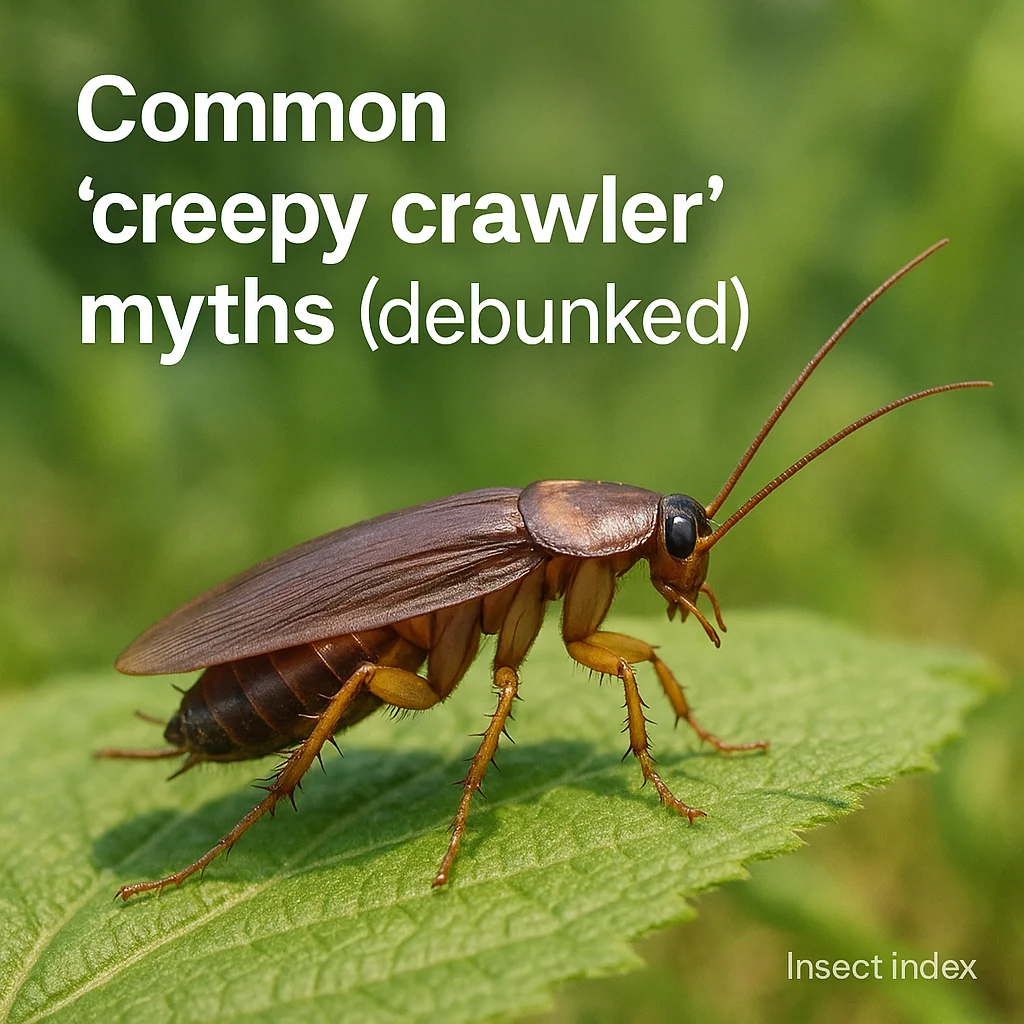
- Common names: Creepy crawlers, bugs, insects
- Scientific name: Varies
- Insect or not: Mostly insects; some are arachnids or other arthropods
- Order / family: Varies widely
- Typical size range (adult): Typically 1 mm to 10 cm
- Key colors/patterns: Varies, including browns, greens, blacks, and bright colors
- Activity: Diurnal and nocturnal species are common
- Typical habitats: Forests, grasslands, urban areas, water edges
- Where in the world it occurs: Nearly every continent, particularly in diverse habitats
- Seasonality: Varies by species and region; many are most visible in warmer months
🔍 Identification
Recognizing various "creepy crawlers" can be challenging due to the wide range of species. However, general identification can be approached by considering their body structure and movement.
- Body shape and silhouette: Insects typically have three main body parts: head, thorax, and abdomen.
- Antennae type: Varies; may include long and thin or short and stubby antennae.
- Wing features: Insects may have wings, whereas other arthropods do not.
- Leg traits and movement style: Insects have six legs; arachnids have eight.
- Distinguishing look-alikes: Can include harmless mimics or species with strikingly similar appearances.
- Check for segmented bodies.
- Note the number of legs.
- Observe for wings and their placement.
- Consider coloration patterns.
- Identify antennae shape and size.
- Watch for movement style.
🧠 Basic Body Structure
The fundamental body structure of insects includes a head, thorax, and abdomen. Most creepy crawlers are invertebrates, meaning they lack a backbone and have an exoskeleton. Arachnids, which are commonly mistaken for insects, have eight legs and a two-segmented body.
If the creature in question is indeed an insect, expect it to molt as it grows due to its hard exoskeleton. For those species with wings, they usually emerge during adulthood.
🌍 Habitat & Distribution
"Creepy crawlers" tend to inhabit various environments from dense forests and open grasslands to urban gardens and wetlands. Microhabitats may include spaces under bark, within leaf litter, below rocks, and along water edges.
While such creatures are found globally, their presence is often influenced by climate, with more sightings probable in warmer and more humid conditions. Urbanization and habitat destruction can greatly affect their distribution and frequency of sightings.
📅 Seasonal Appearance & Activity
These creatures are generally more active during the warmer months when food sources are abundant. Activity can vary between diurnal, nocturnal, and crepuscular, depending on the specific group. Climatic elements like rain and humidity also play a role in their visibility.
- Late spring to early autumn is peak season.
- More sightings in temperate climates during summer.
- Activity may decrease in extreme temperatures.
- Most visible after rain showers or in humid conditions.
🥚 Reproduction & Egg-Laying
Reproductive behaviors among creepy crawlers vary significantly. Some species may engage in elaborate courtship displays, while others may lay eggs discreetly in suitable substrates.
Egg deposition could occur on plants, within soil, or in water environments. The number of eggs laid can depend on the species and environmental conditions, often ranging from a few to several hundred or more.
🌀 Metamorphosis & Life Cycle
Insects undergo different types of metamorphosis. Complete metamorphosis includes stages like egg, larva, pupa, and adult, while incomplete involves egg, nymph, and adult.
Larvae or nymphs typically focus on feeding and growth, often residing in concealed or protected areas. Diet and the duration of each life stage can vary, with some species taking weeks and others years to complete development.
🍽️ Diet & Feeding Behavior
The diet of creepy crawlers changes as they grow. Larvae often consume food that ensures rapid growth, such as plant material or prey. Adults may feed on nectar, other insects, or not eat at all, depending on their role in the ecosystem.
Many have specialized mouthparts adapted to their feeding habits, some having chewing parts and others having piercing-sucking tools. They fulfill various ecological roles as predators, herbivores, scavengers, or pollinators.
🦉 Predators & Defense
Various animals prey on creepy crawlers, including birds, amphibians, reptiles, spiders, and mammals. In response, these creatures have evolved numerous defense strategies, including camouflage and mimicry.
- Many can blend into their environments.
- Imitating more hazardous species is common.
- Some exude or spray chemicals as a defense.
- Swift escape or hiding techniques are used.
👥 Social Behavior & Swarms
The social behavior of creepy crawlers ranges from solitary lifestyles to complex social systems. Most insects are solitary, interacting mainly during mating. In contrast, some like ants and bees form colonies with specific roles such as workers, queens, or drones.
Swarms may occur due to environmental triggers like weather, availability of food, or mating purposes, often forming spectacular natural phenomena.
🧭 Senses & Communication
Creepy crawlers rely on senses adapted to their environments, with vision and smell frequently prevailing. Communication methods vary, using pheromones, light (in the case of some beetles and fireflies), or sound (like stridulation in crickets) to interact with one another.
Understanding these interactions sheds light on their complex social behaviors, chemical signaling being particularly relevant in identifying mates or warning against predators.
🌱 Role in the Ecosystem
Creepy crawlers play essential ecological roles, acting as decomposers, pollinators, and key players in food webs. They aid plant reproduction, control pest populations, and recycle nutrients by breaking down organic matter.
Some have mutualistic relationships with plants and other animals, while a few may serve as parasites during certain life stages.
📉 Population & Conservation Notes
Populations of creepy crawlers fluctuate due to factors like habitat loss, pesticide use, and climate change. While reports often describe them as common, local abundance can differ.
- Encourage planting native flowers and foliage.
- Avoid using chemical pesticides.
- Leave organic debris to provide habitats.
- Support conservation projects focused on ecological balance.
⚠️ Human Interaction & Safety
While many creepy crawlers are harmless, some may defend themselves with bites or stings if threatened. It is advisable to observe respectfully and keep safe distances.
First-aid suggestions include washing the area and avoiding scratching if a reaction occurs. If symptoms are severe, seeking professional medical advice is recommended.
📌 Summary
- Diverse habitats, from forests to urban areas.
- Wide array in appearance and behavior.
- Peak activity during warmer months.
- Complex life cycles: complete/incomplete metamorphosis.
- Diet varies from herbivorous to predatory.
- Faced with natural threats and human impact.
- Fulfill numerous ecological roles.
- Some myths unfounded; many pose no risk to humans.