🕷️ Cockroaches: why they’re so resilient
🧾 Quick Facts
Cockroaches have fascinated and frustrated humans for centuries. Their resilience and adaptability make them successful survivors across the globe.
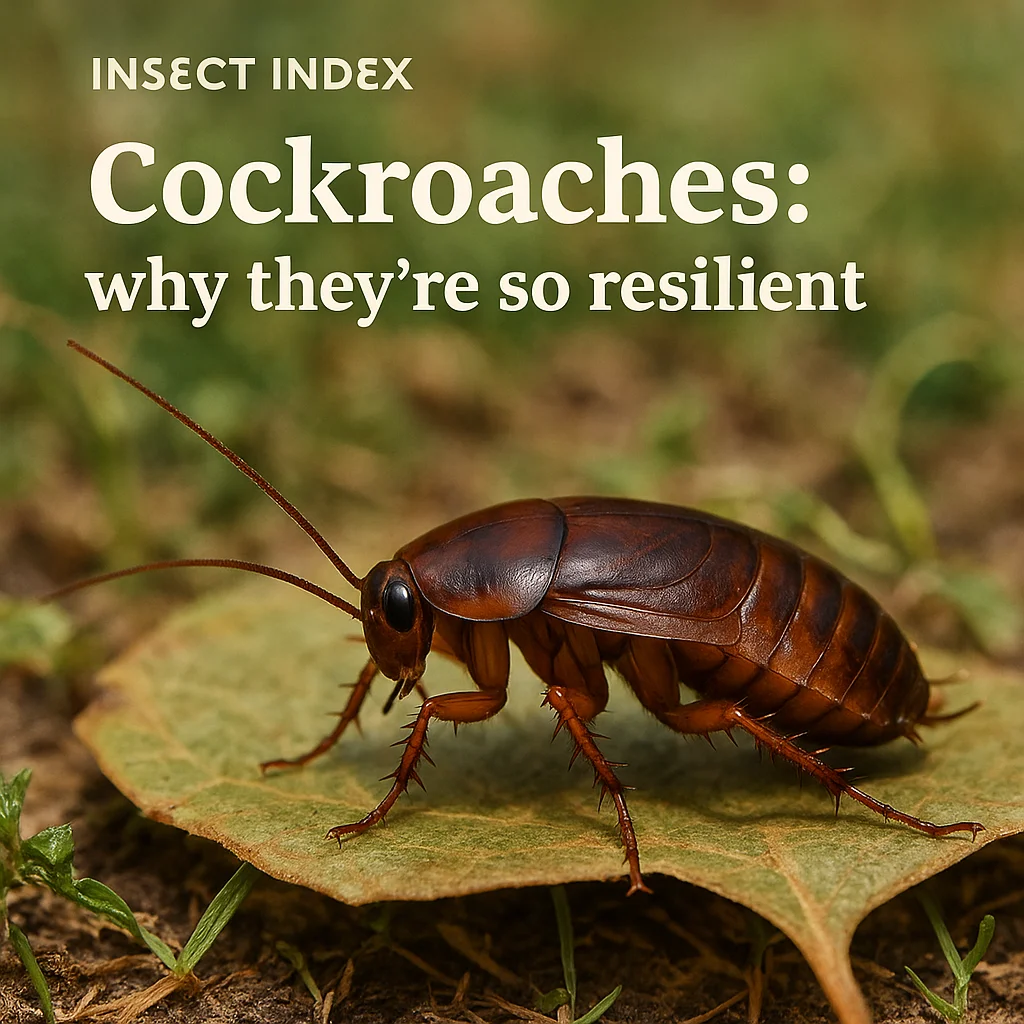
- Common names: Cockroach, Roach
- Scientific name: varies (multiple genera like Periplaneta and Blattella)
- Insect or not: Yes, they are insects, also invertebrates.
- Order / family: Blattodea
- Typical size range: 1.5 - 5 cm (adults)
- Key colors/patterns: Reddish-brown, black, sometimes with lighter markings
- Activity: Nocturnal
- Typical habitats: Warm, humid environments; homes, forests, and urban areas
- Where in the world it occurs: Global distribution
- Seasonality: Year-round in warm climates
🔍 Identification
Cockroaches are easily identified by their distinct body structure and behavior. Typically, they have a flattened, oval shape that allows them to squeeze into tight spaces.
They possess long, thread-like antennae and two pairs of wings, with the forewings forming a protective covering over the hindwings. Their legs are adapted for rapid movement, providing a swift escape from danger.
Common look-alikes include beetles, but cockroaches can be distinguished by their swift, darting movements and preference for hiding when exposed to light.
- Flattened, oval-shaped body
- Long, thread-like antennae
- Wings covered by leathery forewings
- Six spiny legs
- Fast-moving and agile
- Prefer dark, sheltered places
- Distinctive, musty odor
- Often found in damp environments
- Quick to scatter when exposed
🧠 Basic Body Structure
Like all insects, cockroaches have a body divided into three main parts: the head, thorax, and abdomen. They have six legs, each attached to the thorax, and their body is covered by a tough exoskeleton.
As invertebrates, cockroaches lack a backbone, relying on their exoskeleton for support and protection. This exoskeleton is periodically shed through a process known as molting, essential for growth.
🌍 Habitat & Distribution
Cockroaches are adaptable creatures found in a wide range of habitats, from dense forests to urban environments. They thrive in warm, humid climates and are often associated with human habitations.
In natural settings, they can be found beneath leaf litter, inside logs, or under stones. In urban areas, they frequent basements, kitchens, and bathrooms, anywhere that offers warmth, moisture, and food.
Globally, cockroaches are present on every continent except Antarctica, adapting to local conditions.
📅 Seasonal Appearance & Activity
Cockroaches are primarily active at night, taking advantage of cooler temperatures and reduced visibility to search for food. While their presence is more noticeable in warmer months, they remain active year-round in tropical and indoor environments.
- Most active during warmer months
- Primarily nocturnal
- Prefer temperatures above 20°C (68°F)
- Increased activity after rain
- Lesser activity in freezing climates without shelter
- More visible in summer months
- Often found indoors during winter
🥚 Reproduction & Egg-Laying
Cockroaches are prolific breeders, with some species producing several generations per year. Mating involves complex behaviors, including pheromone release and courtship displays.
Females typically lay egg cases known as oothecae, which can contain multiple eggs, often deposited in secure, hidden locations like cracks in walls or under furniture. The number of eggs varies by species, with some laying around 20 eggs per case.
🌀 Metamorphosis & Life Cycle
Cockroaches undergo incomplete metamorphosis, with three main stages: egg, nymph, and adult.
The eggs hatch into nymphs, which resemble smaller versions of the adults but without fully developed wings. Nymphs molt multiple times as they grow, each molt bringing them closer to adult size and form. This process can take several months.
🍽️ Diet & Feeding Behavior
Cockroaches are omnivorous scavengers, feeding on a wide range of materials from organic waste to stored human food. Their robust chewing mouthparts allow them to consume both plant and animal matter.
In the wild, they help decompose decaying matter, playing an important role in nutrient cycling. In human environments, they are adept at finding food wherever it's available.
🦉 Predators & Defense
Despite their resilience, cockroaches are preyed upon by a variety of animals, including birds, reptiles, amphibians, mammals, and some insects like parasitoid wasps.
Their main defenses include quick, agile movements, a flattened body for hiding, and a tendency to avoid light. Some species also produce bitter chemicals as deterrents.
- Quick escape when threatened
- Light avoidance instincts
- Ability to hide in small crevices
- Chemical deterrence in some species
👥 Social Behavior & Swarms
Cockroaches generally lead solitary lives, emerging to feed and mate. However, they can congregate in groups when certain conditions, like food availability or warmth, are present.
While they do not form swarms in the traditional sense, large populations can develop in high-density areas, particularly in urban environments where resources are abundant.
🧭 Senses & Communication
Cockroaches possess well-developed senses of smell and touch, using their long antennae to navigate and detect pheromones. They communicate through pheromone trails, which help them locate mates and resources.
Though their vision is less developed, they are sensitive to light and vibration, using these cues to avoid threats.
🌱 Role in the Ecosystem
Cockroaches play a vital ecological role as decomposers, breaking down decaying organic materials and recycling nutrients back into the ecosystem.
They also serve as prey for many animals, forming an integral part of the food web. In some contexts, they help control detritus accumulation, though they can become pests in human environments.
📉 Population & Conservation Notes
Cockroaches are generally abundant and not considered threatened, with certain species thriving in human environments. However, habitat destruction and pesticide use can affect localized populations.
- Maintain natural habitats
- Reduce pesticide use
- Provide natural cover like leaf litter
- Support diverse ecosystems
- Encourage domestic cleanliness
⚠️ Human Interaction & Safety
Generally harmless to humans, cockroaches do not bite but can trigger allergies and contaminate food in high numbers. As such, proper sanitation and disposal of waste can reduce unwanted encounters.
When managing cockroach presence, it's recommended to observe them respectfully and avoid unnecessary harm.
📌 Summary
- Cockroaches are resilient insects found worldwide.
- Identified by a flattened body, long antennae, and swift movements.
- They thrive in warm, moist environments, often near humans.
- Active year-round, especially nocturnal.
- Life cycle includes egg, nymph, and adult stages.
- Omnivorous scavengers crucial for decomposition.
- Preyed upon by birds, reptiles, and more.
- Communicate through pheromone trails.
- Contribute to ecosystem through nutrient cycling.
- Respectable approach to human interactions is encouraged.