🕷️ Why mosquitoes bite (only females)
🧾 Quick Facts
Mosquitoes are small, flying insects found across the globe, primarily known for their biting behavior, which is exhibited by female mosquitoes. These insects play both nuisance and ecological roles in a variety of environments. Here's a quick overview of what makes mosquitoes unique.
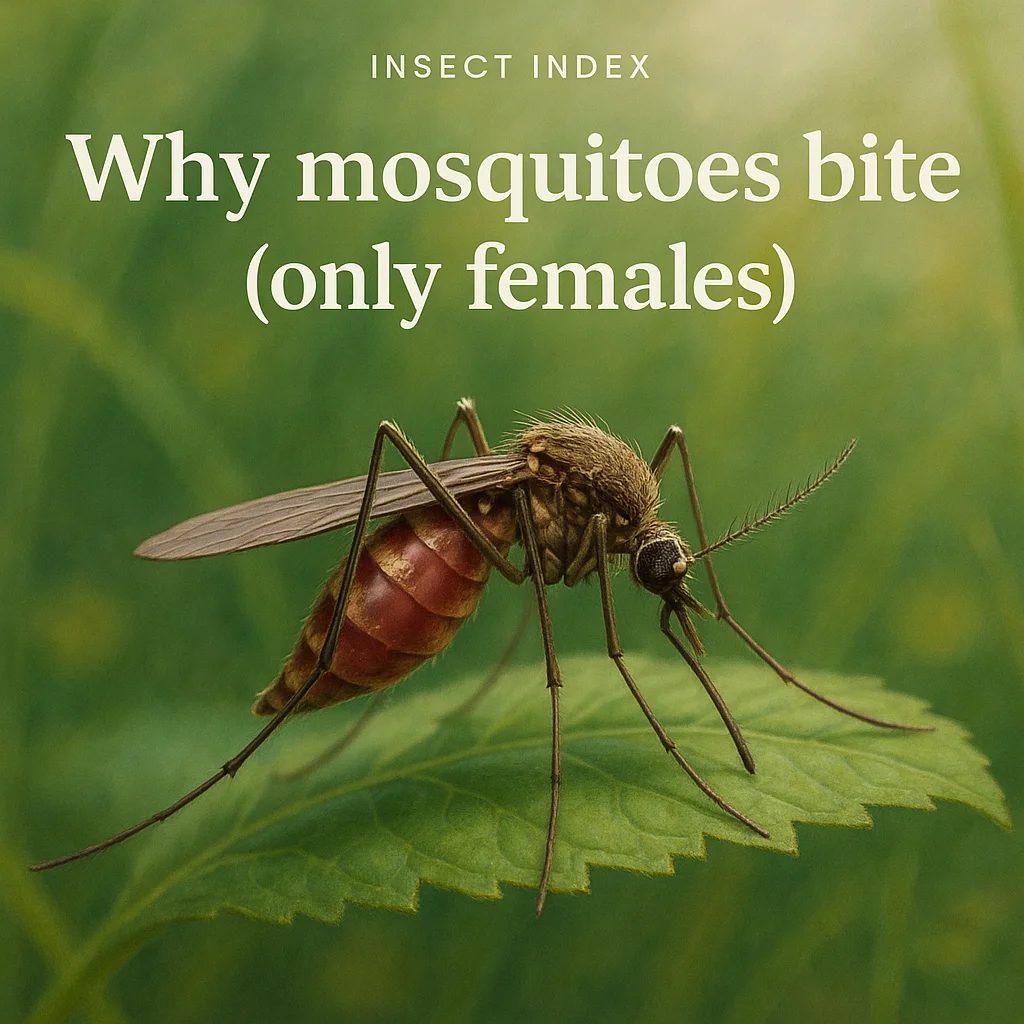
- Common names: Mosquitoes
- Scientific name: Varies (over 3,500 species)
- Insect or not: Insect (invertebrate)
- Order / family: Diptera / Culicidae
- Typical size range (adult): 5 to 16 mm
- Key colors/patterns: Shades of brown, black and gray with some species having iridescent or patterned scales
- Activity: Primarily nocturnal, some species active during the day
- Typical habitats: Wetlands, forests, grasslands, urban and suburban areas
- Where in the world it occurs: Virtually all continents except Antarctica
- Seasonality: Most active in warmer months, depending on climate
🔍 Identification
Mosquitoes can easily be recognized in the field by their slender bodies, long legs, and projected mouthparts. Their delicate wings often display a fringe of tiny scales. Here's how to distinguish them from other insects:
- Body shape and silhouette: Slender bodies with long legs and prominent proboscis
- Antennae type: Many segmented, often feathery in males
- Wing features: Narrow, typically clear or slightly scaled wings
- Leg traits and movement style: Long legs; characteristic hovering flight
- Distinguishing look-alikes: Often mistaken for crane flies, which are larger and do not bite
- Slender body with long legs and proboscis
- Feathery antennae in males
- Clear or lightly scaled wings
- Notable long hind legs
- Often seen near standing water
- Unique buzzing flight sound
🧠 Basic Body Structure
Mosquitoes are classic examples of insects, showcasing a divided body plan consisting of a head, thorax, and abdomen. Each mosquito possesses six legs, adhering to the insect configuration, and a protective exoskeleton that supports their thin wings.
A key feature of mosquitoes is their ability to molt as they grow, shedding their exoskeleton multiple times from larva to adulthood. Mosquitoes are invertebrates, meaning they lack a vertebral column, which is common among insects.
🌍 Habitat & Distribution
Mosquitoes thrive in a wide range of environments but are primarily found near water sources, necessary for their breeding process. They inhabit wetlands, forested paths, grasslands, and even urban gardens. Global distributions span from tropical regions to temperate zones, with each species adapting to its local climate. Changes in habitat conditions, such as temperature and moisture, can influence local mosquito populations.
📅 Seasonal Appearance & Activity
The best time to observe mosquitoes varies by region, but many are most active during warm weather, particularly early in the morning or at dusk when temperatures and wind are lower. Seasonal peaks are often noted in late spring through summer, with activity tapering off in cooler months.
- Late spring through early fall
- Mostly dawn and dusk
- Increased after rainfall
- More prevalent in warmer, humid climates
🥚 Reproduction & Egg-Laying
Female mosquitoes are known for their blood-feeding behavior, which provides the necessary nutrients for egg production. Courtship and mating typically occur in swarms. Eggs are laid on or near water, whether it's stagnant ponds or small puddles, sometimes numbering in the hundreds. The choice of egg-laying sites varies among species, reflecting diverse reproductive tactics.
🌀 Metamorphosis & Life Cycle
Mosquitoes undergo complete metamorphosis, progressing from egg to larva, pupa, and finally to the adult stage. The larval stage is aquatic, with larvae often referred to as "wrigglers" due to their swimming motion. They feed primarily on microorganisms and organic matter.
The pupal stage, also aquatic, marks a transitional period called the "tumbler" phase, where significant transformation occurs. Adult mosquitoes emerge to commence their reproductive and feeding behaviors. The complete cycle from egg to adult varies from a week to several months, largely influenced by environmental conditions.
🍽️ Diet & Feeding Behavior
As larvae, mosquitoes feed on organic particles and microorganisms in water. Adult mosquitoes use their specialized piercing-sucking mouthparts to feed. While females feed on nectar, they require a blood meal for egg production. Blood-feeding involves probing the skin with their proboscis to draw blood.
Males, contrastingly, do not feed on blood and subsist on plant nectars. Mosquitoes play dual ecological roles as pollinators and vectors for various pathogens.
🦉 Predators & Defense
Natural predators of mosquitoes include birds, bats, dragonflies, and certain fish like guppies. To defend against predation, mosquitoes rely on stealth and flight agility. They display minimal direct defense mechanisms other than their tendency to avoid detection through low-profile resting and quick takeoffs.
- Stealthy flight to avoid detection
- Utilize resting coloration for camouflage
- Swift movement and ability to evade
- Short lifecycle aiding quick population recovery
👥 Social Behavior & Swarms
Mosquitoes are largely solitary, interacting primarily for mating purposes. Males form swarms in which females enter to select mates, driven by pheromone signals. This swarming is transient and localized, occurring in open spaces or near breeding waters.
🧭 Senses & Communication
Mosquitoes possess acute sensory abilities. They depend on a combination of vision, thermal cues, and olfactory senses to locate hosts. Antennae play a vital role in detecting carbon dioxide and body odors, while their compound eyes offer broad visual fields.
Communication among mosquitoes is primarily pheromonal, assisting in mating and aggregation. Some species can detect subtle vibrations and sound emitted by potential mates.
🌱 Role in the Ecosystem
In ecosystems, mosquitoes serve as food sources for various animals and minor pollinators for certain plants. They affect food-web dynamics by supporting higher trophic levels. Mosquitoes also play a controversial role as disease vectors, making them a focus in medical entomology.
Complicated interactions with hosts reflect both parasitic and mutualistic relationships, impacting animal populations and ecosystems differently.
📉 Population & Conservation Notes
Due to their adaptable nature and reproductive potential, mosquitoes are seldom considered endangered, often thriving in human-modified landscapes. However, population control is sought for health reasons. Habitat loss from urbanization or pollution can alter mosquito diversity.
- Preserve natural water habitats
- Encourage natural mosquito predators
- Avoid excessive pesticide use
- Participate in community monitoring
⚠️ Human Interaction & Safety
Female mosquitoes bite humans as part of their reproductive strategy. While most bites are harmless, they can transmit diseases in certain regions. For bite management, wash the area with soap, avoid scratching, and seek advice if there is a severe reaction.
Near mosquitoes, it's advisable to use protective clothing and observe respectfully without attempting capture, as their role in nature is essential despite their nuisance.
📌 Summary
- Slender bodies and long legs help identify mosquitoes.
- Found globally, thriving near water bodies.
- Active mainly at dawn or dusk and during warmer months.
- Undergo complete metamorphosis with distinct life stages.
- Females feed on blood; males feed on nectar.
- Part of several food chains, serving as prey and vector.
- Known for transmitting diseases, but also pollinate.
- Human interactions should be cautious and respectful.