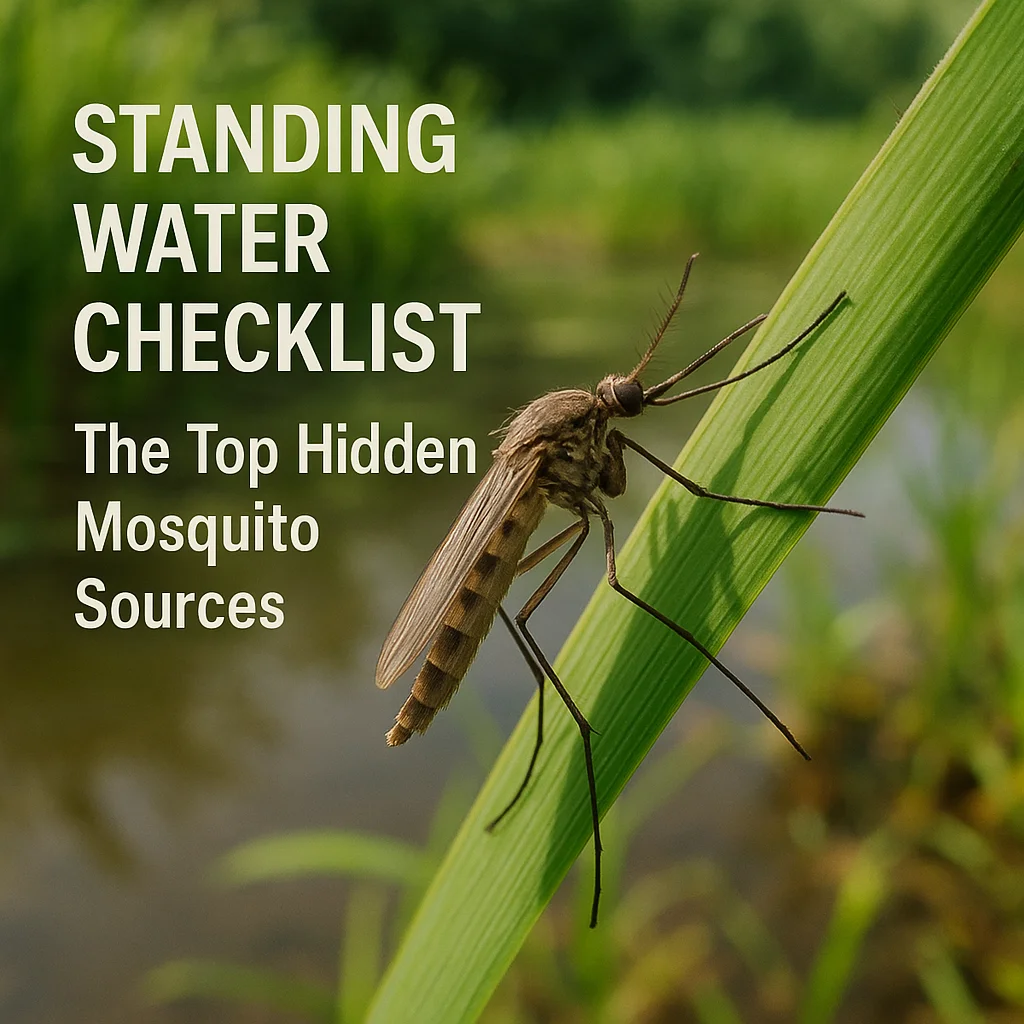
🕷️ Standing Water Checklist The Top Hidden Mosquito Sources
🧾 Quick Facts
Mosquitoes are notorious for their role in transmitting diseases, but understanding their biology and leveraging environmental knowledge can help reduce their prevalence. Finding hidden sources of standing water is key to managing mosquito populations.
- Common names: Mosquito (general term for various species)
- Scientific name: Varies by species
- Insect or not: Insect; belongs to the invertebrate group
- Order / family: Diptera / Culicidae
- Typical size range: 3 mm to 6 mm
- Key colors/patterns: Grey or brown body, sometimes with colorful stripes
- Activity: Most are crepuscular, active at dawn and dusk
- Typical habitats: Near standing water, wetlands, urban areas
- Where in the world it occurs: Found globally, except in Antarctica
- Seasonality: More visible in warmer, wet seasons
🔍 Identification
Identifying mosquitoes involves understanding several physical features that are characteristic of this widely known insect.
- Small, slender bodies with long legs
- Thread-like antennae that vary between species
- Wings with scales that can vary between transparent and patterned
- Unique flight pattern characterized by a buzzing sound
- Easily confused with midges, which do not have scales on wings
- Top ID Tips:
- Look for long, delicate legs
- Soft buzzing sound during flight
- Presence in areas with standing water
- Noticeable proboscis for feeding
- Wings resting flat over body
- Antennae feature fine hairs in males
🧠 Basic Body Structure
Mosquitoes have a fundamental insect structure comprising a head, thorax, and abdomen. As an invertebrate, mosquitoes possess no internal skeleton but have a strong exoskeleton for protection.
The head contains the sensory organs and mouthparts, while the thorax attaches the three pairs of legs and wings. Mosquitoes undergo molting during their development. Being insects, they have six legs and, generally, one pair of wings.
🌍 Habitat & Distribution
Mosquitoes thrive in a variety of habitats, with a preference for warm, humid environments. Tropical regions, rainforests, wetlands, and urban areas with access to standing water are prime mosquito territories.
Microhabitats include puddles, gutters, flowerpots, and any receptacle capable of holding stagnant water. While mosquitoes can be found nearly everywhere except Antarctica, climate change and human intervention can alter their distribution and population dynamics.
📅 Seasonal Appearance & Activity
Mosquitoes are most active during months with higher temperatures and humidity, as these conditions facilitate breeding. Their activity is primarily during the early morning and evening hours.
- Best Time to Spot It:
- Dawn during the warm season
- Dusk when humidity is high
- After rain showers
- Temperatures exceeding 15°C (59°F)
🥚 Reproduction & Egg-Laying
Mosquito reproduction involves specific courtship behaviors, often initiated by the male recognizing the female via her wingbeat frequency. Mating typically occurs in swarms in close proximity to water sources.
Eggs are laid on water surfaces or wet soils, with many species preferring clean, stagnant water. Depending on the species, females can lay between 100 to 300 eggs per batch, utilizing varied strategies and techniques unique to each type.
🌀 Metamorphosis & Life Cycle
Mosquitoes undergo complete metamorphosis including four distinct stages: egg, larva, pupa, and adult.
Eggs hatch into larvae within 48 hours, which feed on microorganisms and organic matter in water. The larval stage is aquatic and lasts about a week, transforming into pupae, which spend a few days maturing before becoming adults.
Adult mosquitoes feed on nectar, with females requiring blood meals post-mating for egg development. The adult stage duration varies by climatic conditions, generally lasting several weeks.
🍽️ Diet & Feeding Behavior
The feeding behavior of mosquitoes is crucial to both their survival and their notoriety. Larvae filter feed on aquatic organic matter, while adults primarily consume nectar. Female mosquitoes, however, need protein from blood to develop eggs, utilizing piercing-sucking mouthparts to draw it from hosts.
Consequently, mosquitoes play roles as both nectar consumers in the ecosystem and as vectors for various pathogens.
🦉 Predators & Defense
Mosquitoes face predation from numerous creature classes, including birds, bats, frogs, and certain spiders. Fish prey on larvae and pupae, maintaining population balance in aquatic environments.
Mosquitoes often evade capture due to their diminutive size and erratic flight, albeit lacking more elaborate defense strategies. Their primary line of defense is dispersal, reducing predator encounters.
- Defense Highlights:
- Erratic flight patterns
- Quick reproductive cycles
- Small, elusive body frame
- Thrives in controlled, low-predation habitats
👥 Social Behavior & Swarms
Mosquitoes are generally solitary in their feeding and resting behaviors, but mating often involves swarming. Males aggregate in swarms, providing locales for females to enter and select partners.
Swarming is influenced by environmental factors such as temperature and moisture, with swarms commonly observed in the proximity of water sources where breeding occurs.
🧭 Senses & Communication
Mosquitoes utilize a range of highly adapted senses, relying heavily on olfactory receptors to detect carbon dioxide and skin chemicals emitted by potential hosts. Their vision aids in locating contrasting silhouettes against the sky.
Communication between mosquitoes is typically mediated through wingbeat frequencies and pheromones, especially during mating rituals.
🌱 Role in the Ecosystem
Mosquitoes, though often maligned, hold significant roles in their ecosystems. Larvae contribute to nutrient recycling by consuming organic detritus in aquatic environments. Adults assist in pollination as they feed on nectar.
Additionally, they serve as an essential food source for numerous predator species and thus have a profound impact on local food webs.
📉 Population & Conservation Notes
Most mosquito species are abundant, given their rapid reproduction rates and adaptability. However, pesticide use, habitat alteration, and climate change can locally impact their populations.
- How to Help (Low-Impact):
- Promote native plant gardening
- Implement non-chemical pest control
- Reduce stagnant water around homes
- Support wetland conservation efforts
⚠️ Human Interaction & Safety
Mosquitoes are famous for their bites, which can cause irritation and transmit diseases. To reduce discomfort, avoid scratching bites and keep the affected area clean. If irritation persists or worsens, seek professional medical advice.
Engage in respectful observation practices, appreciating their ecological roles without harm or collection.
📌 Summary
- Mosquitoes are small, flying insects that thrive near standing water.
- Identification features include long legs and a distinctive wingbeat sound.
- Most active during warm, humid periods, typically at dawn and dusk.
- Mosquitoes undergo complete metamorphosis and feed on nectar, with females requiring blood meals post-mating.
- Common predators include birds, bats, and aquatic creatures.
- Play crucial roles in nutrient recycling and as prey species in ecosystems.
- Population dynamics are affected by environmental changes and human activities.
- Human interactions primarily comprise avoiding mosquito bites through preventive measures.