🕷️ Mosquitoes vs midges: quick differences
🧾 Quick Facts
Mosquitoes and midges are often confused due to their small size and similar environments, but they are distinct insects with different traits.
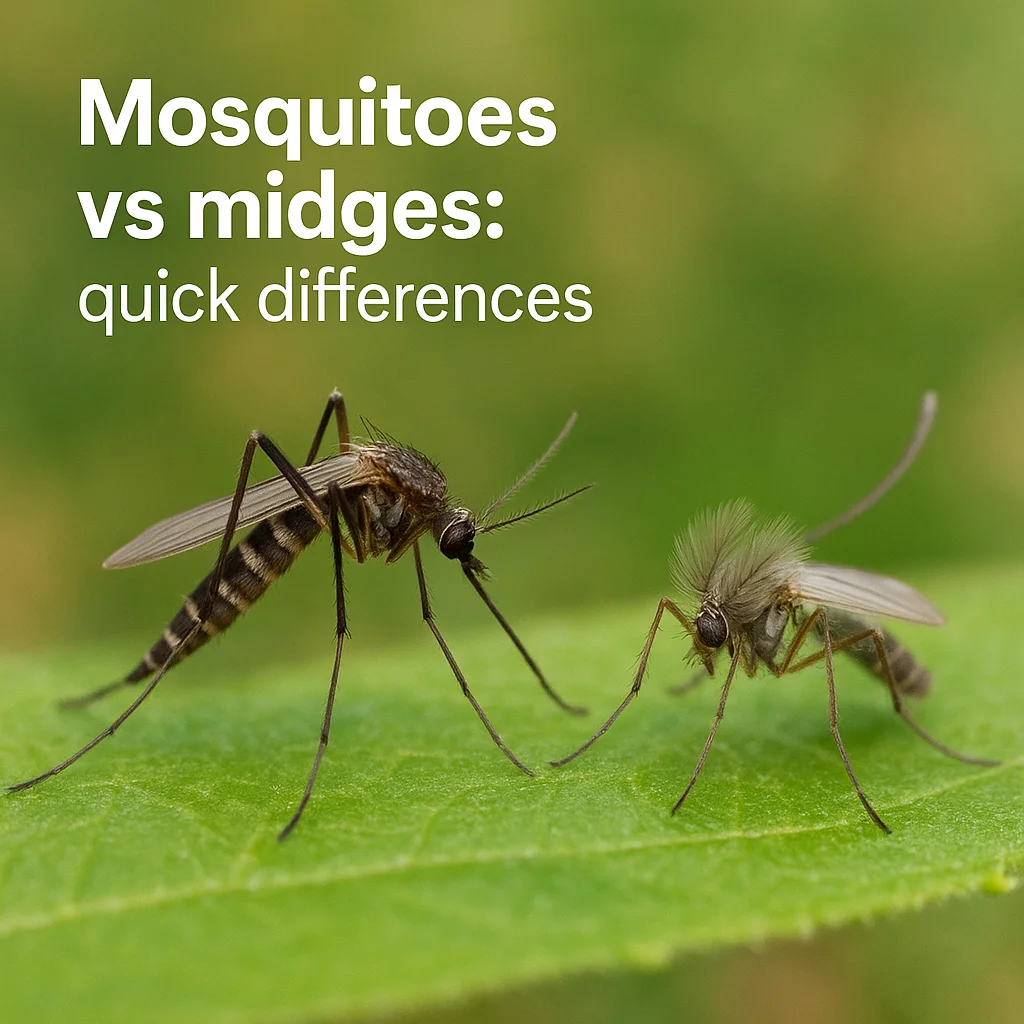
- Common names: Mosquito, Midge, Blind Mosquito, Chironomid
- Scientific name: Varies; mosquitoes (family Culicidae), midges (families Chironomidae and Ceratopogonidae)
- Insect or not: Insects; both groups are invertebrates
- Order / family: Diptera; mosquitoes (Culicidae), midges (Chironomidae, Ceratopogonidae)
- Typical size range: Mosquitoes 3-15 mm; Midges 1-10 mm
- Key colors/patterns: Mosquitoes typically gray or brown; midges range from tan to green or black
- Activity: Primarily crepuscular or nocturnal, though some species are active during the day
- Typical habitats: Near water bodies, marshes, forests, gardens
- Where in the world it occurs: Worldwide
- Seasonality: Varies; peak in warm months
🔍 Identification
Mosquitoes and midges can be recognized by their delicate, elongated bodies and long, thin legs. Mosquitoes have a distinct proboscis, used for feeding, which is absent in midges.
- Body shape and silhouette: Slim and elongated
- Antennae type: Mosquitoes have feathery or thread-like antennae; male mosquitoes have more prominent feathery antennae than females
- Wing features: Mosquito wings are longer than their bodies and have scales; midge wings are clear and lack scales
- Leg traits and movement style: Long legs, held outstretched; both hover in flight
- Distinguishing look-alikes: Mosquitoes have a proboscis; midges do not. Midges are often seen in large swarms.
- Check for presence of a proboscis (mosquito)
- Look for feathered antennae on males (mosquito)
- Midge wings are clear and scaleless
- Mosquito wings have distinct scales
- Notice group activity: midges swarm, mosquitoes less so
- Observe size differences; mosquitoes can be larger
🧠 Basic Body Structure
Both mosquitoes and midges share the basic structure of an insect, comprising a head, thorax, and abdomen. Each has six legs and is encased in an exoskeleton which they must molt to grow. They possess wings, composed of membranous material, vital for their mobility. As invertebrates, they lack a backbone, relying on their exoskeleton for support.
🌍 Habitat & Distribution
Mosquitoes and midges are found in diverse habitats near water, including wetlands, ponds, and streams, as well as urban gardens and forests. They are globally distributed, favoring warm, humid climates. Environmental changes, such as urban development or climate fluctuations, can alter local abundance and sighting frequency.
📅 Seasonal Appearance & Activity
Mosquitoes and midges are generally most visible during warmer months when they are most active. They tend to be crepuscular or nocturnal, although some species may be active during daytime, particularly in cooler regions.
- Warm, humid months most active
- Crepuscular and nocturnal tendencies
- After rain or when humidity is high
- Daytime activity varies with species and region
🥚 Reproduction & Egg-Laying
Mosquitoes and midges use a variety of mating strategies, often involving swarming to attract mates. Eggs are typically laid in or near water sources. Mosquitoes lay eggs in standing water, while midges may use moist soil or plant material. The egg count and laying strategies vary among species, adapting to local environmental conditions.
🌀 Metamorphosis & Life Cycle
Both mosquitoes and midges undergo complete metamorphosis, transitioning through the stages of egg, larva, pupa, and adult.
The larvae of both are aquatic, with mosquito larvae often called wrigglers due to their movement in water, and midge larvae known as bloodworms due to their red color. Larvae feed on microorganisms or organic matter in the water. The pupal stage is relatively short, leading to the emergence of adults which seek to mate and lay eggs, perpetuating the cycle.
🍽️ Diet & Feeding Behavior
Mosquitoes typically have piercing-sucking mouthparts used to feed on nectar and, in females, blood, required for egg production. Midges, however, usually do not bite people; they feed on nectar, detritus, and organic material. Both play roles as decomposers and, for mosquitoes, pollinators for certain plant species.
🦉 Predators & Defense
Mosquitoes and midges face predation from a variety of animals, including birds, bats, spiders, fish, and other insects. Their primary defense mechanisms include their small size and maneuverability in flight. Some mosquitoes utilize mimicry, resembling unpalatable species to avoid predation.
- Quick, erratic flight patterns
- Small size conceals them
- Mimicry to avoid detection
- Camouflage in vegetation or water
👥 Social Behavior & Swarms
Mosquitoes are generally solitary except when swarming for mating. Midges, however, are more frequently observed in large swarms, especially when mating conditions are favorable. Swarming is typically triggered by environmental conditions, such as temperature and humidity.
🧭 Senses & Communication
Mosquitoes and midges have acute senses, using antennae to detect chemical cues and pheromones. Mosquitoes rely on carbon dioxide detection to locate hosts. Visual signals and body vibrations are used to attract mates during swarming events.
🌱 Role in the Ecosystem
Mosquitoes and midges provide numerous ecological benefits. Mosquitoes can be pollinators for particular plants, while both serve as essential food sources for higher trophic levels, contributing to the biodiversity and balance of their ecosystems. Some play roles in decomposing and recycling nutrients within their habitats.
📉 Population & Conservation Notes
Mosquitoes and midges are often reported as abundant locally, though their populations can be affected by factors such as pesticide use, habitat destruction, and climate change. Maintaining habitats and reducing pesticide employment can help balance their ecological role.
- Encourage native vegetation in gardens
- Avoid broad-spectrum pesticides
- Create water features with natural predators
⚠️ Human Interaction & Safety
Mosquitoes are known for biting people, which can result in itching or, in some cases, allergic reactions. It's advised to wash the affected area and seek professional advice if experiencing a severe reaction. Midges generally do not bite humans. It's important to observe them respectfully and minimize disturbances to their natural habitats.
📌 Summary
- Mosquitoes and midges belong to the order Diptera
- Found near water sources worldwide
- Most active during warm seasons and humid conditions
- Undergo complete metamorphosis
- Mosquitoes use piercing mouthparts; midges do not typically bite
- Natural predators include birds and bats
- Important in the ecosystem as pollinators and food sources
- Conservation aided by reducing habitat disruption and pesticide use