🕷️ Mosquito peak times: dawn and dusk explained
🧾 Quick Facts
Mosquitoes are small insects known for their sucking mouthparts and their role as vectors for diseases. They are especially active during certain times of the day, making them a subject of interest for both scientific study and those seeking outdoor adventures.
- Common names: Mosquitoes
- Scientific name: Varies (e.g., Culex pipiens, Aedes aegypti)
- Insect or not: Insect (invertebrate)
- Order / family: Diptera / Culicidae
- Typical size range: 3 to 10 mm
- Key colors/patterns: Gray, brown, spotted wings
- Activity: Mostly crepuscular (dawn and dusk)
- Typical habitats: Wetlands, urban areas, forests
- Where in the world it occurs: Found globally except in extreme cold regions
- Seasonality: Late spring to early autumn in temperate regions
🔍 Identification
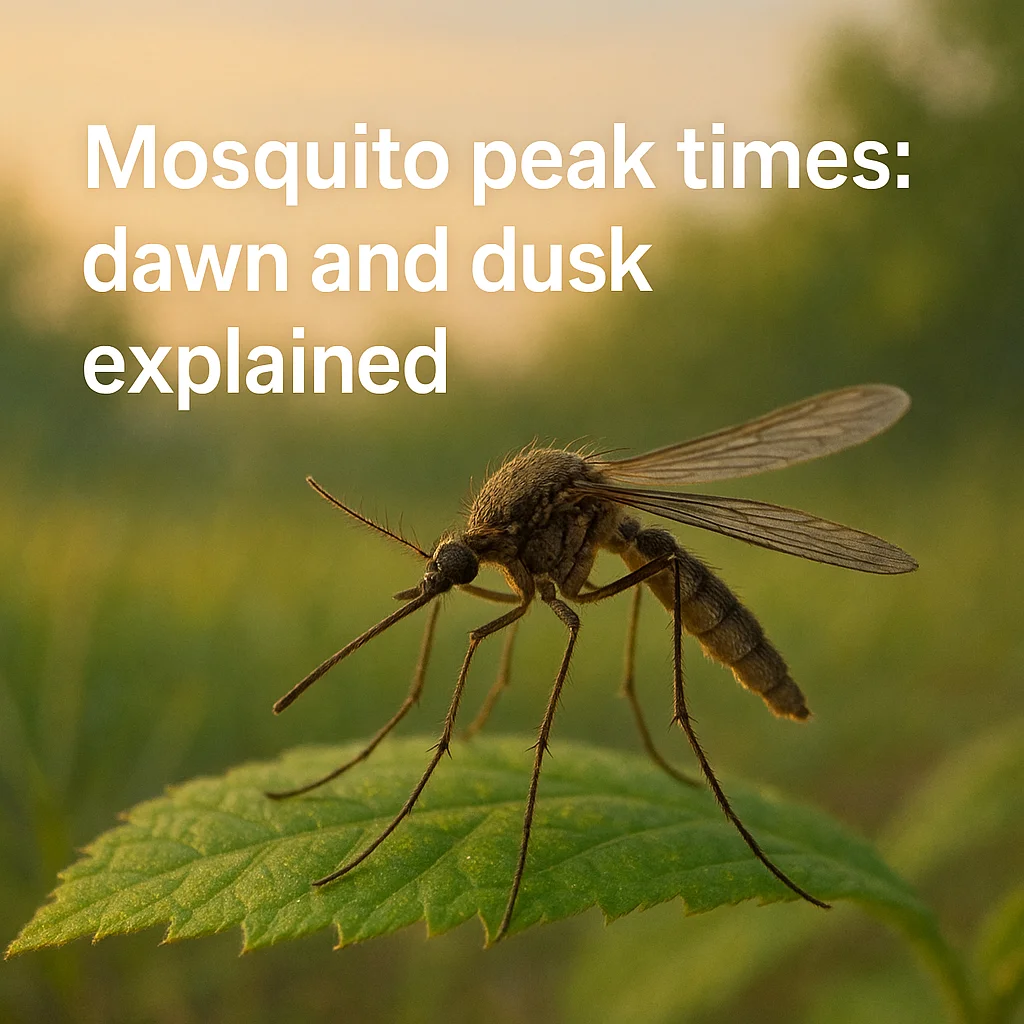
Mosquitoes can be identified by their slender bodies and elongated mouthparts used for piercing skin. Understanding their distinct features can help in distinguishing them from look-alikes.
They have delicate legs and wings covered with scales. Males typically have feathery antennae while females have more thread-like ones. Mosquitoes are often confused with crane flies, which are larger and do not bite.
- Slender, elongated body shape
- Females have thread-like antennae; males have bushy
- Long, folded wings with vein patterns
- Delicate, elongated legs that dangle during flight
- Confusion with crane flies is common; note the size difference
- Entire insect is visible including legs, antennae, and abdomen in images
🧠 Basic Body Structure
Mosquitoes are insects, which makes them invertebrates as they lack a backbone. Their bodies are divided into three main parts: the head, thorax, and abdomen. They possess an exoskeleton, which they molt during development.
Adult mosquitoes have six legs and a pair of wings, although the wing structure includes scales that set them apart from other flying insects.
🌍 Habitat & Distribution
Mosquitoes thrive in environments where there is standing water, which is crucial for their larval development. These include wetlands, lakeshores, and even urban areas with artificial containers holding water.
They are distributed worldwide, except in areas with severe cold climates such as Antarctica. Their presence is heavily influenced by their requirement for moisture and warmer climates to support their life cycle.
📅 Seasonal Appearance & Activity
Mosquitoes are generally more active during warmer months. Their activity is marked by a peak at dawn and dusk, making them crepuscular. Temperature and humidity can significantly influence their presence, with increased activity following rain showers.
- Spring to autumn in temperate zones
- Higher activity at dawn and dusk
- Rain and humidity boost activity
- Less active during daylight hours when temperatures are extreme
🥚 Reproduction & Egg-Laying
Mosquitoes exhibit unique courtship behaviors with males forming swarms to attract females. After mating, females seek out standing water to lay their eggs. Depending on the species, eggs can be laid singly or in rafts, and numbers can vary widely. Larval development depends on species and environmental conditions.
🌀 Metamorphosis & Life Cycle
Mosquitoes undergo complete metamorphosis, consisting of egg, larva, pupa, and adult stages. The eggs hatch into larvae, often called "wrigglers," which live in water and consume microorganisms.
The next stage, the pupa, does not feed and is transitional before emerging as an adult. Adult mosquitoes primarily feed on nectar; only females feed on blood, needed for egg development.
🍽️ Diet & Feeding Behavior
Adult mosquitoes typically feed on nectar from flowers, with females requiring blood for egg production. Larvae filter water for microorganisms. The piercing-sucking mouthparts are adapted for feeding, with females having probes to pierce skin or plant walls.
Mosquitoes play roles as pollinators, though their impact is minor compared to other insects.
🦉 Predators & Defense
Mosquitoes face predation from numerous sources, including birds, bats, amphibians, and other insects like dragonflies. In response, they are adept at flight and employ chemical cues to avoid areas with high predation.
- Camouflage against predators
- Speedy flight to escape
- Detection of predators through sensory organs
- Use of faint colors to avoid attracting attention
👥 Social Behavior & Swarms
Mosquitoes are solitary but some species form mating swarms. These swarms are generally triggered by environmental cues such as temperature and humidity.
Despite swarming behavior, they do not exhibit complex social structures like bees or ants.
🧭 Senses & Communication
Mosquitoes rely heavily on their sense of smell to locate hosts and mates. They can detect CO2 and other chemicals exhaled by animals. Their vision is good but primarily at short distances.
Males communicate during swarming with wing beats that create specific frequency patterns attractive to females.
🌱 Role in the Ecosystem
Mosquitoes hold important roles in ecosystems. As pollinators, they assist some plants, though this role is limited compared to their role as a food source for other animals. They are also critical in population control of microorganisms.
However, some species transmit diseases, impacting human health, agriculture, and livestock production.
📉 Population & Conservation Notes
Mosquito populations can be abundant, primarily due to adaptable breeding and habitat availability. Still, habitat loss and climate changes threaten certain species. Conservation efforts focus on mitigating disease transmission rather than population reduction.
- Encourage natural predators
- Maintain natural wetland habitats
- Limit standing water in urban areas
- Reduce pesticide use
⚠️ Human Interaction & Safety
Female mosquitoes are known for biting, as they seek blood meals necessary for egg development. Reactions to bites can range from mild irritation to severe. It is advisable to clean bites with water, avoid scratching, and seek professional help if symptoms worsen.
Preventative measures include using repellents, wearing protective clothing, and ensuring windows and doors have screens.
📌 Summary
- Mosquitoes are identified by their slender bodies, elongated mouthparts, and scaled wings.
- They thrive in wetland and urban environments with standing water.
- Active mostly around dawn and dusk, with seasonal peaks in warmer months.
- Undergo complete metamorphosis, beginning in water.
- Diet varies from nectar to blood in females for reproduction.
- Prey for birds, bats, and insects; use flight for defense.
- Serve as pollinators, but more crucial in food webs.
- Population control involves environmental management and disease mitigation.
- Bites require basic care; adopt preventative measures for personal safety.