🕷️ Soldier flies: compost helpers
🧾 Quick Facts
The fascinating soldier flies are often celebrated for their ecological role, particularly in composting. These flies are known for their distinct appearance and their ability to aid in the decomposition process, contributing significantly to nutrient cycling in various ecosystems.
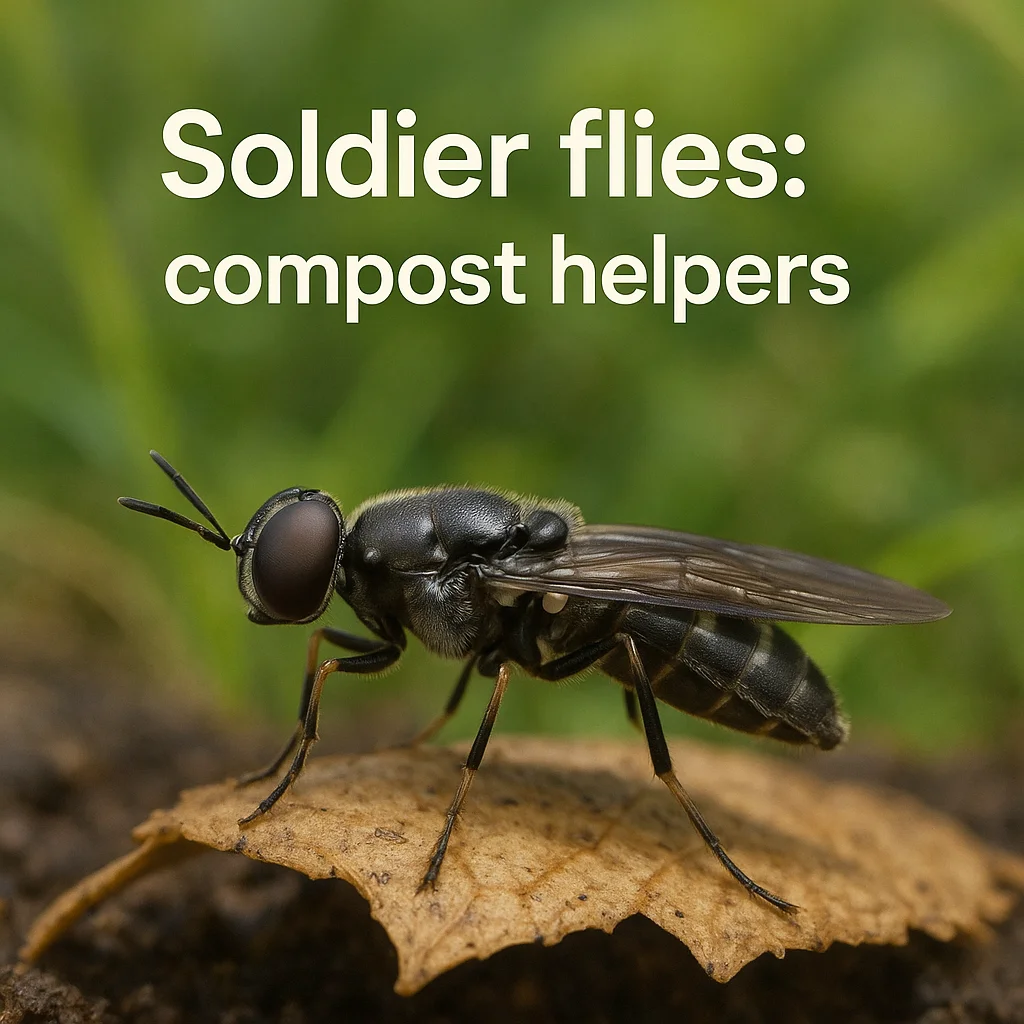
- Common names: Soldier Fly, Black Soldier Fly
- Scientific name: Hermetia illucens (most common species)
- Insect or not: Yes, an invertebrate insect
- Order / family: Diptera / Stratiomyidae
- Typical size range (adult): 5 to 16 mm in length
- Key colors/patterns: Black, metallic sheen, some species have yellowish stripes
- Activity: Primarily diurnal
- Typical habitats: Compost piles, decaying organic matter, forest floors, garden waste
- Where in the world it occurs: Worldwide, predominantly in tropical and temperate regions
- Seasonality: Most visible during warmer months
🔍 Identification
Recognizing soldier flies in the field involves noting their unique body structure and coloration. These flies have an elongated, slender body that resembles a wasp, contributing to their common name.
Their antennae are distinctly longer than those of houseflies and are slightly feathered at the end. Soldier flies possess two wings with a characteristic dark and opaque appearance. Despite possessing strong legs, they are often seen crawling rather than flying rapidly.
They can be mistaken for wasps due to their body shape and coloring, but they lack the stinger and the notable narrow waist typical of wasps.
- Elongated, slender body with wasp-like appearance
- Distinctive long antennae with feathery tips
- Dark, opaque wings held flat over the body
- Metallic black or bluish sheen, some with yellowish bands
- Non-aggressive and avoids human interaction
- Often found near compost or decaying matter
- Body shape and leg configuration differ from houseflies
- Mimic wasps for defense but are harmless
🧠 Basic Body Structure
As insects, soldier flies have a body divided into three main parts: the head, thorax, and abdomen. The head houses sensory organs such as compound eyes and antennae. The thorax supports three pairs of legs and a single pair of wings, while the abdomen contains the digestive and reproductive organs.
Soldier flies are invertebrates, meaning they have no internal skeleton. Instead, they have an exoskeleton that provides structure and protection. They undergo molting to grow, shedding their exoskeleton as they transition through life stages.
🌍 Habitat & Distribution
Soldier flies thrive in various environments, particularly where there is decomposing organic matter. They are commonly found in compost piles, agricultural waste, and forest floors rich with decaying leaves and wood.
Globally, they are distributed across continents, with a higher population density in tropical and temperate climates, where warm conditions favor their growth and reproduction. Their presence in an area often indicates a healthy decomposition process.
Changes in habitat, such as urban development, can affect their populations by reducing available breeding and feeding sites.
📅 Seasonal Appearance & Activity
Soldier flies are most visible during the warmer months when decomposition processes are at their peak. These insects are primarily active during the day when they are often seen resting or slowly crawling on compost piles and similar habitats.
Weather conditions, such as high temperatures and humidity, can influence their activity levels, as these factors accelerate the decomposition process they rely on for nutrition and reproduction.
- Most visible in late spring through early autumn
- Diurnal; active during daylight hours
- Increased activity in warm, humid conditions
- More sightings in regions with a lot of compost or decaying organic matter
🥚 Reproduction & Egg-Laying
Soldier flies exhibit a fascinating reproductive strategy, with males often seen hovering around compost piles or decaying material to find females for mating. Courtship involves short flights and displays near suitable egg-laying sites.
Females lay their eggs in batches on or near decomposing organic matter, such as compost piles, manure, or decaying vegetation. The exact number of eggs per batch can vary significantly depending on environmental conditions, but it generally ranges from hundreds to thousands.
🌀 Metamorphosis & Life Cycle
Soldier flies undergo complete metamorphosis, consisting of four stages: egg, larva, pupa, and adult. This lifecycle is critical to their ecological role in decomposition.
The eggs hatch into larvae (often referred to as maggots), which feed voraciously on decomposing organic matter. This stage is essential for nutrient recycling in ecosystems. The larval stage can last anywhere from a few weeks to several months, depending on temperature and food availability.
After completing the larval stage, they enter the pupal stage, transforming internally into adults. This stage can last from one to two weeks. The adults, which typically live for about one to two weeks, focus on reproduction and usually do not require feeding, surviving primarily on stored nutrients.
🍽️ Diet & Feeding Behavior
At different life stages, soldier flies have varied diets. The larvae are detritivores, feeding on decomposing organic material. This makes them valuable components of compost systems and crucial for nutrient recycling.
The adult stage differs significantly, as they typically do not feed at all or consume very minimal sustenance. Their mouthparts are adapted for sipping liquids but are generally non-functional for consuming solid materials, relying on the energy stored from their larval stage.
🦉 Predators & Defense
Soldier flies face predation from various natural enemies, including birds, small mammals, amphibians, spiders, and parasitoid wasps. Despite these threats, they have developed effective defense mechanisms.
Mimicry plays a significant role; their resemblance to wasps deters some predators. Camouflage due to their metallic coloring helps them blend into decomposing materials. They also exhibit a non-aggressive demeanor, usually avoiding confrontation by staying still or retreating into cover.
- Resemble wasps to deter predators
- Metallic sheen provides camouflage in sunlight
- Non-aggressive; avoids predatory attention
- Relies on speed and cover when threatened
👥 Social Behavior & Swarms
Soldier flies are primarily solitary insects, with individual flies seeking out decomposing materials to lay eggs and develop away from others. Mating encounters are brief, and there are no formal swarms or colonies associated with soldier flies.
There are occasional aggregations observed around abundant resources, but these are opportunistic rather than structured social behaviors. The presence of many individuals in one area often indicates a shared interest in the local resources rather than coordinated behavior.
🧭 Senses & Communication
Like many insects, soldier flies rely on their senses to navigate their environment. Their vision, attuned to detecting movement and contrasting light conditions, plays a critical role during flight and mate seeking.
Smell and chemical communication through pheromones are also likely to be important, especially for locating decomposing materials and potential mates. Soldier flies are not known for producing sounds or engaging in complex communicative behaviors like some other insect species.
🌱 Role in the Ecosystem
The ecological role of soldier flies is significant due to their involvement in decomposition. By consuming decaying organic matter, their larvae facilitate the recycling of nutrients, enhancing soil fertility and aiding plant growth.
Additionally, soldier flies contribute to the breakdown and reduction of organic waste, making them invaluable in composting systems. Their interactions with the environment support a mutualistic relationship promoting ecosystem health and resilience.
📉 Population & Conservation Notes
Generally, soldier flies are reported as common in suitable habitats, supported by their adaptability to human-altered environments. However, factors like habitat loss, excessive pesticide use, and climate changes can impact their local abundances.
- Encourage native plants to support insect diversity
- Avoid using harsh chemicals and pesticides
- Leave leaf litter and organic debris for habitat enrichment
- Participate in composting to provide larvae resources
⚠️ Human Interaction & Safety
Soldier flies are harmless to humans and do not bite or sting. Their resemblance to wasps is purely defensive and not indicative of any threat. As decomposers, they do not transmit diseases or damage crops, making them beneficial in managing organic waste.
When observing soldier flies, it is essential to respect their role in the ecosystem. Instead of collecting them, allow them to remain in their natural environment to continue contributing to ecological processes.
📌 Summary
- Soldier flies are beneficial compost helpers found worldwide.
- They are most active during warm months, typically diurnal.
- Larvae play a crucial role in decomposing organic material.
- Their wasp-like appearance provides a defensive mimicry.
- They exhibit a complete metamorphosis: egg, larva, pupa, adult.
- Their feeding habits change drastically from larvae to adult.
- They are subject to predation but use mimicry and camouflage.
- Not social; solitary apart from occasional opportunistic gatherings.
- Important for nutrient cycling and soil health in ecosystems.
- Conservation involves habitat protection and reducing pesticide use.