🕷️ Robber flies: aerial hunters
🧾 Quick Facts
Robber flies, known for their impressive aerial hunting capabilities, belong to a diverse group of predatory insects. They are highly adaptable and can be found in various habitats across the globe. Here are some key facts about robber flies.
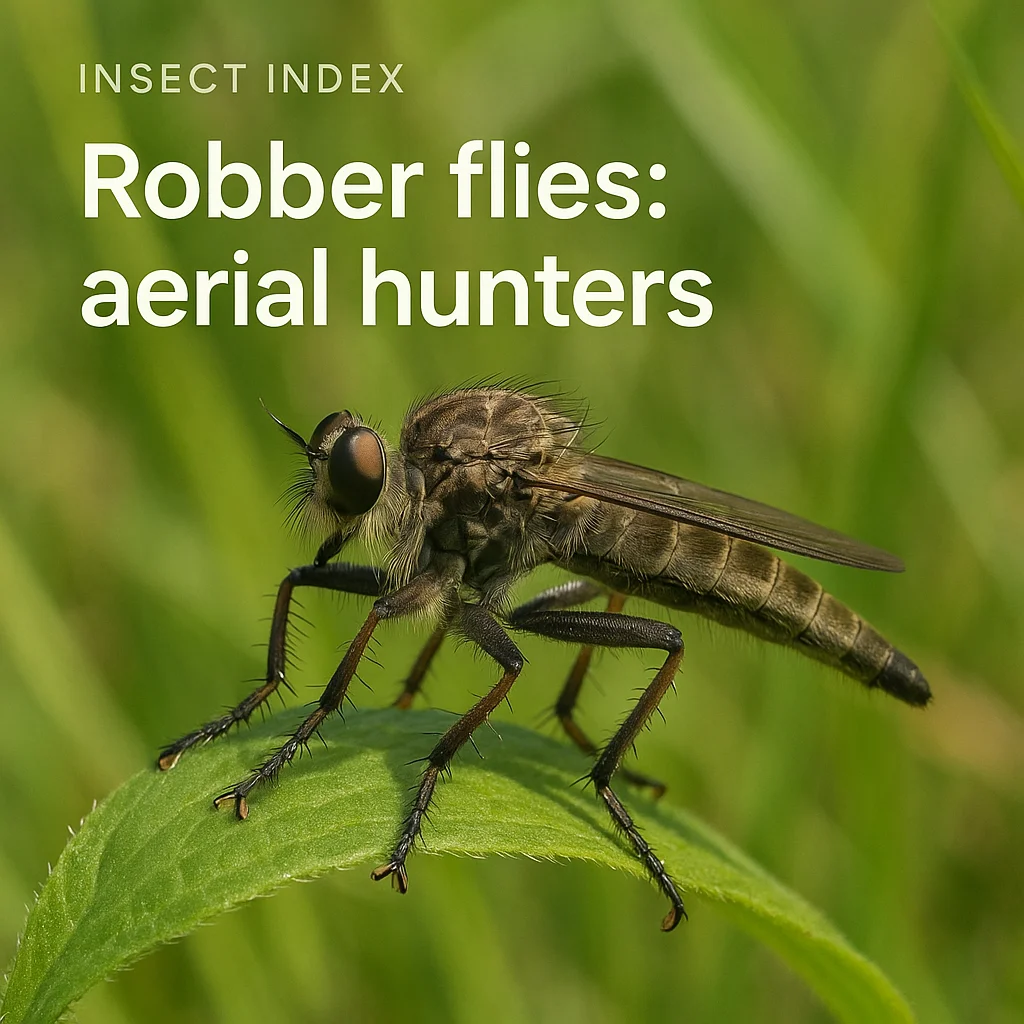
- Common names: Robber flies, Assassin flies
- Scientific name: Varies, as they belong to the family Asilidae
- Insect or not: Insect; a type of invertebrate
- Order / family: Diptera / Asilidae
- Typical size range (adult): 6–50 mm in length
- Key colors/patterns: Gray, black, brown, sometimes with stripes or metallic hues
- Activity: Primarily diurnal (active during the day)
- Typical habitats: Grasslands, forests, deserts, suburban areas
- Where in the world it occurs: Widely distributed, found on all continents except Antarctica
- Seasonality: Most active in warmer months; varies by region
🔍 Identification
Robber flies are recognized as fierce predators with distinctive physical features. Their body shape, wing, and leg structures help in identifying them in their natural habitats.
- Body shape and silhouette: Elongated bodies with a tapered abdomen, often resembling a fighter jet
- Antennae type: Short, spiky bristle-like structures
- Wing features: Two clear functional wings, often longer than the body; resting position is flat or slightly spread
- Leg traits and movement style: Long, sturdy legs adapted for grasping prey; agile in flight
- Distinguishing look-alikes: Sometimes confused with bees or dragonflies due to similar flight patterns
- Top ID Tips:
- Look for elongated, robust bodies
- Notice the distinctive snout-like mouthparts
- Observe their hovering and fast darting actions
- Identify the short, bristly antennae
- Note the long, cushioned setae on the face and beard
- Check the resting wing posture—often flat against the body
🧠 Basic Body Structure
As insects, robber flies possess a typical three-part body plan divided into the head, thorax, and abdomen. They have six legs and an exoskeleton, which is a hard protective outer layer that provides support and defense.
Robber flies undergo molting, in which they shed their exoskeletons to grow. Additionally, they are invertebrate creatures, lacking a backbone, unlike vertebrates. Some species have wings that allow for their notable aerial maneuvers.
🌍 Habitat & Distribution
Robber flies can thrive in a broad range of environments, from dense woodlands and open fields to arid deserts and even urban gardens. They prefer areas with ample prey availability and suitable perching sites. Microhabitats include sunny, open spaces where they can effectively hunt, as well as undergrowth or foliage offering cover.
Geographically, robber flies are found on every continent except Antarctica, prospering in regions from temperate to tropical climates. Habitat modifications, such as urbanization, can influence their visibility and distribution by either providing new niches or fragmenting existing areas.
📅 Seasonal Appearance & Activity
Most commonly observed during warmer months, robber flies are typically active from late spring to early autumn in temperate zones. They are diurnal, primarily hunting during sunlight hours but may also be influenced by temperature, humidity, and prey availability.
- Best Time to Spot It:
- Late spring through early fall
- Sunny days with moderate temperatures
- Mid-morning to late afternoon
- In regions with a stable prey population
🥚 Reproduction & Egg-Laying
Robber flies engage in diverse mating behaviors, which often include aerial displays or specific perching routines to attract mates. Copulation generally involves the male clasping the female with specialized claspers during flight or while perched.
Females typically lay eggs in soil, plant material, or decaying wood, depending on the species. Egg-laying strategies and counts can vary across different species, ranging from a few dozen to several hundred eggs per cycle, laid in environments that provide optimal conditions for larval development.
🌀 Metamorphosis & Life Cycle
Robber flies undergo complete metamorphosis, progressing through the egg, larva, pupa, and adult stages.
During the larval stage, these insects are soil-dwelling predators or scavengers, feeding on other insect larvae and organic material. This stage lasts from several months to a year, depending on environmental conditions and species.
The pupal stage is spent in a protective casing, often underground, where they undergo significant transformation. Emerging as adults, they shift to aerial predation, living for a few weeks to months, depending on factors such as climate and food availability.
🍽️ Diet & Feeding Behavior
As voracious predators, adult robber flies primarily feed on other insects, including beetles, bees, wasps, ants, and even other flies. Equipped with strong, piercing-sucking mouthparts, they inject enzymes into prey to liquefy internal tissues, which they then consume. Larvae also have predatory traits, mainly consuming soft-bodied organisms in soil or decaying matter.
Robber flies play an essential role in controlling insect populations, acting as natural pest regulators within their ecosystems.
🦉 Predators & Defense
Despite their prowess as predators, robber flies are susceptible to various threats, including birds, spiders, even other insect predators. They employ numerous defense tactics to survive.
- Defense Highlights:
- Camouflage: Natural body colors blend with surroundings
- Speed: Quick, agile flight to evade predators
- Bite: Can deliver a sharp bite if handled, though harmless when unprovoked
- Escape tactics: Sudden dives or swift aerial maneuvers
👥 Social Behavior & Swarms
Robber flies are predominantly solitary hunters. Although not territorial, individuals may defend specific valued perches. Mating interactions are generally the only social behavior observed.
They do not form swarms or exhibit migratory behaviors, primarily relying on individual hunting skills and experience to locate prey and mates.
🧭 Senses & Communication
Robber flies possess highly developed visual systems, facilitating superior prey detection and capture. Their compound eyes provide a wide field of view, allowing them to track fast-moving prey efficiently. Olfactory and tactile senses are also present, although less pronounced in hunting behavior.
Communication in these insects is limited, primarily involved in mating rituals and territory defense using visual cues and flight maneuvers.
🌱 Role in the Ecosystem
Ecologically, robber flies are important biological control agents, significantly contributing to regulating insect populations. By preying on myriad insect species, they maintain balanced ecosystem dynamics and support biodiversity.
Moreover, their interactions with plant and insect communities involve complex ecological relationships, including mutualistic roles in some contexts, like pollination, although secondary to their predatory behavior.
📉 Population & Conservation Notes
As a whole, robber flies are not currently threatened, often reported as common where suitable habitats persist. However, certain species may face localized pressures due to habitat destruction, pesticide use, and climate changes.
- How to Help (Low-Impact):
- Plant native flowering species to support diverse insect populations
- Avoid or minimize pesticide use in gardens and landscapes
- Maintain natural habitats like leaf litter and deadwood
- Participate in or promote citizen science projects
⚠️ Human Interaction & Safety
Robber flies generally pose no threat to humans and rarely bite. When a bite does occur, typically only when mishandled, it may cause minor irritation—washing the area and avoiding scratching is advised. If reactions are severe, seeking professional medical advice is recommended.
Encourage respectful observation in natural settings and discourage the collection or harm of these beneficial creatures to promote insect-friendly environments.
📌 Summary
- Robber flies are expert aerial hunters with a wide distribution and habitat range.
- They exhibit complete metamorphosis, developing through distinct life stages.
- Diurnal in nature, commonly sighted in warmer months.
- Serve as natural pest controllers, preying on a variety of insects.
- Warning: Can bite if handled, though generally non-aggressive.
- Valuable ecosystem role in promoting insect population balance.
- Conservation largely stable, but habitat preservation remains crucial.
- Encourage natural habitats while minimizing pesticide use for population health.