🕷️ How to ID hoverflies vs bees
🧾 Quick Facts
Hoverflies and bees are often mistaken for one another due to their similar appearance and behavior. However, with a few key pointers, you can learn to differentiate them efficiently in the field.
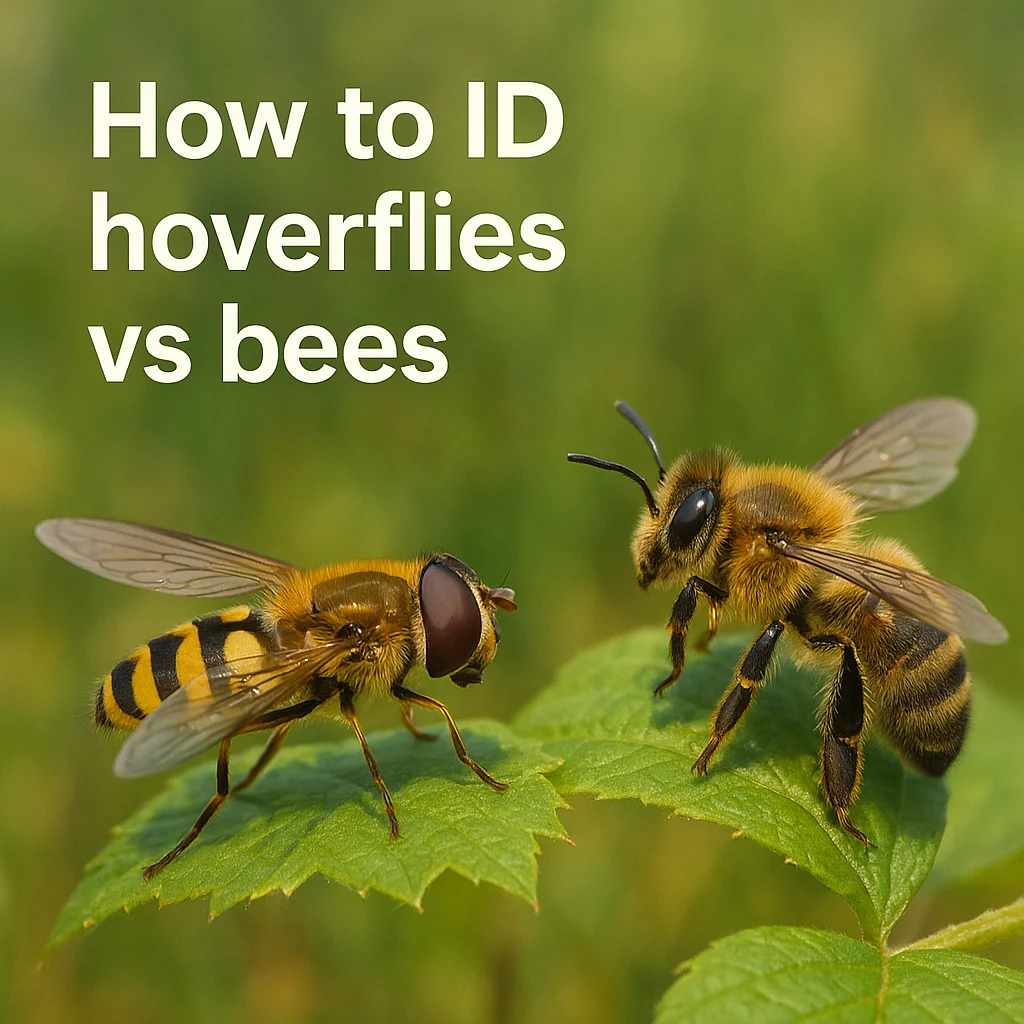
- Common Names: Hoverflies (Syrphid flies), Bees (Honeybees, Bumblebees)
- Scientific Name: Varies
- Insect or Not: Both are insects, meaning they are invertebrates with exoskeletons.
- Order/Family: Hoverflies: Syrphidae; Bees: Apidae
- Typical Size Range: Adult hoverflies are 6-20 mm; bees vary from 2-20 mm
- Key Colors/Patterns: Both display yellow and black banding; bees often have more hair.
- Activity: Primarily diurnal (active during the day)
- Typical Habitats: Gardens, meadows, woodlands, urban areas
- Where in the World: Mostly global, abundant in temperate regions
- Seasonality: Most visible in warm months, varies by region
🔍 Identification
Hoverflies and bees, while similar, have distinct differences that can be easily noted with practice. Recognizing their body shape and flight pattern are crucial to identification.
- Body Shape and Silhouette: Hoverflies tend to have a slimmer, more streamlined body compared to plumper bees.
- Antennae Type: Hoverflies have short, stubby antennae; bees have longer, jointed antennae.
- Wing Features: Hoverflies have one pair of wings; bees have two pairs of wings, though it's not always noticeable at a glance.
- Leg Traits and Movement Style: Hoverflies are often seen hovering in place, while bees are more direct in their flight.
- Distinguishing Look-Alikes: Wasps can also be confused with these insects; they typically have thinner waists and more pronounced stingers.
- Top ID Tips:
- Observe the aerial behavior; hoverflies can remain motionless in the air.
- Look for body hair; bees are hairier and appear fuzzier.
- Compare the antennae length.
- Count the wing pairs if possible; hoverflies have only one visible pair.
- Notice the flight pattern; bees are more direct and purposeful.
- Check for pollen baskets on the legs; these are present in bees.
🧠 Basic Body Structure
Both hoverflies and bees share the basic insect body plan consisting of a head, thorax, and abdomen. They are six-legged invertebrates with an exoskeleton. Insects like these undergo a molting process as they grow and develop. Both possess wings; however, hoverflies have one pair, while bees typically have two pairs.
As invertebrates, they lack a backbone. This classification is crucial because it affects their movement and how they interact with their environment.
🌍 Habitat & Distribution
Hoverflies and bees inhabit a wide range of environments. Their common habitats include gardens, meadows, and woodlands. In urban settings, they are frequently found in parks and flower beds.
Microhabitats such as under leaves, flower heads, and rotting wood provide shelter and breeding grounds. Their geographic range includes all continents except Antarctica, thriving in temperate climates.
Changes in habitat, like urban expansion or agricultural practices, can impact their sightings. Ensuring varied and accessible floral resources can help maintain their populations.
📅 Seasonal Appearance & Activity
Hoverflies and bees are most commonly observed during the warmer months, varying depending on global location. They are primarily active during the day and prefer sunny, warm weather. Rain or colder temperatures might reduce their visibility.
- Best Time to Spot It:
- Spring to late summer in temperate regions
- Mid-morning to late afternoon
- On sunny, warm days
- Near blossoming flowers or flowering plants
🥚 Reproduction & Egg-Laying
Both hoverflies and bees exhibit fascinating reproductive behaviors. Hoverfly mating rituals are typically aerial, involving intricate aerobatics and displays. Bees, particularly those in colonies like honeybees, have more structured mating systems involving drones and queens.
Hoverflies lay eggs on leaves or near aphid colonies, as their larvae often feed on these pests. In contrast, bees lay eggs within hives (honeybees) or in solitary nests (solitary bees).
🌀 Metamorphosis & Life Cycle
Both groups undergo complete metamorphosis, consisting of egg, larva, pupa, and adult stages.
Hoverfly larvae are often predacious on aphids, residing where aphids are plentiful. Their larval stage can last several weeks before pupating into adults.
Bee larvae feed on pollen and nectar, supplied by adult bees within the nest or hive. Their development time can vary greatly depending on species and environmental conditions.
🍽️ Diet & Feeding Behavior
Adult hoverflies are excellent pollinators, feeding primarily on nectar and pollen. Their larvae usually consume aphids and other soft-bodied insects.
Bees primarily feed on pollen and nectar, with honeybees converting it into honey. They possess specialized mouthparts for sucking or collecting nectar.
🦉 Predators & Defense
Both hoverflies and bees have natural predators, including birds, spiders, and other predatory insects. Defense strategies vary between the two; hoverflies often employ mimicry to resemble more dangerous stinging hymenopterans like bees and wasps. This mimicry deters predators who mistake them for something more threatening.
Bees may use stings for defense, with worker bees in some species capable of delivering painful stings, although they usually do so only when threatened.
- Defense Highlights:
- Mimicking bees and wasps
- Some bees have painful stings
- Hoverflies' flight ability to evade predators
- Bees' warning color patterns
- Communication within bee colonies for coordinated defense
👥 Social Behavior & Swarms
Hoverflies are generally solitary, though they may congregate in places where food is abundant.
Bees, especially honeybees and some bumblebees, are social insects living in highly organized colonies. These colonies have distinct roles such as workers, drones, and a queen, each contributing to the group's survival.
🧭 Senses & Communication
Hoverflies and bees have well-developed senses, vital for their survival. Their vision is acute, allowing them to detect patterns and colors of flowers. Bees further excel with an ability to see ultraviolet, aiding in floral identification.
Communication in bees is particularly advanced, with methods including the waggle dance to convey information about resource locations. Hoverflies use visual cues and pheromones less extensively than social bees.
🌱 Role in the Ecosystem
Hoverflies and bees are crucial for ecological health, primarily due to their pollinating activities. They help in the reproduction of flowering plants, contributing to biodiversity and agricultural productivity.
Bees are important for the production of food crops. Hoverflies also assist in natural pest control due to their aphid-consuming larvae.
📉 Population & Conservation Notes
The global population of hoverflies and bees varies widely. Hoverflies are often abundant where habitats are diverse and include flowering plants. Bees, however, face challenges due to habitat loss, pesticide use, and diseases, with some species declining significantly.
- How to Help (Low-Impact):
- Plant native flowering plants
- Limit pesticide use in gardens
- Create pollinator-friendly habitats
- Support conservation initiatives
⚠️ Human Interaction & Safety
Hoverflies are harmless to humans, possessing no stingers. Bees, while not aggressive, can sting if threatened. Generally, maintaining a calm demeanor around them prevents stings.
If stung by a bee, clean the area with soap and water, apply a cold compress to reduce swelling, and seek professional advice if there is a severe reaction.
Respectful observation is encouraged. Avoid collecting or disturbing these insects in the wild.
📌 Summary
- Hoverflies resemble bees but are different species
- Found in diverse habitats worldwide
- Active primarily in warm, sunny conditions
- Undergo complete metamorphosis
- Feed on pollen and aphids, aiding pollination and pest control
- Naturally mimic bees for protection
- Conserve energy for better identification
- Support ecology by providing pollination
- Bee populations are sometimes threatened, requiring conservation focus