🕷️ Hoverflies: Bee Mimics and Pollination
🧾 Quick Facts
Hoverflies, also known as flower flies or syrphid flies, are fascinating insects that play a significant role in pollination. They are commonly mistaken for bees or wasps due to their striking mimicry. Hoverflies belong to the family Syrphidae and are found in various parts of the world. Here are some key facts about these remarkable insects:
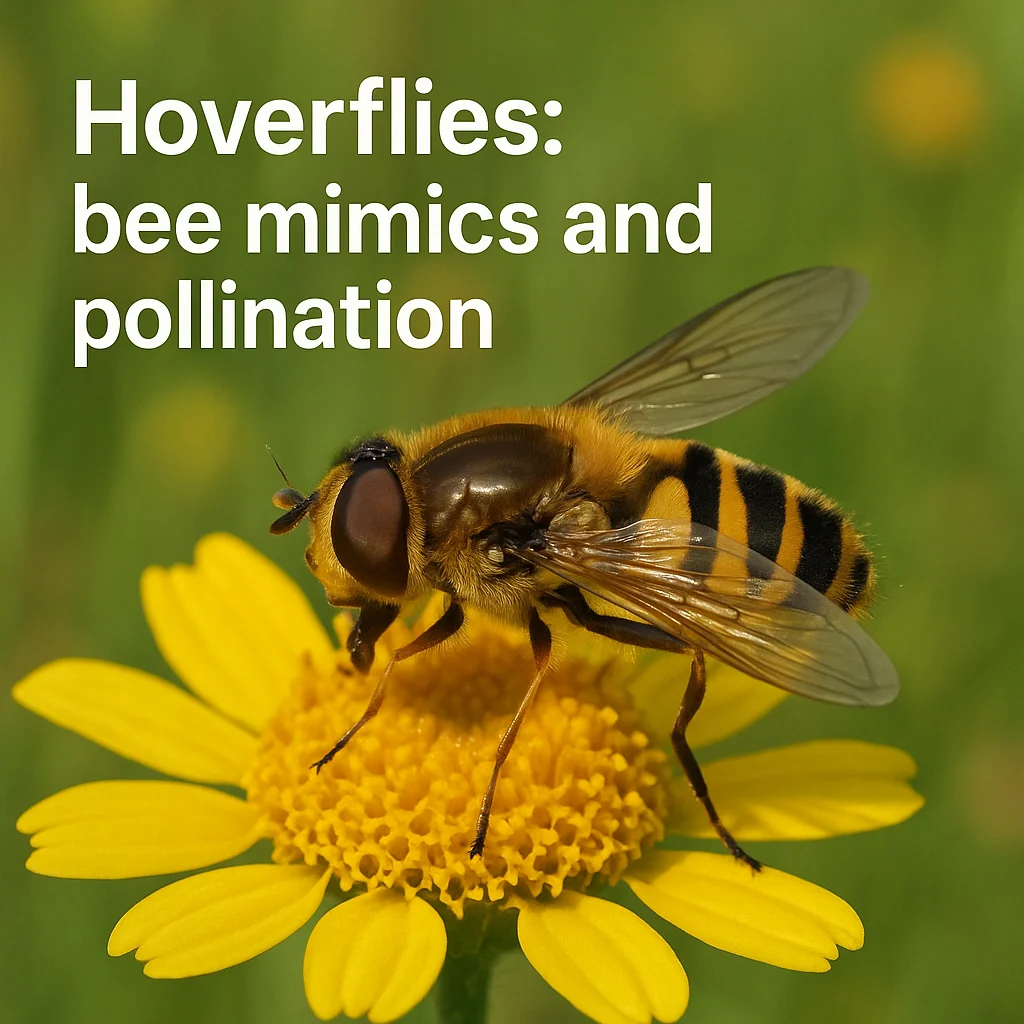
- Common Names: Hoverflies, flower flies, syrphid flies
- Scientific Name: Varies by species
- Insect or Not: Invertebrate insect
- Order/Family: Diptera / Syrphidae
- Typical Size Range: 6 to 25 mm (adult)
- Key Colors/Patterns: Black and yellow bands, bee and wasp mimicry
- Activity: Diurnal (active during the day)
- Typical Habitats: Gardens, meadows, woodlands, agricultural fields
- Where in the World: Found on all continents except Antarctica
- Seasonality: Most visible in spring and summer
🔍 Identification
Identifying hoverflies in the field requires a keen eye due to their mimicry of bees and wasps. Here are some characteristics to help distinguish them:
- Body Shape and Silhouette: Slender body resembling a bee but without the wasp waist
- Antennae Type: Short and inconspicuous antennae
- Wing Features: Two wings (a hallmark of the Diptera order), often clear with visible veins
- Leg Traits and Movement Style: Long legs with adept hovering capabilities, characterized by hovering in place while feeding from flowers
- Distinguishing Look-Alikes: Absence of a sting, and the presence of only two wings differentiates them from bees and wasps
- Top ID Tips:
- Look for black and yellow striping similar to bees
- Observe the hovering flight pattern, like a miniature drone
- Note the absence of a sting
- Check for clear wings and a lack of a narrow waist
- Listen for the gentle hum, softer than a bee's buzz
- Examine flowers - hoverflies often visit them
- Observe the rounded head and large compound eyes
🧠 Basic Body Structure
Hoverflies, like all insects, are invertebrates with an exoskeleton providing structure and protection. Their bodies are segmented into three main parts: the head, thorax, and abdomen, with thorax supporting the wings and legs. Hoverflies possess six legs, typical of insects, allowing adept movement in various environments.
The exoskeleton is made of chitin, providing strength while allowing flexibility. Hoverflies undergo molting to grow, shedding their exoskeleton to develop a larger one. As members of the order Diptera, hoverflies have one pair of wings, and their adult form is a critical phase in their lifecycle for reproduction and pollination activities.
🌍 Habitat & Distribution
Hoverflies thrive in diverse environments, favoring areas rich in flowers due to their role in pollination. They are commonly seen in gardens, meadows, woodlands, and agricultural fields. Moreover, hoverflies can adapt to urban gardens and parks, where they contribute significantly to local ecosystems.
Microhabitats such as under leaves and near flowering plants offer shelter and breeding sites. Hoverflies are globally distributed, except in Antarctica, adapting to various climatic conditions and ecosystems. Habitat changes, especially loss of flowering plants, can significantly impact hoverfly populations and sightings.
📅 Seasonal Appearance & Activity
Hoverflies are predominantly active during the warmer months, with adults typically visible from spring through summer. Their activity peaks during the daytime, especially in sunny conditions when flowers are abundant. Weather changes, such as temperature fluctuations and precipitation, can influence their activity levels and visibility.
- Best Time to Spot It:
- Warm spring days in meadows
- Sunny summer mornings in gardens
- Afternoons in flower-rich woodlands
- During pollinator-friendly plant blooms
🥚 Reproduction & Egg-Laying
Mating behavior in hoverflies involves males capturing the attention of females through aerial displays and visual cues. Fertilized females lay eggs on plants that serve as food sources for larvae, particularly those with aphid infestations. The clutch size and egg-laying strategy may vary, influenced by environmental factors and food availability.
The number of eggs laid can range from a few dozen to several hundred, depending on the species and ecological conditions. These strategies enable hoverflies to exploit both abundant and scarce resources effectively.
🌀 Metamorphosis & Life Cycle
Hoverflies undergo complete metamorphosis, consisting of the egg, larva, pupa, and adult stages. Each stage plays a unique role in the insect's lifecycle:
The egg stage lasts a few days before hatching into larvae. Hoverfly larvae are typically aphid predators, feeding voraciously on these pests and playing a crucial role in biological control. They are often found on foliage, where aphids congregate.
After several weeks of feeding, larvae pupate, forming a protective casing. The pupal stage involves transformation into adults, usually lasting one to two weeks. The adult stage completes the cycle, during which seasonally timed emergence ensures synchronicity with flower availability.
🍽️ Diet & Feeding Behavior
Hoverflies have diverse diets depending on their life stage. Larvae primarily consume aphids and other small insects, showcasing their role as predators in controlling pest populations. Adults, in contrast, feed on nectar and pollen from flowers, contributing to pollination. Their mouthparts are adapted to suck nectar, making them efficient pollinators.
As both predator and pollinator, hoverflies play integral roles in ecosystems, balancing prey populations and aiding plant reproduction. This dual diet underpins their ecological success and widespread distribution.
🦉 Predators & Defense
Hoverflies face predation from birds, amphibians, reptiles, spiders, and predatory insects like wasps. Their primary defense mechanism is mimicry, resembling stinging bees and wasps to deter predators. This visual ruse is supported by their non-aggressive nature and lack of a sting.
Additional defenses include camouflage against floral backgrounds and evasive flight. Some species might also use chemical cues to repel potential threats, though this is less common.
- Defense Highlights:
- Bee and wasp mimicry
- Evasive flight patterns
- Non-aggression signaling
- Camouflage against flowers
👥 Social Behavior & Swarms
Hoverflies are generally solitary, focusing on individual survival and reproduction. Males may defend small territories rich in flowers to attract potential mates. Despite their solitary nature, hoverflies may congregate in large numbers when suitable habitats provide abundant resources.
Swarming behavior is typically driven by environmental factors such as temperature, light, and food availability. These gatherings do not imply social cooperation but rather shared ecological niches.
🧭 Senses & Communication
Hoverflies possess excellent vision, with large compound eyes enabling them to detect movement and colors, crucial for locating flowers and avoiding predators. Their sense of smell plays a minor role in food-finding, with visual cues predominating their behavior.
Communication is limited, involving simple visual displays for mating. Unlike bees, hoverflies do not engage in elaborate communication or social structures.
🌱 Role in the Ecosystem
Hoverflies are valuable pollinators, transferring pollen between flowers as they feed, aiding in plant reproduction. They serve as biological control agents by preying on pest insects like aphids, thus benefiting agricultural systems and natural plant communities.
Their presence in ecosystems supports biodiversity, enhancing interactions among plants and animals. Hoverflies showcase mutualistic relationships with flowering plants, simultaneously benefiting from and contributing to ecological balances.
📉 Population & Conservation Notes
Hoverfly populations are often reported as common in suitable habitats, given their adaptability and ecological roles. However, they face threats from habitat loss, pesticide use, and climate change, which can affect local abundances.
Conservation efforts focusing on preserving natural habitats, reducing chemical use, and planting native flowers can support hoverfly populations and their ecological functions.
- How to Help (Low-Impact):
- Plant diverse, native flowers to provide nectar sources
- Avoid pesticide use in gardens
- Create insect-friendly habitats
- Encourage natural pest control methods
⚠️ Human Interaction & Safety
Hoverflies are harmless to humans, lacking the ability to sting or bite. Their presence in gardens and parks often goes unnoticed, though they provide the essential service of pollination. If a hoverfly approaches closely, there's no need for concern, as it is simply gathering resources.
Respectful observation and appreciation of hoverflies help promote awareness of their ecological contributions. Collecting wild specimens is discouraged to preserve natural populations and their habitats.
📌 Summary
- Hoverflies: Bee and wasp mimics with no sting
- Common in gardens, meadows, and woodlands
- Active mainly in spring and summer during the day
- Undergo complete metamorphosis with life stages: egg, larva, pupa, adult
- Predatory larvae control aphid populations, adults pollinate flowers
- Natural predators include birds and spiders; mimicry serves as defense
- Vital pollinators and pest controllers in ecosystems
- Population stability linked to habitat conservation and reduced pesticide use
- Completely harmless to humans, promotes ecological diversity