🕷️ Crane flies: harmless “giant mosquitoes”
🧾 Quick Facts
Crane flies, often mistaken for “giant mosquitoes,” belong to a large group of flies known for their long legs and delicate appearance. Despite their resemblance to mosquitoes, they are harmless to humans and play an important role in various ecosystems.
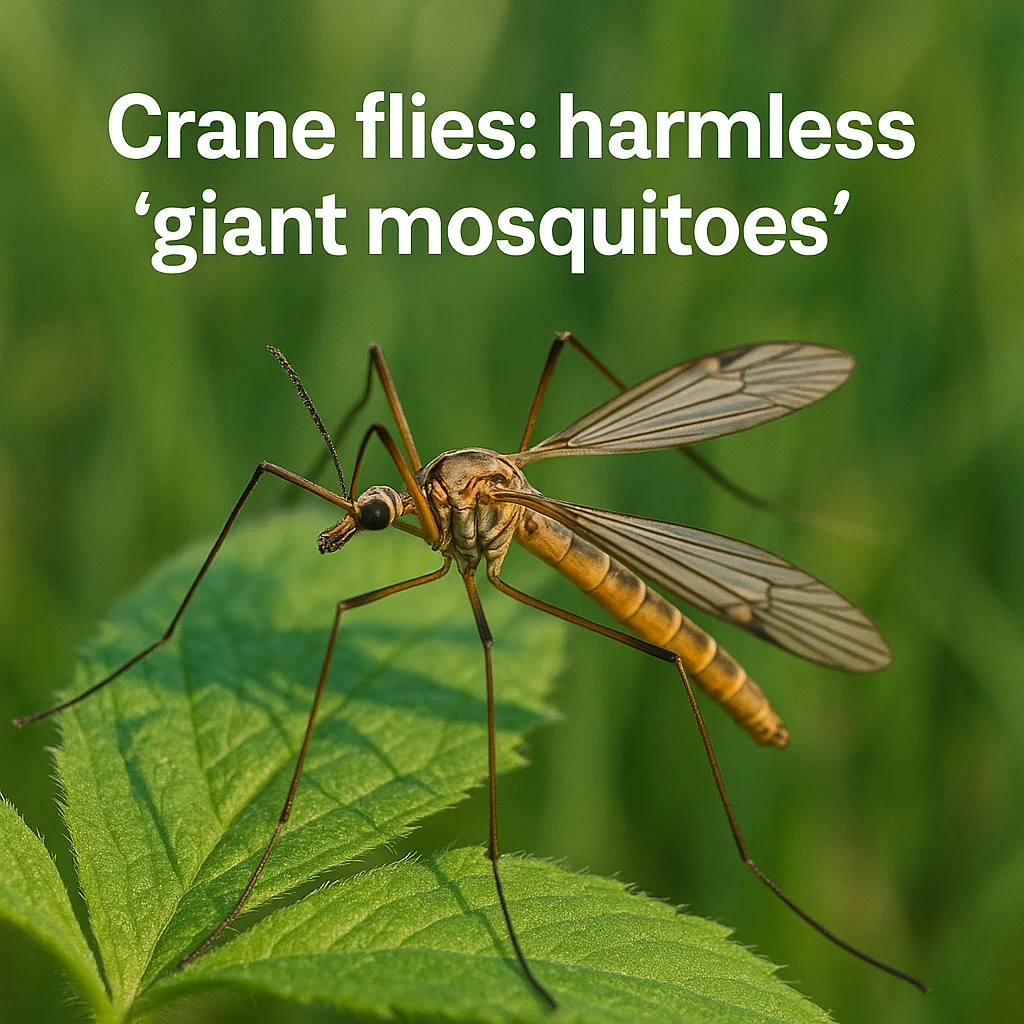
- Common names: Crane flies, daddy longlegs (regional usage)
- Scientific name: Varies (Family: Tipulidae)
- Insect or not: Yes, they are insects, which are invertebrates
- Order / family: Diptera / Tipulidae
- Typical size range: 6 to 60 mm in body length
- Key colors/patterns: Brown or gray with slender, elongated bodies
- Activity: Mostly nocturnal, some are active during the day
- Typical habitats: Wetlands, grasslands, forest edges, gardens
- Where in the world it occurs: Found globally, more common in temperate regions
- Seasonality: Adults most visible in spring and autumn
🔍 Identification
Crane flies can be easily recognized in the field by their unique body shape and long, slender legs. Their slender bodies and elongated legs make them appear delicate and mosquito-like.
- Body shape and silhouette: Thin bodies with a slender, elongated appearance
- Antennae type: Filiform (thread-like), often short in comparison to body size
- Wing features: Transparent wings with distinct veining, held flat when at rest
- Leg traits and movement style: Long, fragile legs that dangle when it flies
- Distinguishing look-alikes: Often confused with mosquitoes, but lack the piercing mouthpart
- Slender and elongated body shape
- Thin, transparent wings
- Long, dangling legs during flight
- Lack of a biting, blood-sucking proboscis
- Typically found near water and moist environments
- Active mostly during night or twilight
🧠 Basic Body Structure
Like all insects, crane flies have a body divided into three main parts: the head, thorax, and abdomen. They possess six legs and an exoskeleton that provides support and protection.
The head houses sensory organs, including eyes and antennae. The thorax bears the wings and legs. The abdomen is segmented and contains reproductive and digestive organs.
Crane flies are invertebrates, meaning they do not have a backbone. Instead, their structure is supported by an exoskeleton. Many species undergo molting as they grow.
🌍 Habitat & Distribution
Crane flies are adaptable and found in various environments. They thrive in wetlands, grasslands, forests, and even urban areas like gardens. Their preference for moist habitats is notable as it supports their breeding and feeding activities.
Geographically, crane flies are present on all continents except Antarctica. They are particularly abundant in temperate regions with suitable moisture levels. Variations in habitat preferences are observed between different genera and species.
Habitat changes, such as the drainage of wetlands or urbanization, can impact local populations of crane flies, affecting their abundance and visibility.
📅 Seasonal Appearance & Activity
Crane flies are most commonly observed when adult populations emerge, notably during spring and autumn. Though primarily nocturnal, some activity may be noted during daylight hours in certain species.
Good weather conditions, including mild temperatures and moderate humidity, enhance sightings.
- Best seen in the spring and autumn
- Most active during twilight hours
- More visible after rain showers
- Peak activity in temperate climates
🥚 Reproduction & Egg-Laying
Crane flies often engage in simple courtship, which may involve the male hovering around a potential mate. Males are typically more numerous, competing for mating opportunities. Females lay eggs in moist environments suitable for larval development.
Eggs are deposited in soil, decaying vegetation, or near water bodies, and the number of eggs laid varies significantly among the species, reflecting adaptability to diverse environments.
🌀 Metamorphosis & Life Cycle
Crane flies undergo complete metamorphosis, transitioning through distinct life stages: egg, larva, pupa, and adult.
The egg stage is relatively short, with larvae hatching into environments like moist soil or water. Their larval stage can last from several weeks to months, depending on species and climate. Larvae are detritivores, feeding on decaying organic matter.
Pupal development is generally quick, leading to the emergence of adult crane flies. Adult lifespan tends to be brief, primarily focused on reproduction.
🍽️ Diet & Feeding Behavior
Crane fly larvae are known to consume decaying plant material, thereby contributing to decomposition processes. In contrast, adult crane flies often do not feed, with some drinking nectar or water to sustain themselves.
Their larvae use chewing mouthparts to process organic material, playing an essential role in nutrient cycling within ecosystems.
🦉 Predators & Defense
Crane flies face predation from various animals, including birds, amphibians, and small mammals. Spiders and insects such as parasitoid wasps also pose threats. Crane flies depend on several defense mechanisms:
- Camouflage: Neutral colors help blend with surroundings
- Wing detachment: Helps escape if caught by a predator
- Erratic flight: Makes capture difficult
- Short adult lifespan: Reduces exposure risk
👥 Social Behavior & Swarms
Crane flies are generally solitary, with interactions mainly occurring during mating events. Their abundance can lead to notable gatherings in suitable habitats, particularly in peak seasons, but these are not true swarms guided by cooperative behavior.
🧭 Senses & Communication
Crane flies possess basic sensory abilities, including sight and limited olfactory functions. These senses aid in navigation and locating mates. Unlike some insects, they do not engage in complex communication.
Communication mainly involves physical contact and pheromone signaling during mating. Their sensory capabilities are sufficient for survival within their ecological niches.
🌱 Role in the Ecosystem
Crane flies are crucial decomposers in their ecosystems. Their larvae break down organic material, enriching soil health and facilitating nutrient return. As prey, they form part of the food web.
However, they can sometimes negatively impact agriculture, as their larvae may damage crops when present in large numbers. Nevertheless, they rarely become significant agricultural pests.
📉 Population & Conservation Notes
Crane flies are often common in environments that meet their needs for moisture and organic material. While data on global populations is limited, localized declines may occur due to habitat modification, pesticide use, and climatic changes.
- Plant native vegetation to support local biodiversity
- Avoid using pesticides in your garden or yard
- Leave leaf litter to create habitat for larvae
- Promote wetland conservation to preserve habitat
⚠️ Human Interaction & Safety
Crane flies are harmless and do not bite or sting humans, despite their resemblance to mosquitoes. Observing crane flies is safe, given respect for their role in nature and maintenance of their habitats. When interacting with nature, it is important to avoid disturbing wildlife and refrain from collecting specimens.
📌 Summary
- Crane flies resemble mosquitoes but are harmless
- Inhabit moist environments globally
- Most active in spring and autumn, often at night
- Undergo complete metamorphosis
- Larvae contribute to decomposition
- Preyed upon by birds and small animals
- Significant ecological role as decomposers
- Encouraged to observe respectfully