🕷️ Blowflies: shiny decomposers
🧾 Quick Facts
Blowflies, belonging to the family Calliphoridae, are fascinating insects known for their metallic sheen and critical role in decomposition. They are commonly associated with decaying organic matter, where they play a vital ecological function.
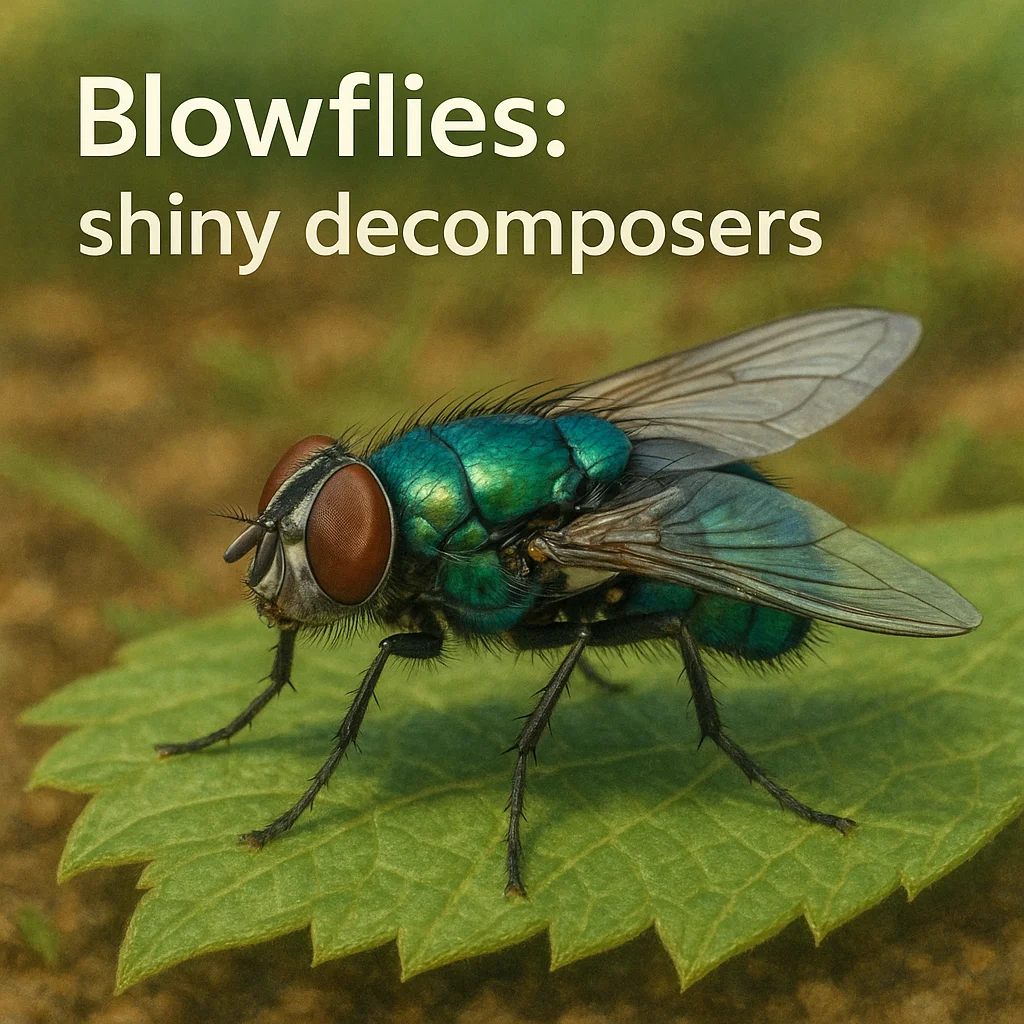
- Common names: Blowflies, Bluebottles, Greenbottles
- Scientific name: Varies (Genera include Calliphora, Lucilia, Phormia)
- Insect or not: Insect, characterized by three distinct body parts and six legs
- Order / family: Diptera / Calliphoridae
- Typical size range (adult): 8–16 mm
- Key colors/patterns: Metallic blue, green, or black bodies
- Activity: Diurnal (active during the day)
- Typical habitats: Meadows, urban areas, forests
- Where in the world it occurs: Globally distributed; common in temperate regions
- Seasonality: Most visible from spring to autumn
🔍 Identification
Blowflies are recognized by their robust, metallic-looking bodies. They have a pronounced, rounded thorax and a tapered abdomen. Their antennae are short and bristly. The wings are clear with distinctive veination, and blowflies are known for their speed and agility in flight. Their legs are strong, permitting rapid movement.
Distinguishing blowflies from bees or other flies can be challenging due to their similar size and shape, but the shiny, metallic body helps in identification.
- Metallic sheen in blue, green, or black
- Clear wings with visible veination
- Robust, compact body structure
- Short, bristly antennae
- Rapid fliers with a distinct buzzing sound
- Commonly found near decaying matter
🧠 Basic Body Structure
Blowflies, like all insects, have three main body parts: the head, thorax, and abdomen. They possess six legs attached to the thorax. Their exoskeleton is a hard outer layer that provides protection and support. As invertebrates, they lack a backbone, relying on their exoskeleton for structure. Blowflies undergo molting as they grow, emerging into their adult form with wings for flight.
🌍 Habitat & Distribution
Blowflies thrive in a variety of environments, from open meadows to urban settings and forests. They are commonly found near sources of decaying organic matter such as carcasses or compost piles, where they lay their eggs. Their distribution is worldwide, with a prominent presence in temperate regions. They adapt well to changing habitats, although urbanization and pollution can impact local populations.
📅 Seasonal Appearance & Activity
Blowflies are most active during warmer months, from spring through autumn, depending on the local climate. They are diurnal, often seen buzzing around in search of food or mates during daylight hours. Temperature and humidity can greatly affect their activity levels, with warm, moist conditions being ideal.
- Spring to autumn
- Active during daylight hours
- Favor humid and warm conditions
- Increased activity after rain
🥚 Reproduction & Egg-Laying
Blowfly reproduction involves complex courtship behaviors, often stimulated by chemical cues. Females lay eggs on suitable substrates such as decaying organic material or carrion. A single female can lay hundreds of eggs, which hatch into larvae after a short incubation period. The choice of oviposition site is critical for the survival of their offspring.
🌀 Metamorphosis & Life Cycle
Blowflies undergo complete metamorphosis, transitioning through distinct life stages: egg, larva, pupa, and adult. Upon hatching, larvae (or maggots) feed voraciously on the surrounding material, facilitating rapid growth. After several days, they pupate, transforming within a hardened casing. The adult blowflies emerge ready to reproduce, beginning the cycle anew. The entire process from egg to adult can vary, typically lasting a few weeks depending on environmental conditions.
🍽️ Diet & Feeding Behavior
As larvae, blowflies are scavengers, consuming decaying organic matter. This diet is crucial for nutrient cycling in ecosystems. Adult blowflies predominantly feed on nectar, although they may also consume fluids from decaying matter. They possess sponge-like mouthparts that allow them to lap up liquid food efficiently.
🦉 Predators & Defense
Blowflies face numerous natural predators, including birds, reptiles, amphibians, spiders, and small mammals. Their metallic coloration may serve as a form of camouflage, reflecting their surroundings to evade detection. Although not aggressive, blowflies can rapidly escape predators due to their fast and agile flight.
- Metallic coloration for camouflage
- Quick, evasive flight
- Commonly preyed upon by birds and spiders
- Nocturnal hiding helps avoid daytime predators
👥 Social Behavior & Swarms
Blowflies are generally solitary, though they can be seen in groups around abundant food sources. These gatherings are not cooperative but rather competitive, each fly vying for resources. They do not form structured colonies or swarms, though favorable environmental conditions can lead to localized population surges.
🧭 Senses & Communication
Blowflies have highly developed senses that aid in locating food and mates. They rely on keen olfactory senses to detect decaying matter and pheromones released by potential mates. Their compound eyes provide excellent vision, although they are primarily sensitive to movement. Blowflies do not use sound as a form of communication, instead relying on scent trails and visual cues.
🌱 Role in the Ecosystem
Blowflies play an integral role in ecosystems, primarily as decomposers. By breaking down dead organic matter, they recycle nutrients back into the soil, facilitating plant growth. While not primary pollinators, they can inadvertently transfer pollen as they move from flower to flower. Negative impacts include the spread of diseases in certain contexts, though they contribute significantly to natural pest control and waste decomposition.
📉 Population & Conservation Notes
Blowflies are typically abundant and commonly observed in suitable environments. Urbanization and pesticide use can lead to localized declines, although their adaptability aids survival. No major conservation efforts specifically target blowflies, as they usually maintain stable populations where conditions permit.
- Maintain garden compost for habitat
- Reduce pesticide use
- Preserve natural or semi-natural areas
- Encourage diverse plantings
⚠️ Human Interaction & Safety
Blowflies do not bite or sting humans but are sometimes regarded as pests due to their association with decay and disease transmission. It is advisable to ensure hygiene and sanitation in environments where they are present to minimize potential health risks. If you encounter swellings or reactions from handling decaying matter where blowflies frequent, wash the area thoroughly and seek professional advice if severe.
📌 Summary
- Metallic bodies help identify blowflies.
- Found worldwide, thriving in diverse habitats.
- Most active in warmer months during the day.
- Complete life cycle includes egg to adult stages.
- Maggots help decompose organic matter.
- Birds and spiders are common predators.
- Key role in nutrient recycling in ecosystems.
- Population stable, low conservation concern.