🕷️ Bee flies: fuzzy pollinators explained
🧾 Quick Facts
Bee flies are an intriguing group of insects known for their unique appearance and important role in pollination. Despite being called "bee flies," they are actually flies that belong to the family Bombyliidae. They exhibit a range of fascinating behaviors and adaptations.
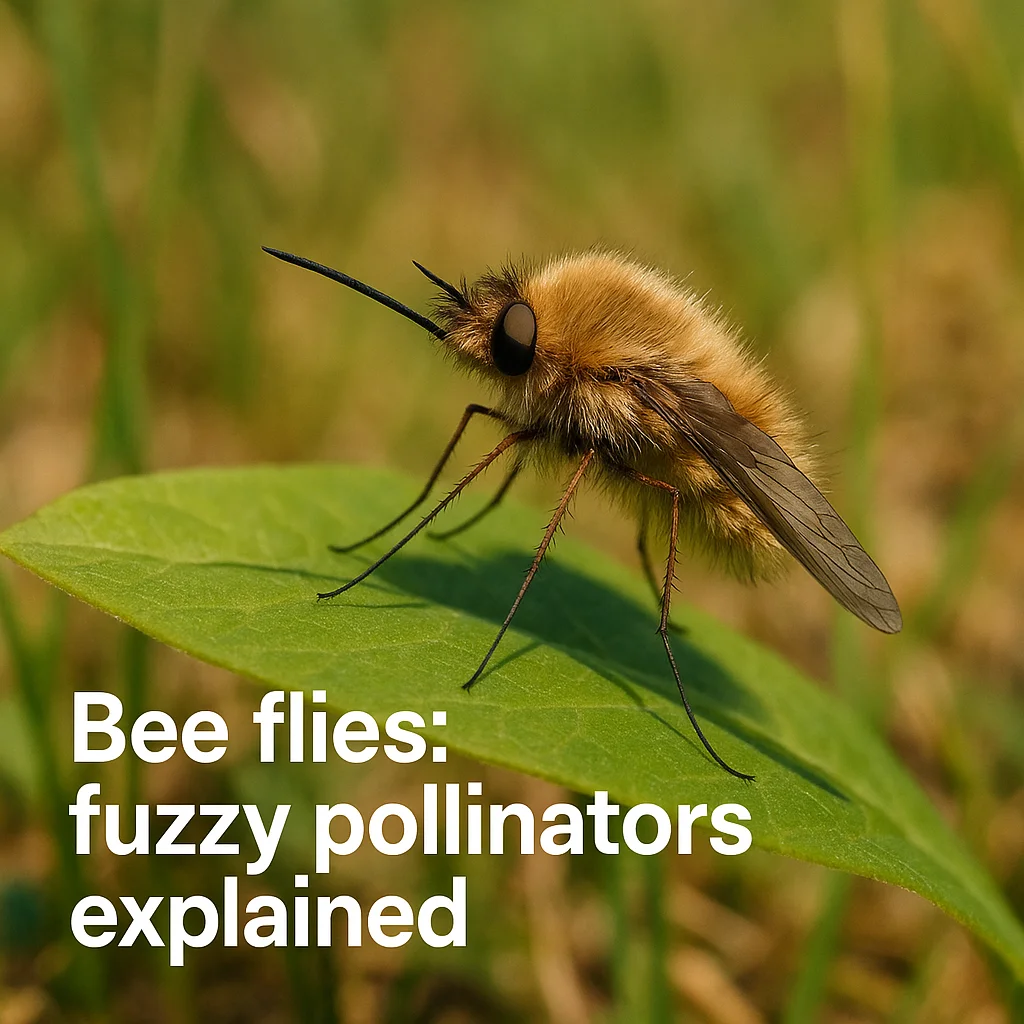
- Common names: Bee flies, humbleflies
- Scientific name: Varies by species
- Insect or not: Yes, they are insects
- Order/Family: Diptera/Bombyliidae
- Typical size range: 5 to 12 mm in length
- Key colors/patterns: Varied, often with fuzzy bodies and patterned wings
- Activity: Typically diurnal (active during the day)
- Typical habitats: Gardens, meadows, woodlands
- Where in the world it occurs: Found in many regions, including North America, Europe, and Asia
- Seasonality: Most visible in spring and summer
🔍 Identification
Bee flies can be recognized in the field by their distinctive body structure and flight patterns. They often have a plump, fuzzy body resembling that of a bee, contributing to their common name. Their long, slender legs and proboscis are well-adapted for hovering near flowers to feed on nectar.
- Body shape and silhouette: Compact and fuzzy with an elongated proboscis
- Antennae type: Short and not very noticeable
- Wing features: Often clear with dark patterns, held outstretched when at rest
- Leg traits and movement style: Long legs used for hovering flight
- Distinguishing look-alikes and common confusion: Often mistaken for bees due to their fuzzy appearance
- Top ID Tips:
- Look for their fuzzy body and bee-like appearance
- Observe their hovering flight near flowers
- Note the long, slender proboscis used for feeding on nectar
- Check for wings held outstretched, often with distinct patterns
- Notice shorter antennae compared to bees
- Watch for them predominantly during the day in sunny areas
🧠 Basic Body Structure
Bee flies, like all insects, consist of a head, thorax, and abdomen. They possess six legs and a pair of wings. The exoskeleton provides protection and structural support, while their metamorphosis involves distinct life stages. Bee flies are invertebrates, meaning they lack a backbone.
🌍 Habitat & Distribution
Bee flies inhabit a variety of environments, favoring sunny areas with abundant flowering plants. They thrive in gardens, meadows, and woodlands, where they can find ample nectar sources. These insects are distributed across continents, with notable populations in North America, Europe, and Asia. Their presence is often influenced by habitat conditions and climate.
📅 Seasonal Appearance & Activity
Bee flies are most commonly observed during the warmer months, particularly in spring and summer when flowers bloom abundantly. They are diurnal creatures, meaning they are active during daylight hours. Weather conditions, such as temperature and light levels, significantly influence their visibility.
- Best Time to Spot It:
- During spring when flowers are in full bloom
- On sunny days, as they prefer warm conditions
- In the morning and early afternoon
- In regions with temperate climates
🥚 Reproduction & Egg-Laying
Bee flies exhibit fascinating reproductive behaviors, often involving specific courtship rituals. Females lay their eggs in proximity to the nests of host insects, such as solitary bees, as the larvae are parasitic. The number of eggs and laying strategies can vary by species.
🌀 Metamorphosis & Life Cycle
Bee flies undergo complete metamorphosis, progressing through the stages of egg, larva, pupa, and adult. The larvae are typically parasitic, feeding on the larvae of host insects. Pupation occurs within a protective casing, and adults emerge to feed primarily on nectar, contributing to pollination.
The duration of each life stage varies among species and is influenced by environmental factors.
🍽️ Diet & Feeding Behavior
As larvae, bee flies are parasitic, relying on the larvae of other insects for nourishment. Adult bee flies primarily consume nectar using their elongated proboscis. They play a significant role as pollinators, transferring pollen from flower to flower as they feed.
🦉 Predators & Defense
Bee flies face various predators, including birds, reptiles, and spiders. In defense, they rely on mimicry, resembling bees to deter potential threats. Their quick flight and ability to hover add to their defenses against predators.
- Defense Highlights:
- Mimicry of bees for protection
- Quick, evasive flight patterns
- Utilization of host nests for larval development
- Hiding in flowers and vegetation
👥 Social Behavior & Swarms
Bee flies are generally solitary insects, although they may be seen congregating in areas rich in flowers. They do not form social colonies or participate in swarm behavior. Their interactions mostly occur during mating or while competing for food resources.
🧭 Senses & Communication
Bee flies possess well-developed senses, including keen vision for locating flowers. They rely on visual cues and possibly chemical signals during mating interactions. While they do not exhibit complex communication behaviors like some social insects, their sensory abilities aid in survival and reproduction.
🌱 Role in the Ecosystem
Bee flies hold ecological importance as pollinators, aiding in the reproduction of various flowering plants. Their parasitic larvae help regulate populations of host insects, impacting ecosystem dynamics. While they play a positive role in pollination, their presence as larvae can negatively affect specific host species.
📉 Population & Conservation Notes
Bee flies are often reported as common where suitable habitats exist. However, environmental changes, including habitat loss and pesticide use, can impact local populations. Conservation efforts should focus on preserving natural habitats and promoting the use of native plants in gardens.
- How to Help (Low-Impact):
- Plant a variety of native flowering plants
- Avoid using chemical pesticides
- Preserve natural habitats and open spaces
- Leave areas of leaf litter for habitat
⚠️ Human Interaction & Safety
Bee flies do not pose significant threats to humans as they neither sting nor bite. While they are fascinating to observe, it is important to respect their role in the ecosystem and avoid disturbing or collecting them in the wild.
📌 Summary
- Bee flies are often mistaken for bees due to their fuzzy appearance
- They inhabit a range of environments, including gardens and meadows
- Typically active in spring and summer during daylight hours
- Undergo complete metamorphosis with parasitic larvae
- Feed on nectar as adults, aiding in pollination
- Face predation from birds and other animals
- Important pollinators, though larvae impact host insect populations
- Conservation involves habitat preservation and reducing pesticide use