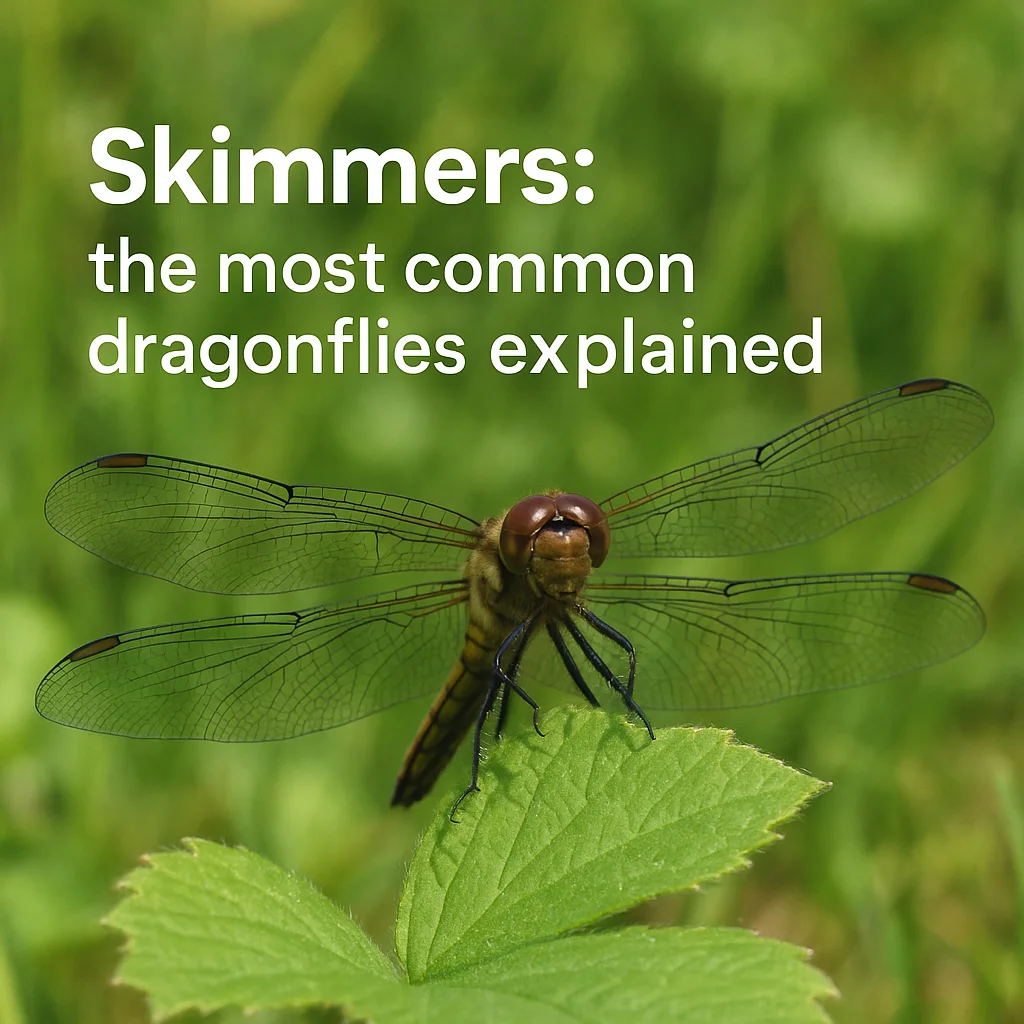
🕷️ Skimmers: the most common dragonflies explained
🧾 Quick Facts
Skimmers are a group of dragonflies known for their widespread presence and recognizable behavior. They belong to the family Libellulidae and can be seen gracefully gliding over pond surfaces and open water.
- Common Names: Skimmers
- Scientific Name: Varies by species (e.g., Libellula, Sympetrum)
- Insect or Not: Insect (invertebrate)
- Order / Family: Odonata / Libellulidae
- Typical Size Range: 3 to 5 cm (1.2 to 2 inches) in body length
- Key Colors/Patterns: Bright colors, often red, blue, or brown with intricate wing patterns
- Activity: Diurnal (active during the day)
- Typical Habitats: Ponds, lakes, marshes, and slow-moving streams
- Where in the World: Widely distributed across the Americas, Europe, Africa, and Asia
- Seasonality: Most visible during warmer months (spring through late summer)
🔍 Identification
Recognizing skimmers in the field is an exciting experience due to their vivid colors and active flight patterns. Adult skimmers exhibit a robust body shape with a notable distinction between their heads, thoraxes, and long, slender abdomens. Their wings are typically transparent but may have patches of color or distinctive markings.
Skimmers have short, bristle-like antennae and large, multifaceted eyes that provide them with excellent vision. The wings are broad at the base and taper to fine tips, with visible venation. Their legs are adapted to seizing prey mid-flight.
Look-alikes may include other dragonfly species, but skimmers can be distinguished by their hovering and skimming flight patterns over water surfaces.
- Robust body shape
- Transparent wings with potential color patches
- Bristle-like antennae
- Large, multifaceted eyes
- Broad wing base
- Frequently seen near water
- Hovering and skimming flight
- Vibrant colors
- Visible wing venation
- Active pursuit of prey in flight
🧠 Basic Body Structure
Like all insects, skimmers have a basic body structure comprising a head, thorax, and abdomen. The head houses sensory organs, including the compound eyes and antennae. The thorax is the central segment, supporting both wings and legs, allowing skimmers to fly and catch their prey. The abdomen is long and segmented, containing reproductive and digestive organs.
As members of the class Insecta, skimmers have six legs attached to the thorax. Their exoskeleton consists of a rigid outer shell that provides protection and structural support, requiring them to molt as they grow and develop.
Skimmers are invertebrates, meaning they lack a backbone. Instead, they rely on their exoskeleton for support and mobility.
🌍 Habitat & Distribution
Skimmers thrive in aquatic and semi-aquatic habitats, including ponds, lakes, marshes, and slow-moving streams. They are commonly found around water bodies where they breed and feed. Skimmers prefer sunny environments with open spaces for flight.
Microhabitats such as reed beds, water surfaces, and nearby vegetation provide both refuge and hunting grounds. They are well-adapted to a variety of climates and can be found in temperate, tropical, and subtropical regions across the globe.
Human alterations to wetlands and water bodies can affect skimmer populations, often reducing sightings in areas experiencing habitat loss.
📅 Seasonal Appearance & Activity
Skimmers are most often sighted during the warmer months when they are actively hunting and reproducing. They are diurnal creatures, so you're most likely to encounter them during daylight hours.
Skimmer activity is influenced by weather conditions; they are typically more active on warm, sunny days and tend to rest or take shelter during rain or cooler temperatures.
- Spring through late summer
- Daytime hours
- Sunny, warm weather
- Avoids rainy or windy conditions
🥚 Reproduction & Egg-Laying
Skimmers engage in elaborate aerial courtship displays where males often chase and vibrate their wings to attract females. Territorial males defend specific areas against rivals to secure mating opportunities.
Females lay eggs directly into or near water. The eggs are attached to water plants or submerged in surface substrates. An average female can lay anywhere from a few dozen to several hundred eggs, depending on the species and environmental conditions.
🌀 Metamorphosis & Life Cycle
Skimmers undergo incomplete metamorphosis, progressing through three stages: egg, nymph, and adult. The life cycle begins with eggs hatched into aquatic nymphs, which are predatory and consume various small aquatic organisms.
Nymphs resemble miniature adults without fully developed wings and typically dwell in the water for several months to up to two years, depending on conditions and species. They emerge onto land to undergo their final molt into adults.
During the adult stage, they dominate the air, feasting on flying insects and continuing the reproductive process.
🍽️ Diet & Feeding Behavior
As carnivorous predators, skimmers feed on a variety of small flying insects, including mosquitoes, flies, and even other smaller dragonflies. Nymphs also exhibit predatory behavior, utilizing grasping mouthparts to capture their aquatic prey.
Adult skimmers employ their excellent flight skills and sharp eyesight to catch prey mid-air. Their mandibles are suited for chewing, allowing them to effectively consume their catches.
🦉 Predators & Defense
Skimmers are preyed upon by birds, frogs, reptiles, spiders, and other larger dragonflies. They rely on rapid flight, agility, and aerial maneuverability to avoid capture. Additionally, some species employ camouflage techniques, blending into their surroundings to evade detection.
- Quick and agile flight
- Camouflage with environment
- Elaborate coloring to confuse predators
- Utilization of terrain for cover
- Flight height variability
👥 Social Behavior & Swarms
Skimmers are primarily solitary except when breeding or in favorable conditions where food is abundant. Males are often territorial, defending their chosen areas against other males. Although they don't form swarms, observational clusters may occur near water sources rich in prey.
During migratory periods, certain species may travel in larger groups for better navigation and protection.
🧭 Senses & Communication
Skimmers depend heavily on vision, with compound eyes that provide a wide field of view and excellent detection of movement. Their sensitivity to ultraviolet and polarized light helps them navigate and hunt effectively.
While they don’t communicate acoustically like some other insects, skimmers use visual displays for courtship and territory establishment. Movements such as wing fluttering and body postures convey intentions among individuals.
🌱 Role in the Ecosystem
Skimmers play a vital role as insect predators, helping control populations of pest insects like mosquitoes. This predation aids in maintaining ecological balance within their habitats.
By contributing to the diet of birds, reptiles, and amphibians, skimmers are integral components of food webs, supporting biodiversity. Their presence is also an indicator of healthy wetland ecosystems.
📉 Population & Conservation Notes
While many skimmer species are common and can be easily observed in suitable habitats, some face threats from habitat destruction, pollution, and climate changes. Wetland drainage and pesticide use are particularly detrimental.
- Preserve natural wetlands
- Plant native water vegetation
- Reduce pesticide usage
- Support conservation efforts
⚠️ Human Interaction & Safety
Skimmers do not bite or sting humans and are generally harmless. They serve an important ecological function by controlling insect populations and provide fascinating opportunities for observation and study. To respect wildlife, it is crucial to observe them without collection or disturbance.
If handling is necessary, washing hands afterwards is advised. Seek professional advice if any unusual irritation occurs from contact.
📌 Summary
- Skimmers are a vibrant and recognizable dragonfly group.
- Thrive in diverse aquatic and semi-aquatic habitats.
- Most active during warm, sunny days in spring to late summer.
- Incomplete metamorphosis from nymph to adult.
- Predators of small flying insects, aiding in ecological balance.
- Face natural predators like birds and spiders.
- Play a significant role in wetland ecosystems.
- Population stability threatened by habitat loss and pollution.
- Safe to observe and enjoy without fear of harm.
- Conservation efforts can help preserve their natural habitats.