🕷️ Clubtails: river specialists overview
🧾 Quick Facts
Clubtails encompass a diverse group of dragonflies within the family Gomphidae. Known for their unique club-shaped tails, these insects are adept river specialists, often found near flowing waters across the globe. They are a vital part of riparian ecosystems.
- Common Names: Clubtails
- Scientific Name: Varies by species
- Insect or Not: Yes, an invertebrate
- Order / Family: Odonata / Gomphidae
- Typical Size Range (adult): 4–5 cm in length
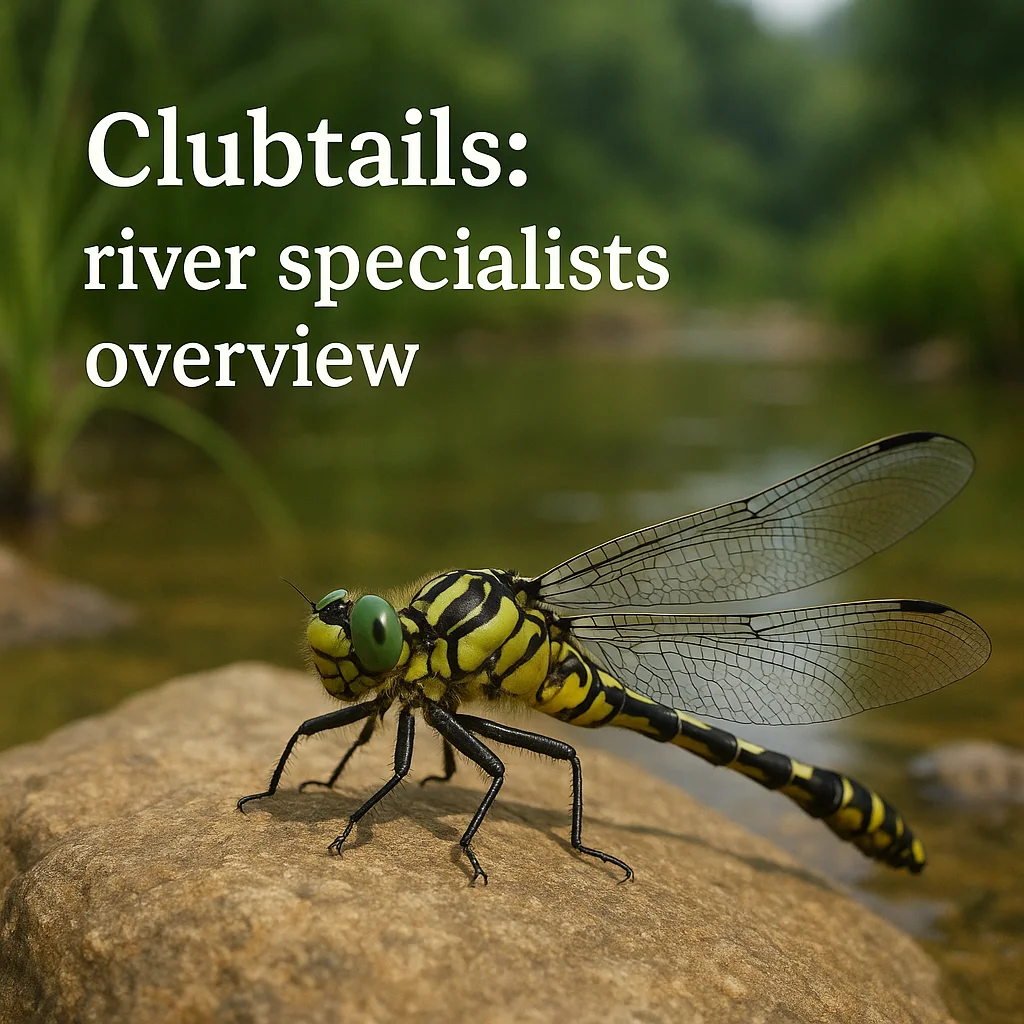
- Key Colors/Patterns: Yellow and black with distinctive clubbed tails
- Activity: Diurnal
- Typical Habitats: Rivers, streams, wetlands
- Where in the World It Occurs: Widely distributed in North America, Europe, and Asia
- Seasonality: Most visible from late spring to early autumn
🔍 Identification
Clubtails can be readily identified by their elongated bodies and distinctive club-shaped tails. Their compound eyes are widely spaced, unlike other dragonflies where eyes often meet. They possess thin abdomens, with the last segments visibly expanded into a club-like shape.
Narrow wings, typically clear with slight yellow tinting, are carried spread when at rest. Their legs are adapted for perching, and they exhibit a graceful, nimble flight. Clubtails can be confused with some damselflies; the key difference is in their body structure and wing positioning.
- Top ID Tips:
- Look for the clubbed tail in adult dragonflies
- Wide-spaced compound eyes
- Slender abdomen with bulging end segments
- Clear wings with slight yellow tint
- Found near flowing water
- Active during the day
🧠 Basic Body Structure
As members of the order Odonata, clubtails have three primary body segments: head, thorax, and abdomen. They possess six legs, typical of all insects, and their bodies are covered with a tough exoskeleton that they molt as they grow. Their wings are membranous and often held horizontally.
Clubtails are invertebrates, meaning they lack an internal skeleton. Instead, their exoskeleton provides structure and protection. This characteristic is crucial for their survival and mobility in various environments.
🌍 Habitat & Distribution
Clubtails are predominantly found near freshwater ecosystems such as rivers and streams. They thrive in environments where water quality is high, as their larvae are aquatic. Depending on the species, they may also occur in wetlands and ponds.
These insects have a wide distribution across North America, Europe, and Asia, inhabiting temperate to tropical regions. Changes in habitat, such as pollution or waterway modifications, can significantly impact their populations and visibility.
📅 Seasonal Appearance & Activity
Clubtails are most often seen during the warmer months, from late spring to early autumn. As diurnal creatures, they are active during daylight hours, particularly when the sun is warming their surroundings.
Seasonal variations in temperature and water levels can affect their appearance. They tend to be more visible on sunny, calm days, as adverse weather like rain or high winds can inhibit their activity.
- Best Time to Spot It:
- Late spring to early autumn
- Sunny, warm days
- Near rivers and streams
- Midday when activity peaks
🥚 Reproduction & Egg-Laying
During the mating season, male clubtails perform aerial flights and displays to attract females. Mating often takes place in flight or at perching spots. Female clubtails generally lay their eggs in or very near water, tapping the water surface with their abdomen.
The number of eggs laid can vary widely, depending on the species and environmental conditions. After laying, the fertilized eggs sink and adhere to submerged vegetation or sediments.
🌀 Metamorphosis & Life Cycle
Clubtails undergo incomplete metamorphosis, progressing through life stages as eggs, nymphs, and adults. After hatching, the aquatic nymphs, or larvae, spend significant time underwater where they are predators of small aquatic organisms.
The larval stage can last from a few months to a few years, depending on the species and environmental factors. Eventually, the nymphs emerge from water and undergo their final molt into adults, leaving behind a visible exuviae on vegetation.
🍽️ Diet & Feeding Behavior
Clubtail larvae are voracious predators, feeding on small aquatic invertebrates such as insect larvae, small fish, and tadpoles. They use their extendable labium, a specialized mouthpart, to capture prey.
Adult clubtails feed primarily on flying insects. Their role as predators makes them essential for controlling populations of mosquito and other pest insects, contributing to their ecosystem balance.
🦉 Predators & Defense
Clubtails face numerous natural enemies, including birds, amphibians, larger dragonflies, and spiders. Their key defense strategies include swift flight and camouflage among foliage and water plants. The coloration of their bodies can help blend them into their natural surroundings to avoid detection.
- Defense Highlights:
- Camouflage in aquatic vegetation
- Rapid, agile flight
- Resting among foliage
- Elusive and quick to escape predators
👥 Social Behavior & Swarms
Clubtails are primarily solitary insects, although they often aggregate in suitable habitats with abundant food resources. They do not exhibit colonial behavior like some other odonates, nor do they form swarms.
Males are territorial during the breeding season, often defending their areas from rivals in aerial dogfights to secure mates.
🧭 Senses & Communication
Clubtails rely heavily on visual cues for navigation and hunting, thanks to their large, compound eyes. They are adept at detecting movement and locating prey. Although less studied, they likely use pheromones or other chemical signals for mating.
They communicate during courtship with flight displays and posturing. This combines with other sensory inputs to ensure successful reproduction.
🌱 Role in the Ecosystem
Clubtails play a vital ecological role as both predators and prey. By consuming vast numbers of mosquitoes and other pests, they contribute to pest control. As prey, they provide sustenance for birds, amphibians, and other higher trophic level organisms.
In their aquatic larval stage, they contribute to freshwater health by regulating invertebrate populations and participating in nutrient cycling. Their presence is often an indicator of a healthy aquatic ecosystem.
📉 Population & Conservation Notes
While some clubtail species are commonly observed, others are experiencing declines due to habitat degradation, pollution, and climate change. Preservation of clean water bodies and riparian habitats is crucial for their conservation.
- How to Help (Low-Impact):
- Support wetland conservation efforts
- Plant native vegetation along waterways
- Reduce pesticide usage near water bodies
- Promote and volunteer in habitat restoration projects
⚠️ Human Interaction & Safety
Clubtails are generally harmless to humans and do not bite or sting. Observing them respectfully in their natural habitats is encouraged. If interacting with them, ensure hands are clean to prevent contamination to their delicate structures.
When observing, maintain a distance that does not disturb their activities. Collecting specimens should be avoided to preserve natural populations.
📌 Summary
- Clubtails are river specialists belonging to the family Gomphidae
- Easily identified by their clubbed tails and wide-spaced eyes
- Inhabit freshwater ecosystems such as rivers and streams
- Undergo incomplete metamorphosis: egg, nymph, adult
- Predatory diet includes mosquitoes and small aquatic organisms
- Preyed upon by birds, amphibians, and spiders
- Important in controlling insect pests and maintaining ecosystem balance
- Encouraged human activities: conservation, native planting, mindful observation