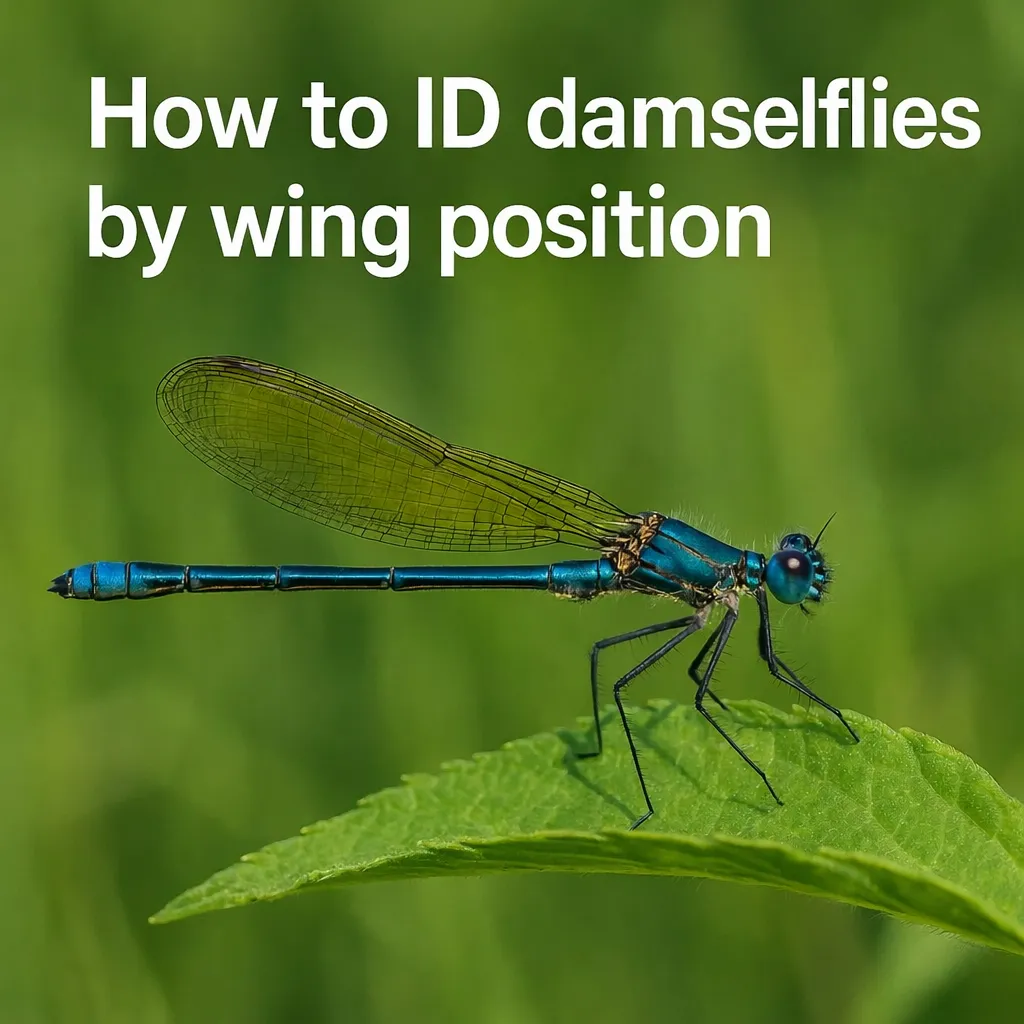
🕷️ How to ID damselflies by wing position
🧾 Quick Facts
Damselflies are graceful, slender insects closely related to dragonflies. They are part of the order Odonata, which they share with their dragonfly relatives. One key characteristic that helps identify damselflies is their unique wing position when at rest.
- Common names: Damselfly
- Scientific name: varies (multiple species worldwide)
- Insect or not: Yes, damselflies are insects which are invertebrates
- Order / family: Odonata / Coenagrionidae (not exclusive)
- Typical size range: 2–5 cm (adult)
- Key colors/patterns: Blues, greens, reds, often iridescent
- Activity: Diurnal (active during the day)
- Typical habitats: Near freshwater, including ponds, lakes, and streams
- Where in the world it occurs: Worldwide, in temperate and tropical regions
- Seasonality: Most visible in spring and summer
🔍 Identification
Damselflies can be identified by their delicate, elongated bodies and the way they hold their wings. Unlike dragonflies, damselflies rest with their wings closed over their abdomens. Their eyes are also positioned laterally, not touching, as opposed to the broader eyes of dragonflies.
- Top ID Tips:
- Slim, delicate body with a narrow abdomen
- Wings held parallel behind the body at rest
- Bright, often metallic coloration
- Non-touching eyes on each side of the head
- Graceful flight pattern, less robust than dragonflies
- Frequently found near water bodies
🧠 Basic Body Structure
Damselflies, like all insects, possess a three-part body structure: the head, thorax, and abdomen. They have six jointed legs and one pair of slender antennae. Their bodies are covered by an exoskeleton made of chitin, which provides support and protection. Damselflies are invertebrates, meaning they do not have a backbone. They undergo incomplete metamorphosis, transforming from egg to nymph to adult.
🌍 Habitat & Distribution
Damselflies are found primarily in habitats close to freshwater, such as ponds, lakes, slow-moving rivers, and wetlands. They thrive in environments where their aquatic nymphs can develop. Geographically, damselflies are present on every continent except Antarctica. They are adapted to a variety of climates, from temperate to tropical regions.
📅 Seasonal Appearance & Activity
Damselflies are most commonly observed during the warmer months of spring and summer, when their activity peaks. They are diurnal creatures, best spotted during sunny days when they are active and hunting for prey. Their presence is influenced by weather conditions; they are more active on warm, calm days.
- Best Time to Spot It:
- Mid to late spring
- Throughout summer
- Warm, sunny days
- Between morning and afternoon
🥚 Reproduction & Egg-Laying
Damselfly mating involves an elaborate courtship display, often involving the male grasping the female behind the head with specialized appendages. Eggs are typically laid in aquatic environments, attached to submerged vegetation or directly into the water. The number of eggs can vary greatly by species and environmental conditions.
🌀 Metamorphosis & Life Cycle
Damselflies undergo incomplete metamorphosis, consisting of three life stages: egg, nymph, and adult. Eggs are laid in or near water, hatching into nymphs, which are aquatic. Nymphs are predatory, feeding on small aquatic organisms, and they undergo multiple molts before emerging as winged adults. The nymph stage can last several months to a few years, depending on the species and climate.
🍽️ Diet & Feeding Behavior
Damselfly nymphs are carnivorous, consuming small aquatic prey using specially adapted mouthparts. As adults, damselflies continue to be predators, feeding on a variety of small insects such as mosquitoes, flies, and other flying insects. They capture their prey using swift, agile flight and rely on their excellent eyesight.
🦉 Predators & Defense
Damselflies face predation from birds, spiders, amphibians, and larger insects. Their defenses include camouflage through their slender, stick-like appearance and rapid flight to evade capture. Some species also exhibit warning coloration to deter predators.
- Defense Highlights:
- Camouflage among vegetation
- Swift, erratic flight patterns
- Warning coloration
- Elusive behavior and hiding
👥 Social Behavior & Swarms
Damselflies are generally solitary, although they can often be seen in swarms during mating seasons or near abundant food sources. While they do not form structured colonies, brief congregations are common around suitable habitats.
🧭 Senses & Communication
Damselflies rely heavily on their acute vision, facilitated by large compound eyes. They can detect movement and have a wide field of view. Communication typically involves visual cues during courtship, such as mating dances and positioning.
🌱 Role in the Ecosystem
Damselflies play a vital ecological role as both predators and prey. As predators, they help control populations of smaller insects, contributing to pest management. As part of the food web, they serve as food for birds and other larger animals. Their presence in aquatic ecosystems also indicates good environmental health.
📉 Population & Conservation Notes
Many damselfly species are common in appropriate habitats, although some face threats from habitat destruction, water pollution, and climate change. Conservation efforts focus on protecting wetland habitats and water quality to support healthy damselfly populations.
- How to Help (Low-Impact):
- Create wildlife-friendly gardens with water features
- Avoid pesticide use near waterways
- Support wetland conservation initiatives
- Participate in local biodiversity surveys
⚠️ Human Interaction & Safety
Damselflies are harmless to humans and do not bite or sting. They can be observed respectfully in their natural habitats, though capturing or disturbing them should be avoided to prevent stress to the insects and disruption of their ecosystems.
📌 Summary
- Damselflies rest with wings closed, unlike dragonflies
- Found worldwide, near freshwater
- Active in spring and summer, during the day
- Undergo incomplete metamorphosis
- Predators of small insects; prey for birds and amphibians
- Indicate healthy aquatic ecosystems
- Harmless to humans; encourage respectful observation