🕷️ Spicebush Swallowtail: mimicry and life cycle
🧾 Quick Facts
The Spicebush Swallowtail (Papilio troilus) is a captivating butterfly, known for its alluring appearance and intriguing mimicry behavior. It inhabits a variety of environments where spicebushes and sassafras thrive.
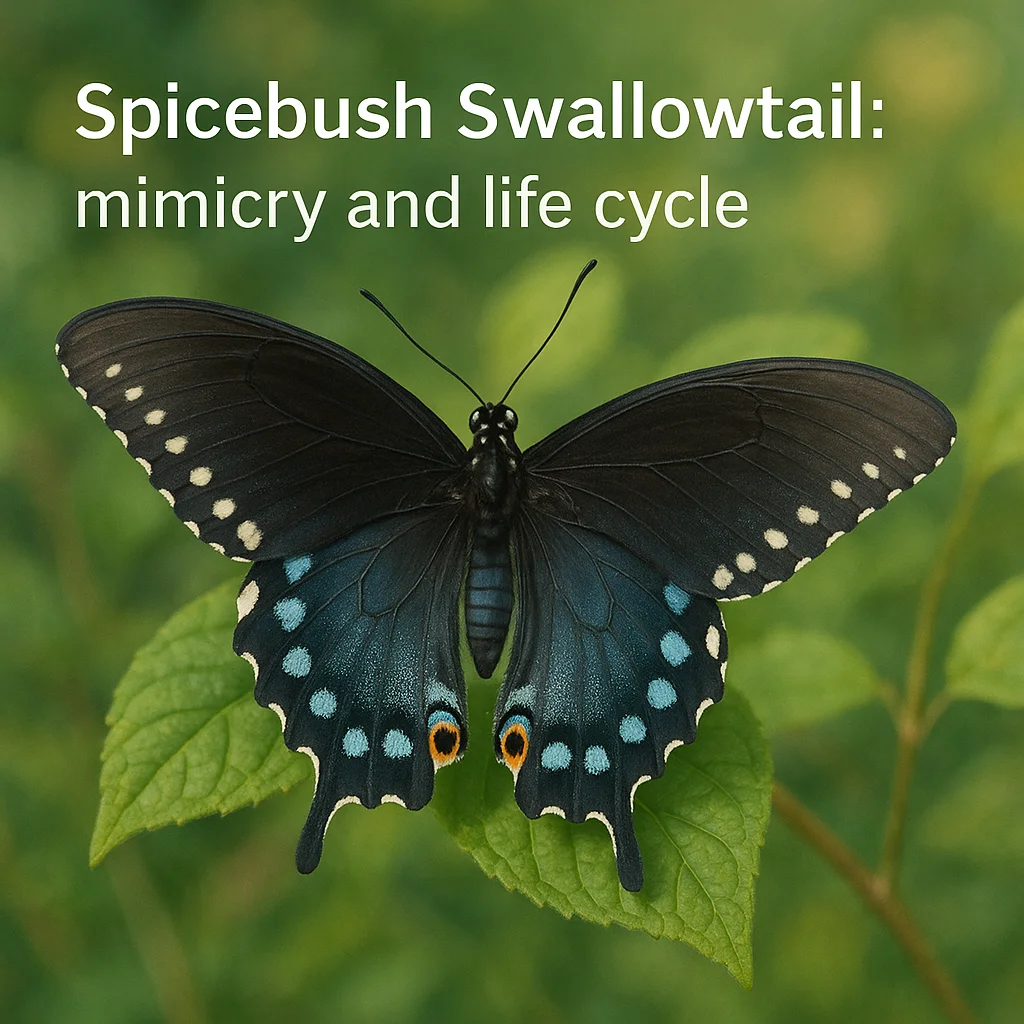
- Common Names: Spicebush Swallowtail, Green-Clouded Butterfly
- Scientific Name: Papilio troilus
- Insect: Yes, it is an invertebrate belonging to the class Insecta.
- Order/Family: Lepidoptera/Papilionidae
- Typical Size Range: 3.5 to 4.5 inches (wingspan)
- Key Colors/Patterns: Black, blue, green, yellow-orange spots
- Activity: Diurnal (active during the day)
- Typical Habitats: Woodlands, gardens, forests, marshes
- Where in the World: Eastern North America
- Seasonality: Late spring through early fall
🔍 Identification
The Spicebush Swallowtail is recognized by its large, striking wings and distinct mimicry of the Pipevine Swallowtail. Its forewings are predominantly black with subtle blue and green iridescence on the hindwings.
- Body Shape: Sturdy and tapered body
- Antennae: Clubbed, curved antennae
- Wing Features: Rounded wings with tails extending from hindwings
- Leg Traits: Typical lepidopteran legs, allowing efficient flight and landing
- Look-Alikes: Often confused with the Black Swallowtail
- Top ID Tips:
- Large black wings with blue to green tints
- Characteristic tail-like extensions on hindwings
- Yellow-orange spots along wing margins
- Underside mimics Pipevine Swallowtail coloration
- Common in areas with spicebush
- Displays fluttering, elegant flight patterns
🧠 Basic Body Structure
As a typical insect, the Spicebush Swallowtail's body is divided into three primary sections: the head, thorax, and abdomen. It possesses six legs, a hallmark of insects, and features a tough outer layer called an exoskeleton. The butterfly undergoes molting throughout its developmental stages, facilitating growth.
The Spicebush Swallowtail, like all insects, is an invertebrate, meaning it does not have a backbone. Instead, its structure relies on a supportive exoskeleton.
🌍 Habitat & Distribution
This elegant butterfly prefers habitats where dense planting of its host plants, spicebush and sassafras, are found, such as deciduous forests, open woodlands, and wetlands. It is especially common in edges of forests or shaded trails.
Distributed widely across Eastern North America, it flourishes in temperate climates. Human-driven habitat changes like deforestation may impact sightings, but conservation efforts are in place to preserve native flora which supports their lifecycle.
📅 Seasonal Appearance & Activity
The Spicebush Swallowtail is predominantly seen from April to November, peaking during warm months. Its activity is mostly observed in daylight when males patrol for mates and females lay eggs on host plants.
Weather influences its visibility, with sunny, warm days favoring flight more than rainy, windy conditions which prompt shelter-seeking behavior.
- Best Time to Spot It:
- Late spring to early fall
- Sunny days with mild temperatures
- Morning and early afternoon for heightened activity
- Near spicebush plants in nature reserves and gardens
🥚 Reproduction & Egg-Laying
Reproductive activities include vibrant courtship flights performed by males. Territory patrolling ensures finding receptive females, followed by complex courtship rituals.
Females lay eggs singly on the underside of leaves of host plants, primarily spicebush and sassafras. Depending on environmental conditions, the number of eggs varies significantly.
🌀 Metamorphosis & Life Cycle
The Spicebush Swallowtail undergoes complete metamorphosis, transitioning through four life stages: egg, larva, pupa, and adult.
Eggs hatch into caterpillars that mimic bird droppings for the initial instars, shifting to a green coloration as they mature, camouflaged against foliage. The caterpillar eventually pupates, forming a chrysalis that blends with its environment, overwintering during colder months in certain regions.
The adult butterfly emerges from the pupal stage, seeking nectar from flowers and playing crucial roles in pollination. It lives for approximately two weeks, continuing the cycle of life.
🍽️ Diet & Feeding Behavior
In adulthood, Spicebush Swallowtails primarily feed on nectar from a variety of flowers. The caterpillars, however, are herbivorous, consuming leaves of spicebush and sassafras.
Their feeding behavior consists of using siphoning mouthparts that allow efficient extraction of nectar, facilitating their role as pollinators in ecosystems.
🦉 Predators & Defense
The Spicebush Swallowtail employs several defense mechanisms against natural predators, including birds and lizards. Mimicry stands as the most notable, as its appearance closely resembles the toxic Pipevine Swallowtail, dissuading predation.
Additional defenses include cryptic coloration in larval stages and the utilization of "eye spots" that confuse potential threats.
- Defense Highlights:
- Mimicry of toxic species
- Camouflage in both larval and pupal stages
- Sudden fluttering to escape predators
- Startle displays with eye spots on caterpillars
👥 Social Behavior & Swarms
Spicebush Swallowtails are primarily solitary insects except during mating cycles. They exhibit territorial tendencies, particularly during the search for mates.
Although not typically forming swarms, mating season may witness increased activity and population density within optimal habitats.
🧭 Senses & Communication
These butterflies rely heavily on vision and olfactory senses for communication. Their keen eyesight aids in recognizing host plants and conspecifics.
Communication methods include subtle wing vibrations and the use of chemical signals to attract mates, providing an effective means of interaction despite solitary tendencies.
🌱 Role in the Ecosystem
The Spicebush Swallowtail serves an essential ecological role, primarily through pollination, as it visits various flowering plants. This interdependent relationship benefits both plants and butterfly populations.
Their larvae form part of the food web, contributing to the diet of various predators, while adults also sustain natural balances within ecosystems.
📉 Population & Conservation Notes
The Spicebush Swallowtail is generally reported as common in suitable habitats, with local abundances varying with environmental conditions. Conservation focuses on preserving native plants vital for their lifecycle.
- How to Help (Low-Impact):
- Plant native spicebush and sassafras
- Create butterfly-friendly garden spaces
- Avoid using harmful pesticides
- Recycle and minimize habitat destruction
⚠️ Human Interaction & Safety
The Spicebush Swallowtail is non-aggressive and poses no direct threat to humans. It does not bite or sting, making it a welcome presence in gardens.
Interactions should focus on respectful observation, encouraging admiration for its beauty while ensuring no harm to natural populations.
📌 Summary
- Identified by black wings with blue-green iridescence
- Thrives in woodlands and gardens of Eastern North America
- Active primarily in late spring through early fall
- Relies on complete metamorphosis: egg to adult
- Diet consists mainly of flower nectar and host plant leaves
- Mimics toxic species to avoid predators
- Plays a crucial ecological role in pollination
- Common but sensitive to habitat destruction
- Non-threatening to humans; encourage respectful observation