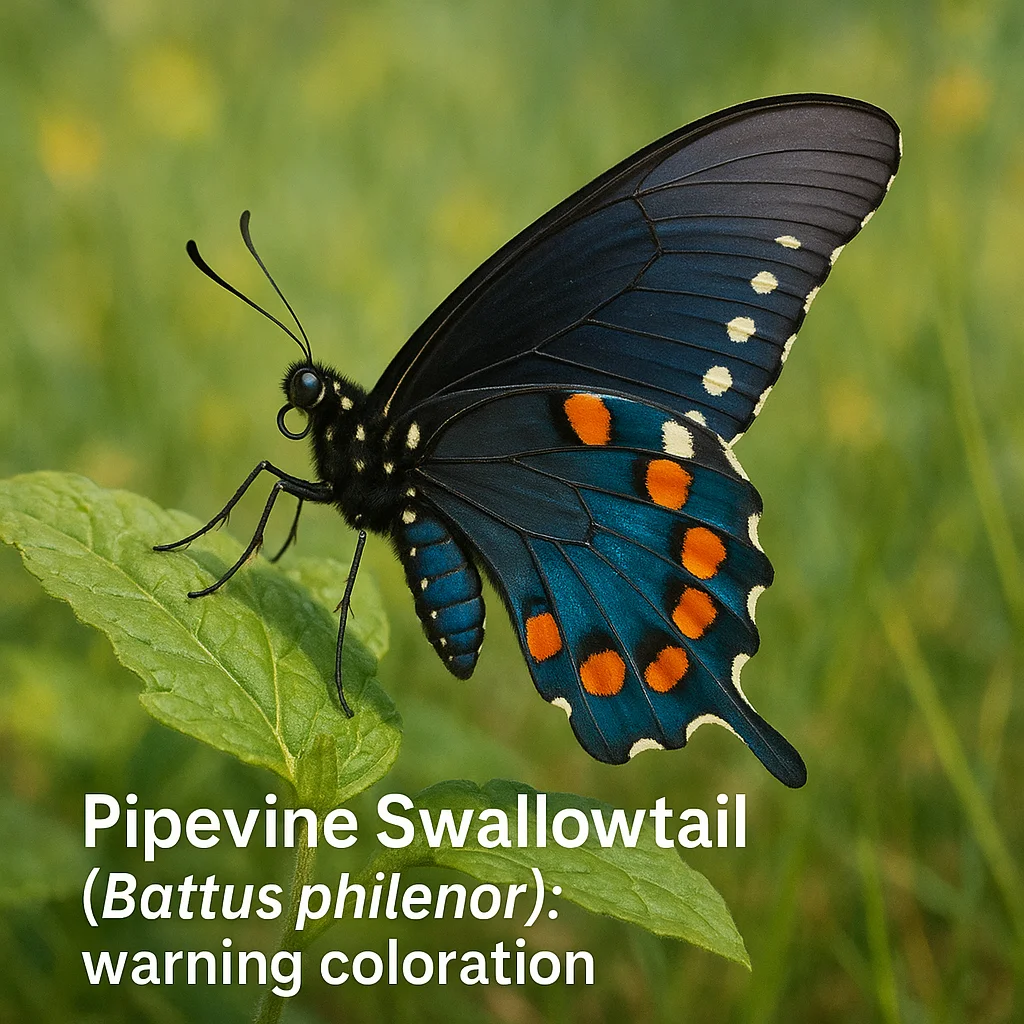
🕷️ Pipevine Swallowtail (Battus philenor): warning coloration
The Pipevine Swallowtail, scientifically known as Battus philenor, is a strikingly beautiful butterfly found in various parts of the United States. Its distinctive warning coloration not only adds to its allure but also serves as a defense mechanism. In this detailed species profile, we will explore the unique characteristics, behaviors, and ecological significance of this fascinating insect.
🧾 Quick Facts
Get familiar with the Pipevine Swallowtail through these quick facts:
- Common names: Pipevine Swallowtail
- Scientific name: Battus philenor
- Insect or not: Yes, it is an invertebrate
- Order / family: Lepidoptera / Papilionidae
- Typical size range: Adults typically measure 7 to 12 cm in wingspan
- Key colors/patterns: Black and iridescent blue with orange spots
- Activity: Primarily diurnal (active during the day)
- Typical habitats: Woodlands, gardens, fields, and meadows
- Where in the world it occurs: North America, mainly eastern and southern regions
- Seasonality: Most visible from spring to late summer
🔍 Identification
The Pipevine Swallowtail is easily recognized in the field due to its distinctive coloration and body shape. The butterflies have a slender body with an elongated abdomen and wide wings. The forewings are mostly black, while the hindwings feature a striking iridescent blue hue with prominent orange spots on the underside.
Its antennae are clubbed, a characteristic feature of butterflies. The legs are long and slender, suited for delicate movement across vegetation. The Pipevine Swallowtail may be confused with similar species like the Black Swallowtail and Spicebush Swallowtail, but can be differentiated by its unique blue hindwing coloration.
- Top ID Tips:
- Look for black forewings with iridescent blue hindwings
- Note the orange spots on the underside of the hindwings
- Slender body with an elongated, tapering abdomen
- Clubbed antennae typical of butterflies
- Often seen fluttering near flowers
- Can be distinguished from similar species by the more vibrant blue on hindwings
- Watch for them in open, sunny spaces like gardens
🧠 Basic Body Structure
As an insect, the Pipevine Swallowtail possesses a basic structure common among its class. The body is divided into three main segments: the head, thorax, and abdomen. It has six legs, all attached to its thorax. The exoskeleton protects its internal organs, and it undergoes molting as it grows from larva to adult. The wings are a quintessential aspect of its anatomy, providing both propulsion and balance during flight.
Being an invertebrate, it lacks a backbone, a typical characteristic of insects. This classification helps in understanding its behavior and physiological adaptations.
🌍 Habitat & Distribution
The Pipevine Swallowtail thrives in a variety of environments, including woodlands, meadows, gardens, and fields. It favors areas where its host plant, the Pipevine (Aristolochia species), is abundant as it lays eggs on these plants. The species is primarily found in the eastern and southern United States. Its presence is often noticed in temperate climates, where host plants are regularly available.
The butterfly's range extends to Mexico, where the climate supports year-round activity. Sightings are often influenced by habitat changes, such as urban expansion reducing available host plants.
📅 Seasonal Appearance & Activity
Observers are most likely to spot the Pipevine Swallowtail from spring through late summer. These butterflies are diurnal and are typically active during warm, sunny days when they are most inclined to feed and mate. Rainy and cold weather can temporarily reduce their visibility, driving them to seek shelter until conditions improve.
- Best Time to Spot It:
- Late morning to early afternoon during sunny weather
- Spring through late summer
- Particularly abundant following warm weather patterns
- Activity peaks with the blooming of nectar-rich flowers
🥚 Reproduction & Egg-Laying
The mating behavior of the Pipevine Swallowtail involves intricate courtship displays by males, who often patrol territories actively. Females lay eggs singly on the leaves of Pipevine plants. The choice of the host plant is crucial as the larvae feed exclusively on its leaves, which are toxic to most predators.
Egg-laying is typically prolific, with females depositing dozens of eggs to ensure some offspring reach maturity. However, the actual egg count can vary depending on environmental conditions.
🌀 Metamorphosis & Life Cycle
The Pipevine Swallowtail undergoes complete metamorphosis, which includes four distinct life stages: egg, larva (caterpillar), pupa (chrysalis), and adult butterfly.
The eggs take about five to ten days to hatch. The emerging caterpillars are velvety black with orange spots and feed voraciously on Pipevine leaves. This stage lasts around three to four weeks. Once fully grown, the caterpillar forms a chrysalis, which may range from brown to green, camouflaging against the environment. The pupal stage lasts anywhere from 10 days to several weeks, influenced by environmental factors.
The adult stage is marked by vibrant coloration and arises from the chrysalis to continue the cycle, living up to one month in favorable conditions.
🍽️ Diet & Feeding Behavior
As larvae, their diet consists exclusively of Pipevine leaves, a food choice that confers chemical defensive properties against predators. In the adult stage, the Pipevine Swallowtail feeds on nectar from flowers using a long, coiled proboscis suited for reaching deep into flowers.
These butterflies serve as pollinators, contributing to the reproduction of flowering plants while sustaining themselves on their nectar.
🦉 Predators & Defense
The Pipevine Swallowtail is subject to predation by birds, spiders, and small mammals. Its primary defense is its warning coloration, manifested through the ingestion of toxic compounds from its larval food plant, Deterring many potential predators.
- Defense Highlights:
- Chemical defenses from toxic host plants
- Bright warning coloration to signal unpalatability
- Flashy underwing patterns to startle predators
- Camouflaged chrysalids aid in pupal-stage survival
👥 Social Behavior & Swarms
The Pipevine Swallowtail is primarily a solitary insect. However, adults can be seen gathering in numbers around abundant nectar sources. Mating is the only social behavior observed, with males flying actively in search of receptive females.
While not forming migratory swarms like other butterflies, localized population booms can occur where conditions are ideal.
🧭 Senses & Communication
These butterflies rely heavily on their advanced vision for locating flowers and mates. They utilize their sense of smell, which is highly developed in butterflies, to identify host plants and other individuals through pheromones.
Communication includes visual signals and chemical cues, vital in mating and for avoiding unsuitable partners.
🌱 Role in the Ecosystem
The Pipevine Swallowtail plays a crucial role as a pollinator, aiding the reproduction of various flowering plants. Its larvae, although obligate herbivores on Pipevine, help regulate the growth of these plants and maintain balanced ecosystems. Additionally, they serve as a food source for specialized predators.
Their interaction with their host plants illustrates a mutualistic relationship, highlighting the complex interdependencies within ecosystems.
📉 Population & Conservation Notes
Generally, the Pipevine Swallowtail is considered stable in its range, often found where suitable habitats and host plants thrive. Habitat loss due to urbanization and agricultural expansion poses threats, potentially affecting localized populations.
- How to Help (Low-Impact):
- Plant native Pipevine species in gardens
- Limit pesticide use
- Create butterfly-friendly habitats with diverse flowering plants
- Preserve wild areas and avoid disrupting natural growth
⚠️ Human Interaction & Safety
The Pipevine Swallowtail does not pose any significant threat to humans. It neither bites nor stings, making it safe to observe and enjoy. As with all wildlife, interactions should be respectful and non-intrusive. Avoid capturing or handling which may harm the delicate insect.
📌 Summary
- Distinctive iridescent blue and black coloration for identification
- Inhabits woodlands, meadows, and gardens across North America
- Active daytime butterfly, seen mostly in warmer months
- Complete metamorphosis from egg to adult
- Feeds on nectar as adults; larvae consume toxic Pipevine leaves
- Defense through warning coloration and chemical sequestration
- Acts as a pollinator and has complex ecosystem roles
- Population stable but affected by habitat changes
- Safe for humans to observe without fear of harm