🕷️ Old World Swallowtail (Papilio machaon): range & traits
🧾 Quick Facts
The Old World Swallowtail, scientifically known as Papilio machaon, is a striking butterfly species recognized for its distinctive wing patterns and widespread distribution. This article provides key insights into its characteristics, habitat, and behavior.
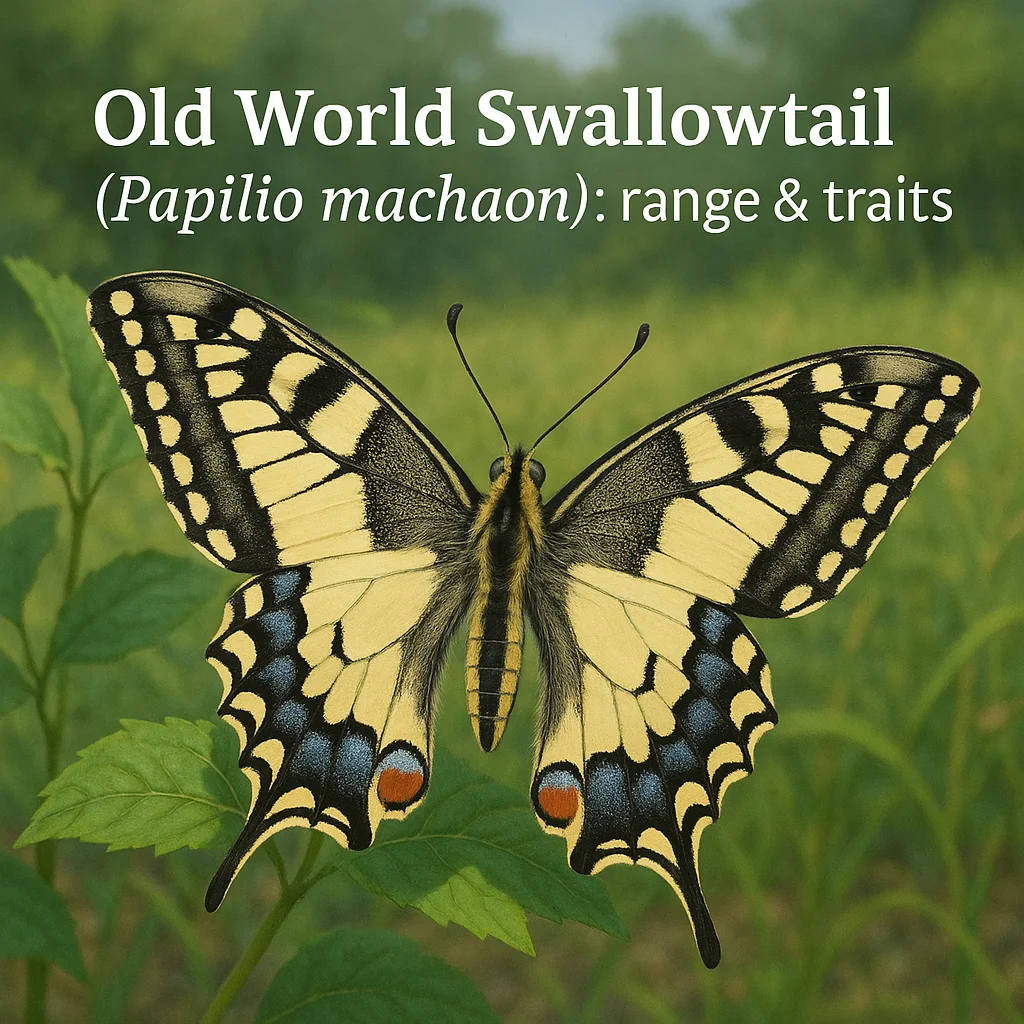
- Common Names: Old World Swallowtail, Swallowtail Butterfly
- Scientific Name: Papilio machaon
- Insect: Yes, an invertebrate
- Order/Family: Lepidoptera / Papilionidae
- Typical Size Range: 7 to 9 cm wingspan
- Key Colors/Patterns: Yellow with black patterns, blue and orange spots on hindwings
- Activity: Diurnal (active during the day)
- Typical Habitats: Meadows, fields, gardens, and open woodlands
- Where in the World It Occurs: Europe, Asia, and North Africa
- Seasonality: Adults are most visible from spring through early autumn
🔍 Identification
The Old World Swallowtail is easily recognizable by its vibrant yellow wings adorned with bold black patterns. Its wings also showcase blue and orange spots on the hindwing margins, accompanied by the characteristic "tails" that give the swallowtail its name.
- Body Shape and Silhouette: Slim, elongated with characteristic pointed wings
- Antennae Type: Clubbed antennae, a hallmark of butterflies
- Wing Features: Yellow with black veins, tails on hindwings
- Leg Traits and Movement Style: Six slender legs, slow, graceful flight
- Distinguishing Look-Alikes and Common Confusion: Similar to other swallowtails but distinguishable by wing patterns and tails
- Top ID Tips:
- Prominent yellow and black coloration
- Distinctive tails on hindwings
- Blue and orange spots near the hindwing margins
- Large size compared to other butterflies
- Clubbed antennae typical of butterfly species
- Active flight during daytime hours
- Frequently seen fluttering in open areas or gardens
🧠 Basic Body Structure
Like all insects, the Old World Swallowtail has a body divided into three main sections: the head, thorax, and abdomen. The head houses the sensory organs, including compound eyes and antennae. The thorax is the movement center; it supports the wings and legs, while the abdomen contains vital organs. It is an invertebrate, meaning it lacks a vertebral column, and is protected by an external exoskeleton. The swallowtail undergoes molting as it grows and develops wings as an adult.
🌍 Habitat & Distribution
Preferred by nature, the Old World Swallowtail thrives in open environments such as meadows, fields, gardens, and the edges of woodlands. Microhabitats often include sunny spots with abundant flowering plants, which are vital for nectar feeding. This butterfly is widely distributed across Europe, Asia, and North Africa, adapting to various climates from temperate to subtropical regions. Changes in land use and urbanization may impact its sightings.
📅 Seasonal Appearance & Activity
Observations of the Old World Swallowtail peak during the warmer months, primarily from spring through early autumn. Being diurnal, it is most active in the sunlight, favoring bright, sunny days. Weather conditions, such as temperature and humidity, can influence its activity levels.
- Best Time to Spot It:
- Late spring through early autumn
- During sunny, warm days
- In meadows and garden areas
- Mid-morning to late afternoon
🥚 Reproduction & Egg-Laying
The mating behavior of the Old World Swallowtail involves aerial displays where males showcase their vibrant wing patterns to entice females. After mating, females lay eggs on specific host plants, favoring those from the Apiaceae family. The egg-laying process targets leaves of both wildflowers and cultivated plants, ensuring food availability for emerging caterpillars. Egg counts can vary, with several dozen laid over multiple plants.
🌀 Metamorphosis & Life Cycle
The Old World Swallowtail undergoes complete metamorphosis, characterized by four distinct life stages: egg, larva (caterpillar), pupa (chrysalis), and adult.
Egg Stage: Eggs are spherical, laid singly on host plant leaves, hatching in about a week depending on temperature.
Larva Stage: Newly emerged caterpillars are initially black with orange spots but develop green banding as they mature, feeding on host plant leaves. The larval stage lasts about 3-4 weeks.
Pupa Stage: After feeding, the caterpillar forms a chrysalis, securing it to a plant with silk. This stage can last from weeks to months, affected by climate and seasons.
Adult Stage: Emerging adults seek nectar from flowers and are ready to reproduce within days. The entire life cycle from egg to adult varies, depending on environmental conditions and local climate.
🍽️ Diet & Feeding Behavior
As caterpillars, Old World Swallowtails primarily consume the leaves of host plants, particularly those in the Apiaceae family. Adult butterflies feed on nectar from a wide range of flowers, using a coiled proboscis to extract it. Their feeding plays a crucial role in pollination, contributing to the reproduction of various plant species. Caterpillars are herbivores, while adults act as pollinators.
🦉 Predators & Defense
Natural enemies of the Old World Swallowtail include birds, insectivorous mammals, spiders, and parasitoid wasps. The butterfly employs several defense strategies to evade predators. Camouflage and mimicking unpalatable species deter some threats. When threatened, the caterpillar can display startle patterns and emit unpleasant scents to ward off attackers.
- Defense Highlights:
- Yellow and black coloration acts as a warning signal
- Caterpillars emit distasteful chemicals
- Swallowtails employ mimicry for protection
- Flight agility aids in predator evasion
👥 Social Behavior & Swarms
The Old World Swallowtail is primarily solitary, with individual butterflies establishing territories during the mating season. Males actively patrol their territories, seeking females while using visual and chemical cues. While they do not form structured swarms, these butterflies may be seen in small congregations around abundant feeding sites or during migration.
🧭 Senses & Communication
Swallowtails are equipped with excellent vision, critical for locating flowers and mating partners. They rely on chemical senses to detect pheromones, which play a key role in mate attraction and territorial behavior. Physical communication, such as wing displays and flight dances, is also integral to their interaction during the breeding season.
🌱 Role in the Ecosystem
Old World Swallowtails are valuable pollinators, aiding the reproductive processes of many flowering plants. Their role in pollination contributes to the ecosystem’s health and biodiversity, supporting the food web and agricultural practices. These butterflies also serve as prey for various predators, thus maintaining ecological balance. Additionally, their caterpillars are important herbivores within their habitats.
📉 Population & Conservation Notes
The population status of the Old World Swallowtail generally reflects local abundance and adaptation to favorable habitats. However, habitat loss, intensive agriculture, and pesticide application pose threats in certain regions. Conservation efforts focus on promoting butterfly-friendly environments through natural landscaping and reduced pesticide use. Data on populations remain limited, emphasizing the need for ongoing monitoring and study.
- How to Help (Low-Impact):
- Plant native flowers to support nectar feeding
- Avoid pesticide use in gardens
- Leave leaf litter for caterpillar habitat
- Foster wildflower growth to encourage host plants
⚠️ Human Interaction & Safety
The Old World Swallowtail poses no harm to humans; it neither bites nor stings. Observation of these butterflies is generally safe and can be a delightful aspect of outdoor activities. To help preserve these beautiful creatures, try to observe them without capturing or disturbing them, ensuring they continue to grace our landscapes.
📌 Summary
- Recognizable by yellow and black patterns with tails on hindwings
- Thrives in open areas like meadows and gardens across Europe, Asia, and North Africa
- Visible during warm months from spring to autumn
- Undergoes complete metamorphosis; feeds on nectar as adults
- Preyed upon by birds, spiders, and wasps; uses camouflage and mimicry for defense
- Solitary, non-aggressive, and important pollinators
- Faces threats from habitat loss and pesticides
- Fostering native flora can support their conservation