🕷️ Underwing moths (Catocala): hidden bright wings
🧾 Quick Facts
Underwing moths, known for their striking concealed underwing pattern, are a fascinating group of moths found primarily in North America and parts of Asia and Europe. These moths are part of the genus Catocala, which consists of around 250 species.
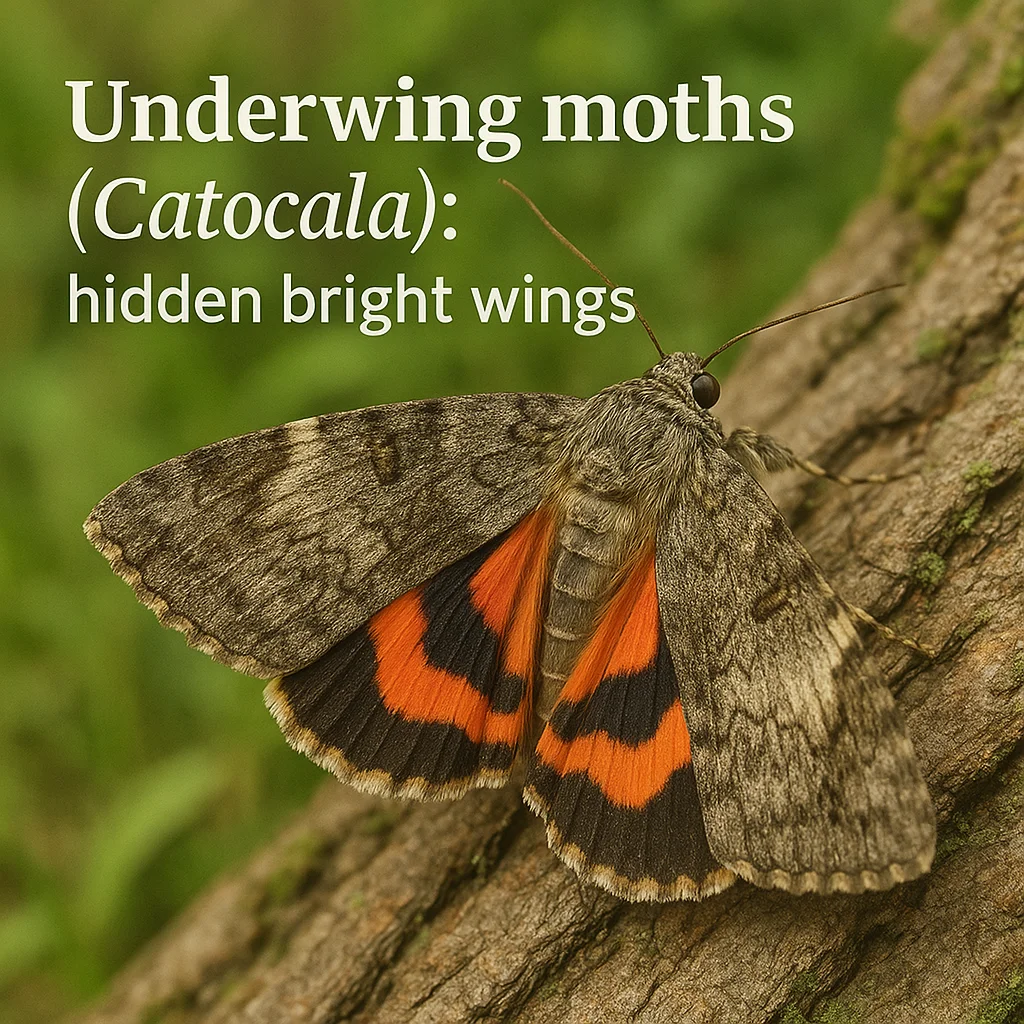
- Common names: Underwing moths
- Scientific name: Catocala (varies by species)
- Insect: Yes, they are invertebrates.
- Order / Family: Lepidoptera / Erebidae
- Typical size range: Adult wingspans from 4 to 11 cm
- Key colors/patterns: Drab forewings; bright orange, red, or yellow hindwings
- Activity: Primarily nocturnal
- Typical habitats: Forest edges, woodlands, gardens
- Where in the world: Found in temperate regions of North America, Europe, and Asia
- Seasonality: Adults are most visible in late summer to early autumn
🔍 Identification
To identify an underwing moth, look for its distinctive size and shape, as well as its unique coloration.
- Body shape and silhouette: Broad wings with a distinguished body tapering to a point.
- Antennae type: Usually thin and feathery in males.
- Wing features: Cryptic gray and brown forewings, hidden colorful underwings that flash during flight.
- Leg traits and movement style: Robust legs for clinging to surfaces; tends to flutter quietly.
- Distinguishing look-alikes: Often confused with other moths with similar cryptic coloration but distinguishable by bold underwing patterns.
- Top ID Tips:
- Check for dull forewing coloration blending into surroundings.
- Look for vivid rear wing flashes when in flight—orange, red, or yellow.
- Notice the broad wing span and tapered body.
- Observe the nocturnal behavior.
- Look for feathery antennae if close enough to inspect.
- Consider the habitat—typically near trees and shaded woodlands.
🧠 Basic Body Structure
Like all insects, underwing moths have fundamental body parts consisting of a head, thorax, and abdomen. They possess six legs and an exoskeleton that provides both protection and structural support. As invertebrates, these moths lack a backbone, which is a defining characteristic of all invertebrate species.
Underwing moths also feature two sets of wings and undergo molting as they transition through their developmental stages.
🌍 Habitat & Distribution
Underwing moths are typically found in mixed temperate forests, woodlands, and even urban gardens where they can find suitable trees for laying eggs and caterpillar feeding.
Microhabitats of underwing moths include tree bark crevices and branches during their larval stage. These moths are well-adapted to a range of climatic conditions but are most prevalent in temperate regions including North America, Europe, and Asia. Changes in habitat due to human activity or climate variations can affect local sightings of these moths.
📅 Seasonal Appearance & Activity
Underwing moths are most visible from mid-summer to early autumn. They generally emerge after dark and are attracted to light sources, which can make them more observable in urban settings during their active periods.
- Best Time to Spot It:
- Late summer evenings
- Warm, dry nights
- Nights when the air is still and calm
- Areas with outdoor night lighting
🥚 Reproduction & Egg-Laying
Mating in underwing moths involves the use of pheromones for attraction, with males typically searching for females. Eggs are laid singly or in small clusters on the bark of trees, which provide the food source for the caterpillars once they emerge.
Eggs generally number in the dozens to hundreds, depending on environmental conditions and species-specific behaviors.
🌀 Metamorphosis & Life Cycle
Underwing moths undergo complete metamorphosis, which includes the stages of egg, larva (caterpillar), pupa (chrysalis), and adult.
The eggs hatch into caterpillars that feed on host tree leaves, primarily oaks, before entering the pupal stage in the soil or under loose debris. This stage can last from several weeks to months. Once metamorphosis is complete, the adult moth emerges to continue the cycle.
🍽️ Diet & Feeding Behavior
Underwing moths primarily feed on tree leaves during their larval stage. As adults, they may sip nectar from flowers but generally rely on stored energy from their larval feeding to power their brief lives.
Underwing moths use specialized sucking mouthparts called proboscis during their adult stage, suitable for consuming liquid sustenance.
🦉 Predators & Defense
Natural predators of underwing moths include birds, bats, and spiders. Defense strategies include their cryptic coloration which camouflages them against tree bark, and the sudden display of their bright underwings to startle predators.
- Defense Highlights:
- Camouflage with cryptic forewings
- Bright, distracting underwing flashes
- Rapid, erratic flight patterns
- Seeking refuge in dense tree canopies
👥 Social Behavior & Swarms
Underwing moths are primarily solitary creatures, engaging with others of their kind mainly during mating periods. They do not form swarms or colonies, typical of many lepidopteran species.
🧭 Senses & Communication
Underwing moths rely heavily on their sense of smell, particularly for detecting pheromones released by potential mates. Their vision, while adapted to low-light conditions, is secondary to olfactory cues. Sound and vibration, while not primary senses, can alert them to the presence of predators.
🌱 Role in the Ecosystem
Underwing moths play roles in their ecosystems primarily as prey for various predators. The larvae contribute to controlling tree foliage and, through their feeding, can affect the distribution and health of their host plants.
They also serve a significant role in pollination during their adult phase, contributing to the biodiversity and health of flowering plant communities.
📉 Population & Conservation Notes
Underwing moths are generally considered common where their habitats remain undisturbed. However, habitat loss and increasing pesticide use pose threats to their survival.
- How to Help (Low-Impact):
- Plant native trees to support caterpillar development
- Reduce pesticide usage in gardens
- Leave leaf litter to provide shelter
- Support local conservation efforts
⚠️ Human Interaction & Safety
Underwing moths do not bite or sting and are harmless to humans. Observing these moths can be a rewarding experience, especially when respecting their natural habitats and avoiding unnecessary disturbance.
For those concerned about exposure to moths in sensitive areas, marginal measures like gently washing any affected area and avoiding scratching are usually sufficient. If a severe reaction occurs, professional advice should be sought.
📌 Summary
- Underwing moths are known for their unique hidden bright wings.
- They are primarily found in temperate forests and urban gardens.
- These moths are nocturnal and most visible late summer to early autumn.
- Undergo complete metamorphosis with visible life stages.
- Feed on tree leaves as larvae and nectar as adults.
- Prey for birds and bats, using camouflage as defense.
- Important pollinators and prey species in their ecosystems.
- Population status is stable but threatened by habitat loss and pesticides.
- Harmless to humans, best observed without disturbance.