🕷️ Owl moths: big eye illusion defense
🧾 Quick Facts
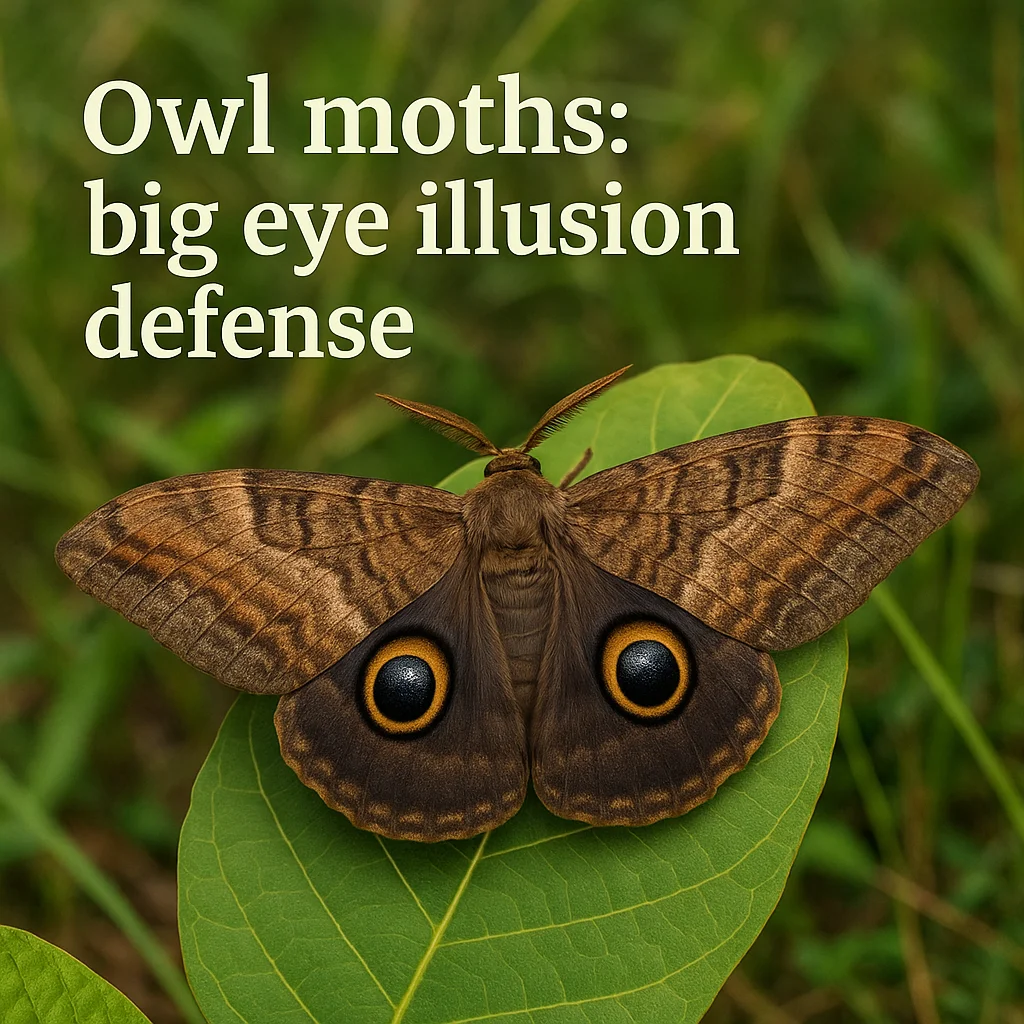
Owl moths are a fascinating group of large moths, renowned for their striking wing patterns that mimic the eyes of owls. This adaptation helps them deter potential predators by presenting a startling, realistic eye illusion, suggesting a much larger animal than a moth. This illusion is particularly useful in their nocturnal environments.
- Common names: Owl Moth
- Scientific name: Varies by species (includes genera like Thysania and Brahmaea)
- Insect or not: Yes, it is an insect
- Order / family: Lepidoptera / varies by species
- Typical size range (adult): Wingspan can range from 10 to 30 cm
- Key colors/patterns: Brown, gray with eye-like patterns on hindwings
- Activity: Nocturnal
- Typical habitats: Forests, woodlands, gardens
- Where in the world it occurs: Americas, Africa, Asia (varies by species)
- Seasonality: Varies; adults often visible spring through fall
🔍 Identification
Owl moths can be recognized by their robust, fluffy bodies and large wings decorated with eye patterns. This mimicry serves as a defense mechanism against predation. The moth’s wings are often held flat when at rest, revealing the eye spots on the hindwings.
- Body shape and silhouette: Large, thick-bodied moths with prominent antennae
- Antennae type: Filamentous or feathered, aiding in detecting pheromones
- Wing features: Large, broad with inner hindwing patterns resembling eyes
- Leg traits and movement style: Six strong legs with smooth, slow walking
- Distinguishing look-alikes: Other large moths, but Owl Moths are unique for pronounced eye spots
- Top ID Tips
- Look for eye-like patterns on the hindwings
- Check for large wingspan and robust body
- Observe nocturnal behavior
- Consider habitat – they prefer wooded and garden areas
- Feathered antennae are a key characteristic
- Note their slow, deliberate flight style
🧠 Basic Body Structure
Owl moths, like all insects, have a three-part body structure consisting of a head, thorax, and abdomen. They possess six legs and wings attached to the thorax. As invertebrates, they have a hard exoskeleton that protects their internal organs and provides structural support. They undergo molting as they grow, shedding their exoskeleton to allow for expansion.
They are invertebrate, meaning they lack a vertebral column or spine, which is a common trait among insects.
🌍 Habitat & Distribution
Owl moths are commonly found in a variety of habitats that support their camouflage and feeding needs. These environments range from dense forests to more open woodlands, as well as gardens where they can find ample foliage and flowers.
Microhabitats include areas under tree bark or beneath leaves, where they can hide from predators during the day. They are distributed across the Americas, Africa, and parts of Asia, with species adapted to tropical and temperate climates. Habitat alteration, such as deforestation or urban encroachment, can significantly impact sightings.
📅 Seasonal Appearance & Activity
Owl moths are most visible during the warmer months, when adults emerge to mate and lay eggs. Their nocturnal activity means they are best observed at night, especially in areas where artificial lights do not interfere with their natural behaviors.
- Best Time to Spot It
- Spring through fall in temperate regions
- In tropical areas, sightings can be year-round
- Clear, warm nights enhance visibility
- Rainy seasons might decrease sightings
🥚 Reproduction & Egg-Laying
Mating in owl moths often involves complex courtship rituals that include pheromone release by females to attract males. Males typically locate females by detecting these chemical signals with their antennae.
Egg-laying patterns vary, often targeting the undersides of leaves to protect eggs from predators and environmental elements. A female can lay several hundred eggs in a season, though numbers can vary greatly across different species.
🌀 Metamorphosis & Life Cycle
Owl moths undergo complete metamorphosis, progressing through distinct life stages: egg, larva (caterpillar), pupa (chrysalis), and adult moth.
Eggs hatch into caterpillars that primarily feed on leaves, growing rapidly and shedding their skin multiple times. This stage can last several weeks.
The caterpillar then pupates, forming a chrysalis where major transformations occur, lasting between a few weeks to several months depending on environmental conditions. The adult moth emerges primarily to reproduce and continues to feed until it completes its lifecycle, often living for a few more weeks.
🍽️ Diet & Feeding Behavior
As caterpillars, owl moth larvae are herbivorous, utilizing chewing mouthparts to consume a variety of plant leaves, which can occasionally make them minor pests in gardens or agricultural settings.
Adult moths may feed on nectar using a proboscis, although some species consume little and rely on energy reserves acquired during their larval stage. However, exact feeding habits may vary significantly between species.
🦉 Predators & Defense
Owl moths face predation from birds, bats, spiders, and small mammals. Their primary defense mechanism - the 'owl eye' illusion - is a startle tactic that helps ward off predators by simulating the eyes of potential larger predatory animals.
- Defense Highlights
- Eye pattern mimicry to scare predators
- Ability to blend into forest environments
- Nocturnal behavior to avoid day-active predators
- Rapid flight to escape threats
👥 Social Behavior & Swarms
Owl moths are largely solitary insects, coming together primarily for mating purposes. While they do not form swarms or colonies, certain environmental triggers like abundant food sources can lead to temporary aggregations.
Interactions involve brief encounters during mating periods, with minimal social behaviors observed post-reproduction.
🧭 Senses & Communication
Owl moths possess highly sensitive sensory organs, enabling them to navigate and communicate in their nocturnal world. They rely significantly on their sense of smell, detecting pheromones emitted by potential mates. Their antennae play a crucial role in this sensory process.
Vision may be less developed, though large eyes aid in low-light conditions. Communication is primarily chemical, with limited acoustic signaling compared to other insects like crickets or cicadas.
🌱 Role in the Ecosystem
Owl moths contribute to their ecosystems as pollinators while feeding on nectar, facilitating plant reproduction. As caterpillars, they are herbivores and occasionally act as prey for larger animals, contributing to the food web dynamics.
Their interactions with predatory species highlight their role in maintaining balanced ecological relationships. Their proliferation can be beneficial or problematic for agriculture, subject to population dynamics and the specific host plants they favor.
📉 Population & Conservation Notes
While many owl moth species remain common and widespread, habitat destruction and light pollution can impact local populations. Conservation efforts often focus on preserving natural habitats and maintaining biodiversity.
- How to Help (Low-Impact)
- Plant native species in gardens to support diverse moth populations
- Reduce artificial night lighting when possible
- Avoid using pesticides harmful to non-target species
- Promote conservation awareness in communities
⚠️ Human Interaction & Safety
Owl moths are harmless to humans, lacking the ability to sting or bite. They are safe to observe and enjoy in natural settings. If touching the insects, wash hands afterward to avoid irritation from potential scales or allergens.
Respectful observation without collecting or disturbing them is crucial to support their ecological roles and conservation.
📌 Summary
- Owl moths are known for large wings with eye-like patterns
- They thrive in forests, gardens, and wooded areas
- Adults are active primarily at night
- Undergo complete metamorphosis from egg to adult
- Larvae feed on plant leaves; adults on nectar
- Key predators include birds and bats
- Play roles as pollinators and in the food web
- Conservation focuses on habitat preservation and reduced light pollution
- Safe for human interaction and valuable for biodiversity