🕷️ Hairstreak Butterflies False-head Defense And Tiny Tails
🧾 Quick Facts
Hairstreak butterflies are part of a fascinating group within the family Lycaenidae, known for their unique defense mechanisms and charming appearance. Their striking colors and deceptive tails make them a favorite subject among butterfly enthusiasts.
- Common names: Hairstreak butterflies
- Scientific name: Varies by species
- Insect or not: Yes, it is an invertebrate insect
- Order / family: Lepidoptera / Lycaenidae
- Typical size range: 2-4 cm wingspan (adults)
- Key colors/patterns: Rich blues, browns, blacks, and sometimes iridescent hues
- Activity: Diurnal (active during the day)
- Typical habitats: Woodlands, forest edges, and meadows
- Where in the world it occurs: Mostly in temperate and tropical regions worldwide
- Seasonality: Most visible in late spring through summer
🔍 Identification
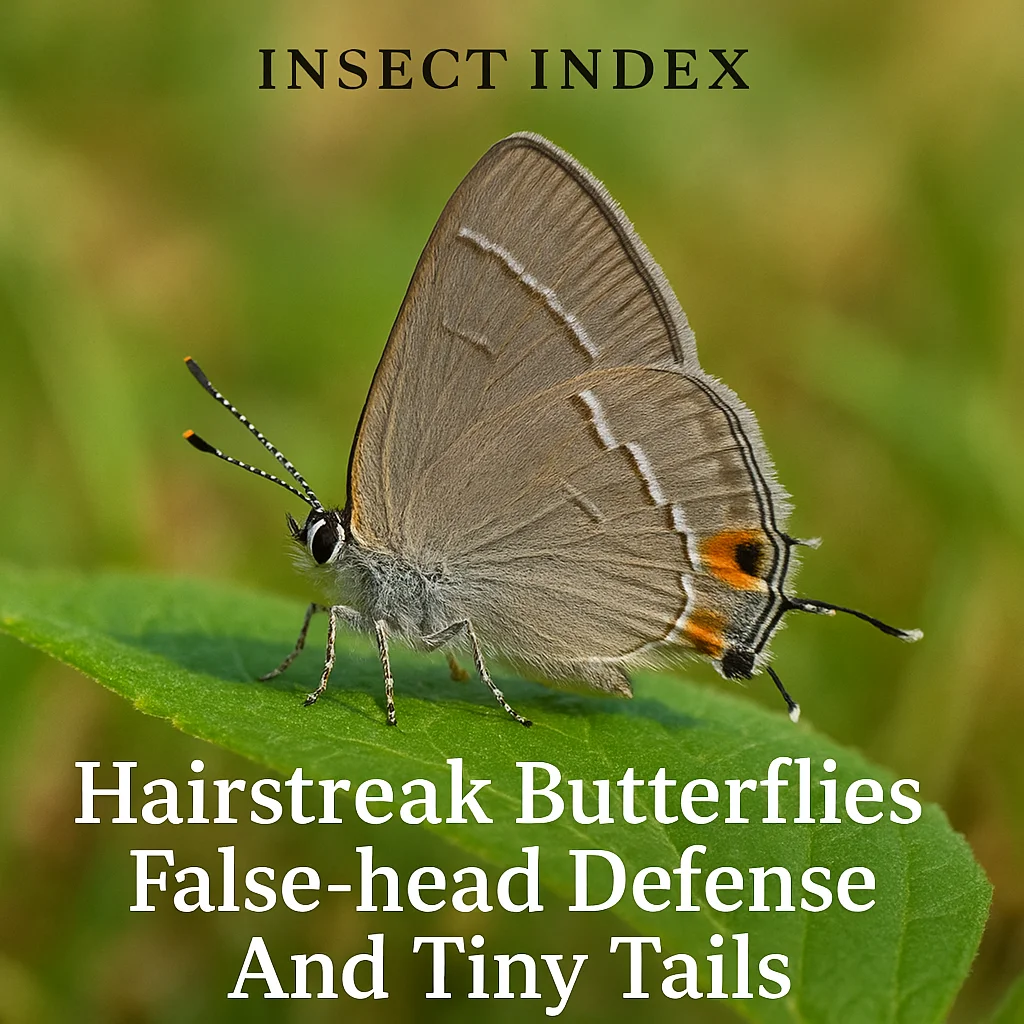
Hairstreak butterflies can be recognized in the field by observing certain distinct features. They exhibit a unique silhouette with intricately patterned wings and characteristic 'tails'. These tails, often located on the hind wings, resemble antennae and play a significant role in their defense strategies. Their antennae are short and clubbed, typical of many butterfly species.
Their flight is often swift and erratic, aiding in evading potential predators. Despite regional variations, hairstreaks usually present a consistent combination of features that help distinguish them from other butterfly species. Lookalikes such as blues or coppers share the same habitats but usually lack the tails and false-head features.
- Top ID Tips:
- Unique tail-like extensions on hind wings
- Symmetrical patterns on both upper and lower wing surfaces
- Rich coloration often with metallic hues
- Distinctive white lines or edge on hind wings
- Erratic but graceful flight behavior
- Short and stubby antennas with clubbed ends
🧠 Basic Body Structure
As typical insects, hairstreak butterflies consist of three main body parts: the head, thorax, and abdomen. They possess six legs attached to the thorax, where their powerful wings are also fixed. Their exoskeleton provides them structure and protection, though they must undergo molting to grow into mature butterflies. As with all insects, they are invertebrates, lacking a spinal column. Instead, their structural integrity comes from their tough outer covering.
🌍 Habitat & Distribution
Hairstreak butterflies thrive in diverse habitats, predominantly in temperate forests and grassland areas where they can easily find host plants for their larval stages. Although they are adaptable, they prefer regions that offer an abundance of flowering plants for nectar feeding. Variations in microhabitats include areas beneath dense canopy, on flowering shrubs, or grassland edges.
Geographically, hairstreak butterflies are prevalent in North America, Europe, and parts of Asia. Specific distributions depend on the species and environmental conditions, with sightings influenced by habitat health and plant availability.
📅 Seasonal Appearance & Activity
These butterflies are most active during the warm months when temperatures favor their lifecycle processes. Generally, you can observe them from late spring through summer, with activities peaking during the sunniest and warmest parts of the day.
- Best Time to Spot It:
- Late spring through early summer
- Mid-morning to afternoon on sunny days
- Days with little to no wind
- Warm, dry spells
🥚 Reproduction & Egg-Laying
Hairstreak butterflies engage in characteristic courtship behaviors that involve intricate flight patterns and wing displays. Females lay eggs on host plants, selected carefully to ensure that emerging caterpillars have immediate access to food. Eggs are often laid singly or in clusters, though numbers can vary widely.
🌀 Metamorphosis & Life Cycle
Hairstreak butterflies undergo complete metamorphosis, transitioning from egg to larva (caterpillar), pupa (chrysalis), and finally to adult butterfly.
In the egg stage, hairstreaks are vulnerable but resilient, often placed in concealed locations. As larvae, they are voracious eaters, consuming host plant leaves voraciously. The pupal stage involves transformation within a chrysalis, which can last a few weeks to months based on climate, before emerging as mature butterflies.
🍽️ Diet & Feeding Behavior
At different life stages, hairstreak butterfliers showcase varying dietary behaviors. While larvae feed on leaves of host plants, adults enjoy the nectar from a wide variety of flowering species. Their feeding apparatus comprises a coiled proboscis, allowing them to suction nectar efficiently.
As adults, they contribute significantly to pollen transfer, acting as vital pollinators in many ecosystems.
🦉 Predators & Defense
Natural predators of hairstreak butterflies include birds, lizards, and small mammals. To counter these threats, hairstreaks employ several defense mechanisms.
The intriguing false-head defense involves intricate markings and tail features that resemble a head, diverting predator attacks from vital body areas to expendable parts. This mimicry effectively deceives predators, allowing the butterfly to escape unharmed.
- Defense Highlights:
- False-head mimicry with hind wing tails
- Erratic flight patterns
- Camouflaged undersides
- Sudden flight escape
👥 Social Behavior & Swarms
Hairstreak butterflies are mostly solitary creatures. When not mating, they are occasionally seen clustering around abundant food sources but do not form significant social bonds or colonies. Encounters for mating are primarily transient. Some species may exhibit mild local migrations tied to seasonal changes or food availability.
🧭 Senses & Communication
These butterflies rely heavily on their vision and scent for communication and navigation. Pheromones play a key role in mate recognition and attraction. Their visual acuity aids in identifying conspecifics and locating food and laying sites. While not known for sound production, their flight patterns can communicate presence to other butterflies in proximity.
🌱 Role in the Ecosystem
Hairstreak butterflies contribute significantly to pollination, assisting in the reproduction of several flowering plant species. They are integral components of their ecosystems, forming critical links in food webs as both prey and pollinators. Relationships with plants, particularly host plants and nectar sources, highlight their mutualistic impact on botanical reproduction and growth.
Though hair streaks are beneficial for natural plant populations, their populations themselves may at times influence local agriculture by interacting with crops, usually positively through pollination services.
📉 Population & Conservation Notes
Overall, hairstreak butterflies are considered common yet vulnerable in certain regions facing habitat loss and environmental changes. Specific population levels of individual species can vary greatly, influenced by pesticide use, urban development, and climate change.
- How to Help (Low-Impact):
- Grow native flowering plants in gardens
- Avoid pesticide and herbicide use
- Preserve patches of natural habitats
- Encourage local conservation efforts
⚠️ Human Interaction & Safety
Hairstreak butterflies do not pose any significant threat to humans. They neither bite nor sting and can be safely observed from a distance. When engaging in wildlife watching, maintain a respectful distance and avoid handling or capturing wild specimens to preserve their populations.
📌 Summary
- Hairstreak butterflies boast intricate silhouettes with unique tail-like extensions.
- Found across temperate and tropical regions, often within woodlands and meadows.
- Most visible during warm summer months, primarily diurnal.
- Engage in complete metamorphosis with distinct life stages from egg to adult.
- Feed on leaves (larvae) and nectar (adults), serving as ecosystem pollinators.
- Employ false-head defenses against diverse predators, enhancing survival.
- Solely solitary, with minimal social interactions outside mating.
- Play crucial ecosystem roles through mutualistic plant relationships.
- Population stability threatened primarily by habitat alteration.
- Non-threatening to humans, deserving of careful observation and conservation.